
Tipping the Scales

However low you go, or however you go low, God will raise you up.


Proper 25c 2013 • SJF • Tobias Stanislas Haller BSG
O Lord, have you completely rejected Judah? Does your heart loathe Zion? Why have you struck us down so that there is no healing for us?

Today we conclude our series of readings from the letters of Paul to Timothy. As we’ve seen over the last few weeks, Paul has been encouraging Timothy in the struggles that he faces with and among the congregation over whom he has charge. People have been caught up in controversies about the interpretation of Scripture, indulging in false teaching, and wandering away into myths. People have been casting doubt on Timothy’s authority, in part due to his relative youth, but also in rebellion against the very gospel message that he delivers. And at every stage at which people have sought to cut Timothy down, Paul has encouraged him to remain strong and to fight the good fight with all his might, to proclaim the gospel fearlessly, and in the knowledge that God’s power is with him.

Now Paul himself, it seems from the passage we read today, is about ready to retire from the combat. As he says, “I have fought the good fight, I have finished the race, I have kept the faith.” Using once more the analogy of a footrace, he portrays Jesus as the scorekeeper and judge who will give him his crown at the end of the race — the race he has run so faithfully.

But not before Paul will have what the English call a bit of a good moan first — you know what that’s about! Sometimes you just feel better when you let it all out and complain for a bit — not to make a habit of it, but just to let off a little steam of frustration. Contrasting the heavenly grace he expects with the earthly problems he has encountered, all the things he has been running through, Paul complains that everyone has deserted him and no one has supported him — except the Lord himself. In fact, Paul is using how low he has been to show just how powerful God is — who can lift up one who has been abandoned and betrayed. The message Paul shares here with Timothy, based on his own experience, is, No matter how low you have fallen in your own confidence, no matter how much you have been cut down by adversaries or problems, God will raise you up.

+ + +

Today’s gospel presents us with a different kind of up and down — but ends with a similar message. Jesus portrays two people: a proud and self-righteous Pharisee and a humble and penitent tax collector. I almost picture them standing on a seesaw or teeter-totter: the Pharisee high and lifted up, and the tax collector down in the dumps. For it seems that the very reason for the Pharisee to be so high is because he is so pumped up and proud of himself, because he sees himself in relation to others, whom he regards as sinners worse than he. It is the weight of the sin of those on the other side of the scale that gives that Pharisee his boost, his exaltation, his pride. He has no consciousness of sin in himself, and he plays that off against those whom he regards as “obvious” sinners — thieves and adulterers — or even like this tax collector here.

But enough about him — as I can imagine he learned better when he finally did face the Almighty judge at the end. (And let’s hope he was ashamed of himself and at the last accepted God’s forgiveness!) I would rather focus on that tax collector down there.

Jesus portrays him as being low in comparison to the Pharisee being high. If you picture that seesaw I mentioned there is no doubt that the tax collector is on the heavy end of the scale. We do not know what his sins are — unlike the Pharisee who declares what his sins aren’t and catalogs a few of the things that he imagines make him virtuous, the tax collector does not enumerate his sins — he merely repents. He beats his breast in that ancient act that forces home to me that it is I who am at fault: (for when I beat my breast I am forcibly reminded of my own physical reality and presence! And maybe we all need a little of that spiritual CPR, now and again, to remind us of where we are, and help us rediscover the true meaning of our lives.)

Jesus promises that this man, this man on the low side of the scale, who has humbled himself will return home exalted and justified. And so the message here is that it is by lowering yourself that God will raise you up. As a proverb (3:34) quoted by both James (4:6) and Peter (1P 5:5) puts it, “God opposes the proud but gives grace to the humble.” Or, as someone with even greater authority, Mary the mother of Jesus, put it: “He has cast down the mighty from their thrones and has lifted up the humble and meek.”

+ + +

So the clear message appears to be consistent through all these readings: whether you have been brought low by others, have fallen low in your own estimation and disappointment, or humbled yourself in the knowledge of your sins — however you came to be low, or however low you came to be, God will raise you up. Let the teeter totter as it may, and swing us down even so low that we can feel the warmth of hell-fire toasting our feet — even then God can and will bring us up again, so long as we turn towards the one from whom our help and rescue comes. Even if we don’t look God’s way with our eyes — for recall that the penitent tax collector was so cast down he dare not even raise his eyes to heaven — even if we don’t look God’s way with our eyes, if that is towards God that our hearts are turned, God, who after all looks into our hearts and knows us better than we know ourselves, will also know that we have turned our hearts towards him, and God will raise us up from where we have been cast down, or fallen, or lowered ourselves.

God is not like that famous statue of Justice — the one who holds the scales but wears a blindfold, blind to the relative weight of sin or innocence, and simply allowing the scale to tip as it may. God is also not like the Egyptian god Thoth, who weighs the heart of the dead against the feather of innocence, and condemns all of those whose hearts tip the scale towards guilt.

No, my friends — and it is a good thing for us — God is neither blind like Justice nor a mere secretary like Thoth recording the result shown by the scale. No, my friends, the good news for us is that God tips the scales in our behalf, for the mercy of God is greater than the justice of God, and although God is just, the heart of God is love and mercy and forgiveness.

When God sees we are cast down by the assaults of others, God will raise us up. When God sees that we have abased ourselves in our own eyes, discouraged or despondent, God puts a powerful arm around us and raises us up. And when we are sunk low in the depths of the knowledge of our own faults and failings, God pushes that lightweight Pharisee from the other end of the seesaw and presses it down with a strong arm and a mighty hand — and O my friends, are we in for a ride!+

Memory of Persistence

Keeping on keeping on, urged towards justice and blessing...

Proper 24c 2013 • SJF • Tobias Stanislas Haller BSG
Be persistent whether the time is favorable or unfavorable; convince, rebuke, and encourage, with the utmost patience in teaching.

In keeping with the theme for the readings today, we persist in hearing from the letters of Paul to his disciple Timothy. Today we hear Paul urging Timothy on, like the coaches who accompanied Diana Nyad on her swim from Cuba to Florida. Look at all the encouragement Paul pours out: “Continue in what you have learned… I solemnly urge you… be persistentenduredo the work… carry out your ministry fully.”

As with most of Paul’s letters, we only have one side of the conversation. That is, we have no copies of the Letters of Saint Timothy to Paul. But common sense tells us that Paul does not write a letter such as this — full of the voice of a coach offering encouragement — if Paul has not heard, either from Timothy himself or perhaps from some other messenger, that there is something about which Timothy is discouraged.

We don’t have to look very far to find indications of what is causing Timothy’s discouragement. People are challenging his teaching — which involves passing along the gospel that Paul has passed along to him. As we saw in last week’s passage, people are “wrangling over words,” that is, perhaps arguing over different interpretations of Scripture.

In a verse we don’t hear between last week’s portion and this week’s, Paul complains that some people are giving in to“profane chatter” as he calls it, that will “spread like gangrene” because some — and Paul is not afraid to name names — “some have swerved from the truth by claiming that the resurrection has already taken place.” Paul denounces these people as frauds who are just trying to take advantage of people and make themselves rich.

In today’s passage he alludes to those who have “itching ears,” who choose teachers to their own liking instead of listening to the truth, putting their faith in myths rather than in the sound teaching that Timothy is trying to offer them.

In the midst of all this trouble — and doesn’t it sound familiar, even in our own day? — Paul urges Timothy to press on, to keep the faith and to spread it. Four times in this relatively short correspondence, he uses the phrase, “The saying is sure” to introduce some fundamental doctrine to which he urges Timothy to hang on as he would to a life preserver in a flood. The message to Timothy is persistence.

+ + +

Our other readings today reinforce this theme of persisting, holding fast, and not giving up. The story of Jacob’s wrestling match with God takes the image of holding fast literally. The amazing thing is that, not only does Jacob wrestle with God — or God’s messenger — but that he gets his adversary to cry uncle! Jacob simply will not let go until he gets that blessing, and so he receives the blessing; he becomes a father of nations, and he gains a new name, Israel — which means “he who contends with God,” whose face he sees, and yet lives — even though he is left out-of-joint and limping.

+ + +

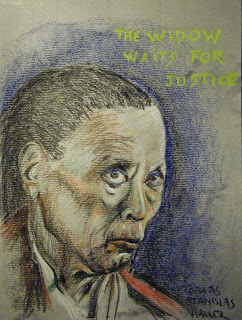
The gospel today shows a different kind of persistence, in the parable of the widow and the unjust judge. Whenever I hear this parable I can’t help but think of those women who for many years stood in the public squares in Argentina, El Salvador, Chile, and Guatemala — all of them holding up photographs and posters with the images and names of Los Desaparecidos — the “disappeared ones” — their brothers, sons, husbands and fathers abducted by political authorities with no more care for justice than the unjust judge in today’s parable. They persisted, in a testimony to their faith that justice will eventually prevail, and that right will triumph in the end. Sadly, some of them are still waiting.

In the parable, however, we aren’t given the details of what the widow’s complaint is, only that she has an opponent, and the judge — who has no fear of God or respect for people — is not rendering a decision. Perhaps he is looking for a bribe, perhaps he just doesn’t care enough to take up her case, or perhaps — in spite of his not having respect for people — he doesn’t want to cross whoever her unnamed opponent is. Whatever the reason, justice is delayed — and as the old saying goes “justice delayed is justice denied.” Finally, though, in this case, we hear the end of the story, and the persistent widow wears the unjust judge down.

+ + +

Jesus then gives us a moral to this parable, as he spells it out, and it is an example of a teaching technique that the rabbis called “light and heavy” — a teaching device very common among the rabbis, and used a number of times by the Rabbi Jesus. We heard an example of it some weeks ago when Jesus confronted those who were upset with him for healing that woman on the Sabbath: and he confronted them by saying, if you will rescue an animal on the Sabbath how much more a human being.

This teaching technique of light and heavy was very popular with the rabbis, and Jesus uses it again and again; even in perhaps his last teaching. Even on the road to Calvary, as he carried his cross to his crucifixion, when he met the women weeping for him, he ended by saying, “If they do this when the wood is green, what will they do when it is dry.” Light and heavy — simple and hard.

So too here the “light” is the unjust judge and the “heavy” is the just God. If even an unjust earthly judge will eventually give in and do justice for those who appeal to him, how much more will the just God hear and respond to his people when they cry out to him for justice. Light and heavy.

As with Paul’s encouragement to Timothy, this is Jesus’ encouragement to the disciples, “about their need to pray always and not to lose heart” — if an unjust human will finally do justice, will not the just God ultimately do justice as well — and far more powerfully, with far more weight?

And as with all of Jesus’ teaching, this is directed to the church to which Paul ministered and Timothy ministered — and to which all of us minister in the church today, for we are his disciples. I don’t just mean the ordained ministers but each and every one of you, as each of you has some ministry, some service in the gospel to the spread God’s gospel on earth, to let all hear of the kingdom and its coming. We are, all of us, called to persevere and persist in our work and in our prayer.

As I said a few moments ago, when I was listing some of the problems that Timothy had to face: some things haven’t changed since the first century. There are still people who will get deeply into arguments about words, using the Scripture not as a medicine for the soul but as a weapon to bash other people over the head. There are some who engage in profane chatter and spread false doctrines or their own half-baked ideas instead of relying on the wholesome gospel truth of Christ and his saving life and death, and life again. There are some who prefer myths and fantasy to the tested and assured doctrines of salvation, or who have itching ears and seek out teachers who will tell them what they want to hear, instead of challenging them with the demands that Christ places upon us. And there are some who are willing to be such teachers, willing to give people what they want to hear, and make a fine living out of it, creating personal cults with devoted followers — and we’ve seen the tragic results of such things in places like Jonestown and Heaven’s Gate.

I’m tempted almost to cite our Lord’s pessimistic — it seems — closing comment, “when the Son of Man comes, will he find faith on earth?” Will he? Will he find it hear among us? Everywhere the church seems to be in decline; it is so much less a part people’s lives today than it was even thirty years ago, even twenty years ago; while the “new age spirituality” section at Barnes & Noble takes up several shelves — and anyone with itching ears for salvation through crystals, or yoga, or transcendental meditation can find plenty to occupy their time — and fill the pockets of those who are ready to provide such spiritual junk food.

But, to quote Saint Paul, “as for you, continue in what you have learned and firmly believed.” For we have studied the Scripture together, persistently examining it and exploring it for all of the benefits that can be found in it: a light to our feet upon the way. We have recognized that the inspired Scripture is useful — this is no fantasy game! We are called and challenged, my brothers and sisters, to persevere in these disciplines of prayer and devotion and work, ministers of God as much as Paul and Timothy, each of us equipped with varying skills and differing talents, all of which can be used to the service of God and to spread God’s kingdom. Only let us persevere, and blessing and justice will be ours at last.+


Bondage and Freedom

Constraint comes in many forms... some prevents, some serves the gospel.


SJF • Proper 23c • Tobias Stanislas Haller BSG
Remember Jesus Christ, raised from the dead, a descendent of David — that is my gospel, for which I suffer, even to the point of being chained like a criminal. But the word of God is not chained.

In our Scripture readings today we hear of three different kinds of bondage, and also of the paradoxical freedom that transcends bondage in each case.

The situation in which Saint Paul found himself involved bondage in its most literal sense. As he wrote to his young disciple Timothy, he was bound in iron chains, kept under house arrest and unable to move from the inexorable path towards judgment before the imperial tribunal and death by execution — though he would move soon enough.

The Scriptural record of the early church, much of it from Paul’s own hand, cuts off before we reach the end of his story. To hear what happens after the end of Luke’s record in Acts of the Apostles, we must rely on other early historians of the church. They tell us of Paul’s execution in Rome in the days of the Emperor Nero.

But regardless of Paul’s ultimate end, here in this letter to his young disciple Timothy as we have been hearing over the last weeks — here he writes of his imprisonment, the indignity of being chained up like a common criminal. But he uses his situation as an opportunity to contrast the human condition of bondage with the divine freedom of truth. He may be in chains, but the gospel is not chained.

Ironically, Paul’s arrest and imprisonment not only did not stop the gospel from spreading, but actually helped the gospel to spread. This is part of the great paradox of his suffering. For as Paul was ferried from port to port on his journey to Rome, at each stop along the way he preached and shared fellowship with Christians in each place. And later in Rome at last he was given opportunity to witness to the power of the gospel, and make his testimony even in the court of the emperor. There he ultimately achieved the crown of martyrdom, executed by the earthly power of humans, but bearing witness to the heavenly power of God, trusting in those words he wrote to Timothy — “The saying is sure: if we have died with him, we will also live with him; if we endure, we will also reign with him.”

There is an incident much later in Christian missionary history that bears witness to this truth as well. A group of Europeans in 19th-century Burma were captured by a warlord and placed in prison. Among them was a Christian missionary. The prisoners were hung by chains in a dank prison. One of the other prisoners, a colonial trader, jeered at the missionary, saying, “What do you think your chances are now of converting the heathen!” The missionary answered, “They are just as bright as ever they were, for the light of the Gospel is not quenched — even here.”

My friends, even in the place of bondage, the Christian is free. Think for a moment of the letters that Christians have written from prison: from the time of Paul, writing to Timothy; from Dietrich Bonhoeffer, writing from a Nazi prison, facing his own execution, awaiting his death; of the letter from Birmingham Jail, from Martin Luther King — yes, the man may be bound, but his gospel is not bound; it goes forth. And those letters are read to this day, while those who imprisoned those men are long gone and forgotten. Another Martin, for whom Martin Luther King was named, Martin Luther, stated it well in his great hymn: “The body they may kill, God’s truth abideth still; his kingdom is forever.” The bondage of restraint cannot stand against the power of God.

+ + +

Our gospel reading today tells of a different kind of bondage: a bondage not from without but from within. It is true that the lepers whom Jesus heals are freed from the bondage to disease that has kept them cut off from the rest of human society. But the bondage I want to note today in their case is not that external bondage, but rather the inner compulsion that leads one of them, one out of the ten, the Samaritan, to turn back to Jesus, to thank him for healing him. Here we are not dealing with the iron chain of imprisonment, but rather the elastic band of conscience. You know how that works. When you know that you ought to do something that you haven’t done, and that the longer you wait, and the further you get from the thing your conscience is calling you to, the stronger the pull becomes — the elastic band gets harder to pull the further it goes.

With every step that the healed Samaritan takes away from Jesus, the stronger he feels the pull grow, the pull of the need to give thanks. Finally the pull becomes so strong that he snaps right back to the feet of Jesus and falls there, offering his thanks!

The English writer Dorothy L Sayers once observed that “The divine scheme of things... is at once extremely elastic and extremely rigid. It is elastic, in that it includes a large measure of liberty for the creature; it is rigid in that... however created beings choose to behave, they must accept responsibility for their actions and endure the consequences.” This bondage of the conscience — this responsibility for ones own actions — becomes more binding the more you stretch it. The more freely you move, the stronger will be the pull.

And as we see in the story of the healed Samaritan, this is not a negative bondage — this is not a bad thing. In this case it is the bondage of gratitude: when you know you need to give thanks for something, because as even the casual expression puts it, you owe someone thanks. And it is no accident (I remind us in this stewardship season and on this day of the harvest) that it is exactly a tithe — one tenth — of the healed lepers who turns back: one out of ten, one tenth — a tithe.

This reminds us of our own call to give thanks by returning a portion of the abundance with which we have been blessed back to God — to God’s church, for the work of the church, the work of the spread of that ministry here and now — even to realize that somehow we owe God this portion of what we have received — and how some struggle, and how tautly pulled is that particular elastic in some cases! But when we return in faith and thanksgiving to the one to whom we owe that debt of gratitude, we feel the relief of knowing we have done as God wants us to do. Responding to the bondage of duty leads us to the true freedom of thanksgiving.

+ + +

The third form of bondage in our scripture readings today appears in that story of Naaman the Syrian. He too suffers from leprosy, but what seems to hold him in bondage, isn’t the disease himself; it seems to be more his pride — both his personal and his national pride. When the messenger from the prophet asks him to do a simple thing to free himself from the bondage of leprosy, to dip himself in the River Jordan, his personal and national pride stand in the way. He doesn’t want a messenger — he wants the prophet himself! He doesn’t want a to be told just to take a dip in the river, he wants a ritual; he wants a ceremony; after all, he is an important person! He deserves it! And he protests that the rivers of his homeland are better than all the waters of Israel. It takes the wise words of his servants to put him back on the right track: if you’d been asked something hard you would have done it; why not do what is simple? This wise counsel finally frees him from his bondage of pride and nationalism — and he takes those dips in the river, and he is healed of his disease, with his skin like that of a child.

Three forms of bondage — two negative and one positive — are set before us today. May we too, my dear sisters and brothers in Christ, when constrained by bondage beyond our control find the freedom of the Gospel; when healed of our ills give generously in response to the bondage of gratitude; and when challenged to do what is simple, released from the bondage of pride, and trust that God knows best what to ask of each and every one of us, and that God will be true in imparting gracious blessings, when we do as we are bid.+


Lessons for the Rich

To work with what you have while you have it and can use it... for good.


P21c 2013 • SJF • Tobias Stanislas Haller BSG
The love of money is a root of all kinds of evil, and in their eagerness to be rich some have wandered away from the faith and pierced themselves with many pains.

One sign that fall has arrived, as sure and certain as the leaves on the trees turning from green to red and gold, is the appearance of another kind of green and gold — money — in the Scripture readings appointed for worship. This is no coincidence, as fall is the time when churches take up planning their budgets for the next year and engaging in stewardship campaigns. But money and its right use are major concerns not just for the church, but for every person trying to live an ordered and just life.

Money, in spite of the misquote of Scripture, is not the root of all evil. It is the “love of money” — as Paul reminds Timothy. Money itself is neither good nor evil. It is how you relate to it, how you make use of it — or how you allow it to make use of you — that is good or evil. Money is no more evil in itself than food, or sex, or relaxation. But all of these things provide a means to sin when they are misused. Something good, good when used as God intends, can become a gateway to evil when used to excess or to the wrong ends. Gluttony is the misuse of food; sloth is the misuse of leisure; lust is the misuse of sex; and greed is the misuse of money.

All of our Scripture readings today point an accusing finger in the direction of greed, and counsel ways around it or away from it. Amos issues a strong condemnation of the rich — not just because they are rich, of course, but because while they are rich, they “are not grieved over the ruin of Joseph,” that is, about the impending day of doom that is about to fall upon Israel. Like Nero fiddling while Rome burns, these easy-chair loungers are oblivious to the coming disaster. They will be horribly surprised when their world collapses around them, and their lives end, having spent their wealth almost as a kind of anesthetic, insulating them — but not protecting them — from the realities of a troubled world.

For that “real world” breaks in, shattering the plans even of the virtuous, even of the innocent. Whether from a suicide bomber last week outside a church in Peshawar, or 50years ago outside a church in Birmingham, Alabama, or from a gang of terrorists invading an upscale shopping mall in Nairobi, or a madman in a Navy Yard, horror and disaster can overtake even good and innocent people. As poet Kofi Awoonor, one of the victims of the attack in Kenya wrote in a prophetic poem,

We are the celebrants
whose fields were
overrun by rogues
and other bad men who
interrupted our dance
with obscene songs and bad gestures

If such horror can overtake even the innocent and perceptive, how much more the prideful and ignorant? In the midst of our shock and horror, it is well to learn the sad lesson that you can take your life in your hands even going to an upscale shopping mall, even going to a humble church. Upscale, downscale, or no-scale, Anglican or Baptist, — ruin can come upon you unawares.

+ + +

And so, being aware is part of what Jesus offers us in the cautionary parable of Lazarus and the rich man. We don’t get much detail about this rich guy, other than that he feasts every day but ignores — remains unaware of — that poor, sick man who lies at his gate. His riches seem to blind him to reality. Even the dogs pay more attention to Lazarus than this rich man does, this oblivious rich man. He is not even bothered enough to chase him away, far less give him something to eat. He is unaware — ignoring the poor man as much as those who were at ease in Zion and Samaria ignored the world falling apart around them. He reminds me of another verse in Kofi Awoonor’s prophetic poem:

On the seaside, the ruins recent
from the latest storms
remind of ancestral wealth
pillaged purloined pawned
by an unthinking grandfather
who lived the life of a lord
and drove coming generations to
despair and ruin

This rich man is clueless; he lives the life of a lord, but he is ignorant, he doesn’t even know what he is looking at. He is like that rich man who couldn’t believe it the first time he saw a one-dollar bill; he couldn’t believe they made money in such small denominations. It must be a joke someone cooked up! (He should have come to church more often...)

So too should have that the rich man in the parable — at least to the synagogue, where safe from bomb-blasts or not, at least he would have heard the warnings of Moses and the Prophets — perhaps risking his life, but hearing, learning, marking and inwardly digesting those words and so gaining his immortal soul. Instead, when his proverbial sell-by date arrives he is bundled off to Hades, there to suffer torment both physical and mental.

For not only is he roasted in flames, but he realizes that his five brothers are just as bad — and just as doomed — as he. They will join him in the pit of Hell if they do not repent and amend their ways — and yet when he shows perhaps the first spark of interest in anyone other than himself in his whole life, in wanting to warn them, he receives the sad sentence that nothing special will be done for them, any more than was done for him. The warning sign was there in the Law of Moses: “You shall love your neighbor as yourself”; and that warning was proclaimed by the Prophets.

But this man not only did nothing for his neighbors, he didn’t lift a finger to help a man dying on his own sidewalk. That poor, sick, starving man was a beacon shining right on his doorstep, a light that could have saved him, had he not closed his eyes and turned the other way, pulling the blinds of his heart, closing the door of mercy, and barring the gates of grace.

+ + +

We too are shown such beacons of need; they shine on every street-corner of this great and terrible city. I don’t think that any of us here is so rich as to be blinded by wealth, and are much more likely to find it enough to be content with our food and our clothing. Yet we are still called to share what we have — rich or poor — what we have, with those who have not, as Paul reminded Timothy, “to do good, to be rich in good works, generous, and ready to share.” And as for those who truly are rich, Paul has a word for them as well: not to be haughty, or to set their hopes on their uncertain riches, but rather on God who desires that everyone be rich in the Spirit, and richly provides us with everything we need.

So there is no way out of the responsibility to keep an eye open for the signs of need, those beacons of need — whether one is poor, rich or middle-class, there is always someone less well off who can be helped by one who has more. The important thing, as the parable reminds us, is to do this while we are able — for once the time of parting from this life arrives, all that we have accumulated will be beyond our reach. When the time of parting comes, we lose the power to do good with whatever resources we had, and only if we’ve made a will and given direction can they do any good at all, after we have gone.

This truth is brought out very poignantly in a scene from Dickens’ A Christmas Carol. Jacob Marley, unlike the rich man in the parable, is given the opportunity to warn his old friend Ebenezer Scrooge, so that Scrooge can escape his fate. And what is that fate? It is not quite like that of the man in the parable — whose punishment in part is not to be able to warn his brothers. No, Marley’s punishment, what he suffers, serves in itself as an additional warning to Scrooge when Scrooge looks out the window and sees, that, as Dickens describes it,

The air was filled with phantoms, wandering hither and thither in restless haste, and moaning as they went. Every one of them wore chains like Marley’s … One old ghost ... with a monstrous iron safe attached to its ankle... cried piteously at being unable to assist a wretched woman with an infant, whom it saw below upon a doorstep. The misery with them all was, clearly, that they sought to interfere, for good, in human matters, and had lost the power for ever.

Their fate is that terrible frustration not to be able to make use of earthly wealth — even for good — once they have departed earthly life. They end up helpless, chained to ghostly wealth that they cannot share in this world.

God calls us all to make use of what we have while we are able, as Dickens says, “to interfere, for good, in human matters.” We can still heed Moses and the prophets, heed the beacons of need on our doorsteps, on our sidewalks, and even more: heed the words of the one who did rise from the dead, who speaks to us still in the voice of Scripture and by echoing of the Holy Spirit in our own consciences — to do good, each as we are able, by the strength and in the name of Jesus Christ our Lord.+


The Ransom

Exploring the Atonement, one tree at a time, ending with the Rood, the Ransom.


Proper 20c 2013 • SJF • Tobias Stanislas Haller BSG
There is also one mediator between God and humankind, Christ Jesus, himself human, who gave himself a ransom for all.
We continue today with our readings from the letters Paul the Apostle wrote to his disciple Timothy with a short portion from the first of those letters. In a few words Paul declares his gospel — affirming that it is for this that he was appointed a herald and apostle, a teacher of the Gentiles in faith and truth. He even adds a parenthetical “I am telling the truth, I am not lying” just to emphasize his point.

He begins with a restatement of the Jewish creed: There is one God. But he then quickly moves to the Gospel truth that there is one mediator between God and humankind. This is Christ Jesus, himself human, who gave himself a ransom for all.

What Paul speaks of here is a crucial doctrine at the heart of what the Christian faith is all about: the Atonement. This doctrine asserts that Jesus somehow made right all that had gone wrong since humankind fell through sin. He did this by his birth, life, death and rising, mediating between God and humankind and settling accounts between them, making them “at one” — in case you wonder where atonement comes from.

But just as our other readings today show us that there are many different ways to settle accounts — some of them involving cheating customers with phony weights or a thumb on the scale, some involving a bit of clever discount bookkeeping — so too there are many different ways in which the single doctrine of the Atonement has been understood through Christian history. None of these understandings has ever been settled upon in mainstream Christianity as the only right way to understand the Atonement — in fact, what marks off most of the side-streams or backwaters in Christian history is their exclusive attachment to one explanation at the expense of all the others! So I give thanks that in our Anglican tradition we are free to explore and embrace all of the different ways of understanding the saving work of Christ — more grateful for the fact that Christ has saved us, than concerned with exactly how he did so. In fact, we are so grateful, we sing about it. Almost all of our hymns today reflect on one aspect or another of the Atonement. (From the Hymnal1982: 495, 368, 167, 158, 685) So let’s explore this stream of tradition a bit, starting with the words of Paul to Timothy.

He describes Jesus as a ransom. Some early theologians picked up on that language of “ransom” and wondered — to whom was the ransom paid? Some came to believe that by falling and failing as humanity did, we became captive to the one who led us to fall: Satan. So God ransomed humanity by paying Satan the ransom of Christ Jesus. This idea held on for quite a while, but eventually dissatisfaction with this line of thought developed: Why should God pay Satan anything! Why should God owe Satan anything at all? And so the ransom came slowly to be transformed into more of a debt, a debt that we incurred, a bill we had run up. Humankind had effectively gone into debt by disobeying God, to whom we owed obedience. Because this debt was owed to one who is the ultimate Good, God himself, it could only be satisfied by one, the debt could only be settled, as the hymn we sang before the Gospel (#167) puts it, by one who was “good enough to pay the price of sin.” So Christ paid our disobedient debt through his perfect obedience.

This “satisfaction” theory held on for quite a while — as you see from the hymns today, it forms a part of our devotional life — and it held sway for quite some time, but at the Reformation other ideas came forward. For example, the Evangelical Martin Luther didn’t find the idea that God was a creditor who held debts was entirely fitting, as it seemed a bit too commercial. So he drew on elements of Scripture that strongly portray Jesus as one who takes on our punishment, the punishment due to us — death — on our behalf, as a substitute, himself sinless, but reckoned as among the sinners in our place, taking upon himself the sins of the world.

Now, that’s a perfectly Scriptural view, and it’s a view forms a major part of our devotional life and theological life as Anglicans. At the offertory today, we will sing one of the great hymns that come to us from the Lutheran tradition: Herzliebster Jesu: Ah, Holy Jesus. (#158) As the third verse puts it: “The Good Shepherd for the sheep is offered, the slave has sinned and the Son has suffered” — why? — “for our atonement.” Pay attention to that as you sing the offertory hymn.

This idea of Jesus stepping into our place wasn’t quite strong enough for some of the most extreme Reformers, like Calvin. He wanted things a little “harder” than that. He insisted that the Atonement was more than voluntary substitution, and he stressed the notion that what we had done in the fall was not just a mistake, this was a criminal offense against God — a crime that warranted the death sentence. So in Calvin’s hands the Atonement took on a judicial or legal air, with God as judge, jury and executioner — as well as victim, since Christ is both fully human and fully God.

In more recent times some theologians have tried to hark back to some of the early musings of the fourth to the eleventh century, arguing for a more mystical understanding and a less legal understanding of Atonement — drawing on Paul’s teaching (1 Cor 15:2) that “as in Adam all die, so also in Christ shall all be made alive.” The notion here is that just as the fall of Adam touches all of humanity, so too does the redeeming act of Jesus in the Atonement — not simply focused on his death but on his whole Incarnation, life and teaching, Resurrection and Ascension — bearing a redeemed humanity along with him even to the throne of God. This sense of being made clean and redeemed by Christ is common in much of our tradition, including the hymn Rock of Ages (#685), that we’ll sing at communion — we are cleansed by his blood, the blood of his death, which is not punishment or debt paid on our behalf, but something in which we participate by our communion in him, being, as Paul said, baptized into his death, and so that we share in his life. (Rom 6:3-5)

+ + +

As I said before, and as you can see from the selection of hymns we sing today, all of these various views of the Atonement find a place in our Anglican tradition. They all have some basis in Scripture, and none of them is singled out — as is true in Calvin’s Reformed Protestant tradition and in some other Protestant sects — as only one acceptable way to understand the work of Christ in the Atonement. So because we are free to wander amidst this forest of different ways of looking at things, not getting focused on just one tree or another, I’d like to take a slight liberty and offer one more twist on things, returning to that word ransom, that comes to us from Paul’s letter to Timothy, but to look at it in light of that strange reading in today’s Gospel.

In this parable Jesus describes a rich man whose manager has been mismanaging his business. The text says, “squandering” — and it’s the same word used in the immediately preceding story of the Prodigal Son; the Prodigal Son who squandered his inheritance, in the chapter just before. In this case it must mean the manager is not a very good manager, is spending more than he is taking in, selling short and buying long. The rich man naturally calls for the manager to produce the accounts. And what does he do? In order to make friends with his master’s debtors he fiddles the books even more, getting from the debtors only a fraction of what they owe, even further depleting his master’s balance sheet.

The surprise comes when the master finds out about this, and instead of putting the crooked — there’s no other word to describe him — manager into jail, commends him; he doesn’t condemn him. The normal expectation is turned upside down. The manager has, in effect, ransomed himself at his master’s expense — it’s the master who is losing out here — and yet the master commends him for it.

So what I’d like to do is turn the ransom of Christ around in a similar way. Rather than stressing that humanity was held captive by Satan or death, or owed a debt to God, or committed a crime against God — all of which are true — what if we think of Christ’s ransom as being paid to us! Like the Prodigal Son or the shifty manager, we in effect hold God hostage — or try to do so — by our actions. As with the father of the Prodigal and the master of the manager, though, God doesn’t play that game — God goes along with it; he pays us the ransom himself, in the person of his Son giving himself to us. He brings out the ring and the robe and the shoes for the Prodigal, he kills the fatted calf; he commends the manager with a pat on the back; he forgives us even from the cross, completing there the Atonement by paying us the ransom of his life, what we demanded in our folly, but which he paid in full — not to God, but to us.

It is to us that Jesus gives himself, to us and for us, because he loved the world so much that he would not allow us to be lost. We held God hostage by our sins, and we crucified him when he paid us the ransom that we demanded in our folly. And by that cross we are saved. Praise be to him, by whom that price was paid!+


Why God Came

God tests us, but loves us, and forgives us...


Proper 19c 2013 • SJF • Tobias Stanislas Haller BSG
The saying is sure and worthy of full acceptance, that Christ Jesus came into the world to save sinners…

There is a strange phrase at the end of today’s Old Testament reading: “The Lord changed his mind.” Well, it certainly looks as if God changes his mind. It starts when God tells Moses to deal with his problem people as if they belonged to Moses: “Your people, who you brought up out of Egypt!” Sounds like many a parent when a child acts up! Have you ever been told, or perhaps even said, “Look at what your son has done! He sure didn’t get it from me!”? Well, God is giving Moses a hard time on account of the Israelites. And God is prepared to give them an even harder time! So Moses tries to placate God, to intercede. He suggests that if God wipes out the people he will get bad press back in Egypt. And God appears to change his mind, and let the Israelites be.

Well, yes, that’s what the story says. But let’s not forget who wrote the story: Moses. There is a rule when you study history, sacred or secular: consider who is writing it. From Moses’ point of view he is the calm one, the reasonable one. It is God who is flying off the handle.

There is another, better explanation for this passage, that takes account of the rest of Scripture: which shows that God is not likely to fly off the handle; God is not “flighty.” God is wise, powerful, loving, and just; but not flighty or given to whims. As the prophet Samuel would later say, “God is not a mortal to change his mind.”

So maybe Moses misses something in this event, in what is going on here. God is indeed testing his people Israel, as he will continue to do. But in this particular moment God is testing Moses. God wants to know what kind of leader Moses is. If God gives him the chance, will he say, “Yes, God, wipe them out! Make a great nation out of me!” Is that the kind of person God wants to lead his people, a people he’s loved and cared for throughout their bondage in Egypt? the people he’s delivered with signs and wonders, and to whom he has promised a land flowing with milk and honey, a people God loves even when they act up, as any loving parents love their children?

Of course not. Moses doesn’t reveal himself as as someone who would willing to condemn his fellow Israelites, to wipe them out so that he can be the founder of the new kingdom; he passes God’s test. Moses doesn’t grab the chance to become the father of a great nation; in fact he “reminds” God of the promises God had made to the real fathers, the patriarchs, to Abraham, Isaac and Jacob. God then sees that Moses would even talk back to him, even confront God himself on behalf of his people; he will be a mediator, an advocate, to stand between God and his righteous judgment of those fellow-Israelites (as bad as they are) and beg God to be merciful.

So it isn’t that God has a change of mind or of heart, but rather that God finds that Moses is a man after his own heart. For the heart of God, is love, not destruction, it is mercy and forgiveness. As Jonah would discover hundreds of years later, in very similar circumstances, when God confronted him after he got upset that God didn’t wipe out Nineveh, and said to Jonah, “Am I not to care for this whole city — and you’re upset about a little sun shining on your head because the bush withered?!” People get to know God better when they face God — you know that!

There is a wideness in God’s mercy that goes beyond the measure of our mind: God’s grace is amazing; so it is understandable that Moses might have misunderstood what was going on that afternoon when he thought he calmed God down. Moses passed the test, he passed the trial, without even realizing he was being tested or tried! You might be able to picture God smiling to himself years later, looking over Moses’ shoulder as Moses wrote those words, “And the Lord changed his mind about the disaster that he planned to bring on his people.”

+ + +

No, brothers and sisters, it is not in God’s nature to change his mind as a mortal does. For God is single-minded in loving, in forgiveness, and in willingness to put up with us in our error, our wandering, and our sin. The mind of God doesn’t change. Thank God!

Saint Paul knew this well. He had been a terror to the church. As he says of himself, “a blasphemer, a persecutor, a man of violence.” God didn’t change his mind about Paul; but God changed Paul. God didn’t wait for Paul to come to his senses. God met Paul on the Damascus road, while Paul was carrying in his bloody hands the death warrant for more Christians. God met Paul, a man who thought he was God’s own hatchet man on earth, who thought he was doing God’s work while he was killing God’s servants — and God knocked him senseless to the ground.

Jesus Christ appeared to Paul on the way to Damascus, revealing himself as one who forgives even before repentance; who comes to us while we are yet sinners; who reaches out to us even when we are at our most impossible, tooth-gnashingly, frowningest, mean and ornery and self-righteous, “I don’t need your help thank you very much” selves. Christ revealed himself as the Son of God who is love and who does not change his mind but whose mind is always towards the best for his children.

Over the next few weeks we’ll be reading from the Letters Paul wrote to his disciple Timothy. Today we heard, from the first letter, those familiar words, “The saying is true and worthy of full acceptance, that Christ Jesus came into the world to save sinners.” These are familiar and comfortable words. We don’t often hear Saint Paul’s punch-line: “...Christ Jesus came into the world to save sinners of whom I am the foremost.” Paul knows that the grace of God is poured out precisely where most needed, on the dry, hot, mean and angry ground of his own self-righteous self. The water of grace wells up in the desert waste where I am the only lone who is right, and everybody else is wrong and needs fixing.

+ + +

Jesus tries to tell the Pharisees and scribes the same thing. They have a chance to join him at the banquet, and instead they stand outside grumbling that he shares his table with sinners. “Just look at the company this Jesus keeps. Guess that tells what sort of a character he is. Birds of a feather!”

You know they were right! Those Jesus calls to supper tell us just what sort Jesus is. This is a true saying, and worthy of all to be received. That Christ Jesus came into the world to save sinners; to find the lost coin, the lost sheep. He came into the world to find the unloved, the disposable, the outcast, the misfit. He came to find those who know their need of God, and those so far-gone they have lost hope even in God.

But he also came to save the ones like Paul, the self-righteous ones who don’t even know they need saving; who think they have God in their hip-pocket, the ones who think they have it made. Those are the hardest sort to save, since they don’t even know they need saving! Jesus calls them to supper; some will respond, but some, rather than joining the feast, will stay outside, shaking their heads and grumbling. They cluck their tongues and shake their heads, deaf to the voices of all the angels in heaven rejoicing and shouting out loud that the lost has been found, and are sitting down right now to the banquet with the king of heaven. Outside, shaking their heads, they fail the test God put to Moses, hardening their hearts in the time of trial, and imagining they are righteous when they are absolutely and completely wrong.

+ + +

And it still happens. Time and again people who profess and call themselves Christians fail that test; they crumble in the time of trial, failing to refrain from self-righteousness, judgment, and prejudice — sometimes even violence — choosing instead to condemn and reject those they judge not up to their standard, forgetting that they too must answer to the one just judge of all.

Today is the 50th anniversary of the bombing of the 16th Street Baptist Church in Birmingham, Alabama. That bomb was set by the Ku Klux Klan, men who thought they were righteous, who wore on their chest the sign of the cross in a circle, believing themselves just and righteous, secure in their racial superiority. They didn’t just bomb an empty church building to destroy the property of that congregation. They set the bomb to go off at 10:15 on Sunday morning when they knew that church would be full of people, and killed four little girls who were down in the restroom combing their hair, getting ready for the Sunday service. It was Youth Sunday that day, so the place was full of kids and proud parents. And a group of men who thought themselves to be doing God’s work blew up that church.

God is just. God sees it all, and God doesn’t change his mind.

When it comes down to it, there is only one right answer for this test, a test that some so often fail when their limited hearts face God’s abundant grace. There is only one right answer in the time of trial, one right response to the prosecuting attorneys: the clucking tongues and shaking heads, the angry hands full of blood, and the self-righteousness of hypocrites. There is only one right testimony. It is a saying that is sure and worthy of acceptance, that Christ Jesus — our only mediator and advocate, our defense attorney in the time of trial — came into the world to save sinners — among whom, thanks be to God, we have had the grace to acknowledge ourselves numbered, and have accepted God’s welcome to come to this place and sit at his table. Blessed are those who know their need of God! Blessed are those invited to the supper of the Lamb!

May God shake self-righteousness and hypocrisy from the fabric of his world, bringing of all his children, even the most stubborn and resistant ones, even the ones who don’t even want to be seen dead in that company, into the banquet hall. So that we may then on that great day, join with Saint Paul and all the saints who once were sinners, in giving glory and honor to the great unchanging mind of our loving God, giving “to the King of ages, immortal, invisible, the only God, all honor and glory forever and ever.”


Hard Words

Jesus has some hard words for at least some in the crowd that followed him... but is it all or nothing?


Proper 18c 2013 • SJF • Tobias Stanislas Haller BSG
Whoever does not carry the cross and follow me cannot be my disciple.

In this morning’s gospel, Jesus has some hard words for the large crowds that are following him. In addition to the challenge about carrying the cross and giving up all of their possessions, he calls for a complete separation from ordinary family life: “Whoever comes to me and does not hate father and mother, wife and children, brothers and sisters, yes, and even life itself, cannot be my disciple.” These words are shocking to us now — even though we’ve heard them more than once in our lives. So imagine how shocking they must have been to the crowds who followed Jesus, and who heard them for the first time.

These words are perhaps all the more shocking because Jesus himself criticizes the Pharisees for neglecting their parents as they perform their religious duties; and in his conversation with that rich young man he cites the commandment to honor your father and your mother. Is Jesus talking out of both sides of his mouth? This passage warrants a much closer look before we come to any such conclusion.

First of all, let’s pay attention to the fact that each of these things — forsaking family, carrying the cross, and giving up all of one’s possessions — are set as the conditions for becoming a disciple. Jesus is speaking to crowds who are following him, but says, “If you want to be my disciple you have to do these things.” This raises the question, Is Jesus talking about anyone who simply puts their faith in Jesus as a Christian, or is he referring only to those who are called literally to give up everything to follow him — the real “disciples” — the apostles and the others who traveled with Jesus on the road? Not just coming out for a day or two to hear what Jesus had to say, but who would follow him for the rest of their lives. If these are requirements just to be a Christian, then precious few would qualify! I know I wouldn’t.

Secondly, it’s helpful to look closely at that first qualification for discipleship — probably the hardest for us to understand in light of the scriptural commandments to love and honor one’s parents, to be faithful to one’s spouse, and support one’s family.

If we look at the whole of Scripture more closely we will find that there are particular exceptions to those general laws regarding loving your father and mother, caring for your spouse, and caring for your children. For example, in the book of Deuteronomy (33:9) a blessing from God is pronounced upon one “who said of his father and mother, ‘I regard them not’; he ignored his kin, and did not acknowledge his children.” And in the book of Numbers (6:7) a rule is laid down concerning deceased family members, “Even if their father or mother, brother or sister, should die, they may not” go near them to do the usual and customary funeral preparations. Finally, a similar rule concerning the dead is described in Leviticus (21:11), “He shall not go where there is a dead body; ...even his father or mother.”

Obviously these exceptions did not apply to everyone — that’s why they are exceptions. So to whom do these exceptions apply? The first — about the one who said of his father and mother, “I regard them not,” who ignored his kin, and did not acknowledge his children — that is part of the farewell blessing bestowed by Moses upon the tribe of Levi — the tribe of the priests, who have no property in the land of Israel, and instead lived dispersed throughout the land, and have to be provided for by the rest of the people of Israel, for they have no property to hand down to their children.

The second is part of the rule for a Nazarite: that is someone who has taken a dedicated vow to serve the Lord in a particular way for a period of time, separated from normal society by means of strict regulations.

And the third is part of the rule of life of the high priest himself, a member of the tribe of Levi but set apart even further and regulated more severely than his brothers.

The Jewish believers who followed Jesus, that crowd that came out following him during his ministry, they would have recognized his demands as a reference to these portions of the Law of Moses. They would have understood that these are not general rules for the Christian life, but special requirements for those who are indeed prepared to give up everything and serve him as disciples — whose life would be as different from the normal life of most Christians as the Levites , the Nazirites, and high priest would be from ordinary Israelites.

+ + +

Now, before we get too relaxed and imagine that we are off the hook of having to despise our families, crucify ourselves, or give up all of our possessions — because not everyone is called to be a disciple in the sense of following Jesus on the dusty roads of Palestine — let us also remember that there is another kind of discipleship that involves following Jesus on the dusty sidewalks of the Bronx!

It is also helpful to know that there is one more passage in the law of Moses concerning the kind of harsh treatment of one’s own family described by Jesus. It relates to the passage from Deuteronomy we heard this morning — the choice between serving God and serving idols, described by Moses as choosing a blessing or choosing a curse; choosing life and prosperity, or death and adversity.

For earlier in Deuteronomy (13:6-10) Moses had laid down a law concerning the worship of idols: “If anyone secretly entices you — even if it is your brother…, or your own son or daughter, or the wife you embrace, or your most intimate friend — saying, ‘Let us go to worship other gods,’ ... you must not yield…. Show them no pity or compassion… you shall surely kill them; your own hand shall be first against them to execute them…. Stone them to death for trying to turn you away from the Lord your God….”

Strong words! Stronger indeed than those of Jesus who only called for separation from family — not their slaughter. But those words of the Law of Moses must also have echoed in the minds of the Israelites who heard Jesus that day, those crowds that went out to follow him. And they echo in our minds today as we consider that sometimes family does get in the way of being even an ordinary Christian believer, much less a disciple. Possessions and belongings do sometimes get in the way of the ordinary practice of Christian generosity and charity. And don’t each and every one of us want to be a disciple of Christ in the truest and the purest sense of that word — to follow him with all of our heart and mind and soul and strength?

If so — and I think it is so for many of us here — we had best also take to heart the advice that Jesus gives, to consider, to count the cost. Will we will be able to follow through on this commitment once we begin? No one wants to spend time and effort to build half a tower or to fight one battle and then surrender. The path of discipleship of this sort is not an easy path — and perhaps not all are called to it. But if you think you are, my friends, then consider it carefully — and if a member of your family or a close friend tempts you away from serving Christ as you think you ought to serve, have the courage to shake the dust from your heels and move on. The sad fact is I know — you may know too — there are plenty of people who haven’t spoken to a brother or sister, a son or daughter, in years because of some small slight, some passing insult or neglect — would the same person have the courage to do so — to cut them off — if they drew them away from a call from God to a path of discipleship?

It is the same with possessions — and only each of us can know in our own hearts whether you own the things you have or they own you! I will be candid and say that there are times I think I spend too much time tending to my computer and its needs than it does to serving me! And don’t get me started on smart phones. I’m not sure who’s really smart. Maybe it is the phones! I think they are the smart ones and we the dumb ones. I sometimes wonder who is in charge — but when I do I am called to remember that neither I nor Microsoft nor T-Mobile are the rulers of my life.

Like Moses, my friends, I set before you this day a choice — to forget it all and go about your life without allowing God to be a part of it, or to strive each day to live your life in such a way that God’s Name will be honored and the people of God served. Consider, my friends, which path you choose. But as Joshua said in similar circumstances, “As for me and my house, we will serve the Lord.” (24:15)+


The Ethics of Jesus

A crash course in the history of ethics, and where Jesus fits into it all...


Proper 16c • SJF • Tobias Stanislas Haller BSG
If you refrain from trampling the sabbath... if you honor it, not going your own ways, serving your own interests, or pursuing your own affairs; then you shall take delight in the Lord.

The news reports daily inform us of unethical behavior by people who are supposed to be the pillars of society. We hear of judges taking bribes, police abusing or even murdering unarmed citizens, politicians engaged in “sexcapades,” and perhaps worst of all, coverups of clergy sexual misconduct. Sometimes we will hear of an attorney or a politician or a doctor called before a professional ethics board. So what are these “ethics” that people keep talking about — and violating.

Well, ethics is a system of morality — for deciding what is right or wrong. And it should come as no surprise that there are a number of different ethical systems, just as there are many different philosophies and religions. Some ethics are intertwined with specific religions or philosophies, but many of them have impact well beyond the faithful or the philosophers. I’d like to explore a few of these systems, in order better to understand where Jesus and his teaching on ethics fit into this big picture of morality: how do we know if something is good or evil.

+ + +

One ethical approach is to take a look at the results of an action, and to decide whether the action was good or bad based on the results, in particular in terms of utility or usefulness: is the result productive or destructive. This is likely the common-sense way that most people think about good and bad. The proof is in the pudding. Of course, it raises two questions: first, results are not always what we intend them to be. We might well be able to say that the results of an action are good or bad, but that will not really tell us whether the person who did those things intended them to be good or bad, and surely the morality must lie in the person. What if there was no intention at all? What about, for instance, an accident? This is precisely how the law courts distinguish between manslaughter and murder — the lethal result is the same, but we don’t judge manslaughter as seriously as we do murder, because the person who did the action didn’t intend it, and is judged less harshly.

The second question raised by a results-oriented ethic goes a bit deeper. How do you measure, apart from gut feelings, if the result of an action is good or evil? A number of philosophers, from Epicurus of ancient Greece on up through Jeremy Bentham of Georgian England, came up with a reasonable way to measure good and evil, based on the amount of happiness or pleasure. This forms part of the many a political or economic system: I’m sure you’ve all heard the expression, “the greatest good for the greatest number,” in terms of well-being or happiness. And any people find this notion easy to understand, and it is very popular. I think if you were to scratch the surface of most people’s thinking, you will find this underlying it: what is best for most is best. The downside, however, is the way in which it becomes too easy to trade off the happiness of the many for the sufferings of the few, or the one. It is a favorite puzzle of ethicists to ask such a question as, “If you could stop a train from going over a cliff and killing 100 people on board by pushing one man in front of the train to stop it, would it be moral to do so?” I know if you were to ask that question, you would see some hands go up, and say, yes! Others would say, no. This ultimately is the ethical question to which Caiaphas answered Yes, he explicitly chose the death of Christ because it was expedient that one should suffer instead of many. So in spite of its common-sense attractiveness this utility ethics falls a bit short of providing trustworthy guidance, and might lead you to do something very bad indeed.

+ + +

A number of the philosophers of the centuries before the birth of Christ made a similar judgment on using utility as a benchmark. Among the most important of them all was Aristotle, who in later years simply came to be referred to as “The Philosopher.” He was an exponent of what is called virtue ethics. In this system you incorporate the notion of happiness, of well-being, but combine it with the character of the person who is acting, cultivating personal virtue, and righteousness, and uprightness, and most important of all, moderation. as the best guide to doing good.

That too sounds logical, but in a way it is a kind of circular reasoning: good actions are what good people do, much as art is what artists do. But isn’t there bad art? And while it is true that a good tree brings forth good fruit — isn’t it the goodness of the fruit that tells us that the tree is good, and not the other way around? Moreover, relying on such a way of thinking, relying on ones own sense of virtue, that we are good in ourselves, can blind us to our failings. A recent study found that people who reported themselves as the most generous, and could prove it on the basis of what they gave to the church or to charity, were also the ones who were most likely to cheat on other matters; and it is also a sad truth that in spite of their zeal to “defend marriage,” the divorce rate is actually highest among Evangelicals. People who think of themselves as good in their own eyes seem to feel entitled to a “pass” to do the occasional bad thing; much as someone who has stuck to their diet feel they “owe it to themselves” to binge with a quart of ice cream — and so undo any good their diet might have done.

+ + +

Dissatisfaction with these forms of ethics led to yet another philosophical answer: the ethics of duty. This is the ethics of law. If you want to know what is right or wrong, look at the law-code and it will tell you — simple as that. This form of ethics is popular precisely because it appears to give clear guidance. It is the ethical form of the Law of Moses, which spells out what is good or bad in black and white, in words ultimately attributed to God’s own hand and voice at Mount Sinai, written on stone and spoken in a voice that terrified its hearers, so that they begged not another word be spoken.

The problem with this approach — as we see in the Gospel — lies in the fact that rules have to be applied to real life, and interpreted and understood. The words spoken by God on Mount Sinai had to be put into practice. Isaiah provides us with a reminder of one of the most important laws: keeping the sabbath holy. Most importantly, no work is to be done on the sabbath, so it became necessary to define — well — “what do you mean by work?” and then to apply those definitions to changing circumstances and technologies. For example, Exodus (35:3) specifies that kindling a fire is a form of work and not to be performed on the sabbath: no lighting of fires. With the advent of electricity — electric stoves and lights — this law came to be applied in modern settings, and observant Orthodox Jews will not turn on a light switch or a stove once the sabbath has begun. If you’ve ever visited an Orthodox Jewish hospital — like the other Mount Sinai right here in New York! — you will have encountered the phenomenon known as the “sabbath elevator” — an elevator that stops on every floor, and the doors open and close on every floor, so no one has to push any buttons, thereby “lighting a fire.”

This is one of the problems with duty ethics — rules provoke even more rules, and very clever ways around them. And although Jesus, as a Jew, respected the spirit of obedience and duty, he also had a bone to pick with those who were more caught up in the letter than the spirit of the law.

And so he advocated, as we see in the gospel passage today, an ethic based on love — and love not just as an emotion but as an action. We know that he taught — from the law — that you should love your neighbor as yourself. But in today’s passage he brings the point home — literally home — even more keenly by saying, essentially, “Forget the neighbor! You should treat this woman at least as well as you would treat your own livestock!” No wonder he is angry, and those who tried to send that poor, sick woman away are ashamed!

Jesus rejects any ethic based on selfishness, pleasure, expediency, usefulness, or a mere list of regulations. He would never think of throwing one person under a train in order to save others from going over a bridge; but he would — and he did — throw himself under the headlong rush of all of our sins, giving his own life so that we might not perish, but have everlasting life.

Ultimately any ethical system must stand the test that Jesus set in the Golden Rule: to do as you would be done by — not just not doing things to other people that you would not want done to yourself. But actively doing for others what you would want done for you. That is whey he said that there is no greater love than to give your life for the life of someone else — to throw yourself down on that hand grenade, killing yourself in the process, but saving all of those around you. There is no greater love than to give yourself for the sake of others, because that is what anyone would want done for them, isn’t it? Don’t we all want to be saved? And aren’t we glad that someone has saved us!

It is one thing to say, do not cheat, do not steal, do not covet; it is quite another, as Isaiah says, to remove the yoke of suffering from those who suffer, to offer food to the hungry and satisfy the needs of the afflicted. If we do this, the light indeed will rise in the darkness, and the goodness of God will shine like the noonday, in the never-ending sabbath rest where all is good and all is peace, and all are freed from bondage.+


State of the Union

How do we discern the state of things, and how do we act on what we discern?


Proper 15c • SJF • Tobias Stanislas Haller BSG
Will the hearts of the prophets ever turn back — those who prophesy lies, and who prophesy the deceit of their own heart? They plan to make my people forget my name by their dreams that they tell one another. Let the one who has my word speak my word faithfully.

Article 2 of the Constitution of United States instructs that the President “shall from time to time give to Congress information of the State of the Union and recommend to their Consideration such measures as he shall judge necessary and expedient.” For just about a century — since the days of President Woodrow Wilson — this has taken the form of a speech delivered to a joint session of Congress, often with additional guests such as the Justices of the Supreme Court and the military leaders of the Joint Chiefs of Staff. By tradition the speech is delivered early in the year; and as the Constitution requires it normally consists not only in an assessment of the state of the nation, but also as a way for the President to give an outline of possible or desired legislation for Congress to consider.

All of our readings today present us with a kind of State of the Spiritual Union — about how things have been, how they are and how they ought to be. To carry the analogy further, all three of these readings are a bit like the speeches a President might make in wartime!

Jeremiah in particular delivers the word of an impatient Lord and God. Jeremiah lets the people know that God is not happy with the state of things: in particular not happy with those prophets who are relying on their dreams instead of upon his word. They are leading the people astray with their dreamy promises, and Jeremiah as much as says, “Who do they think they’re fooling? Don’t they know that I can hear every word they say?” “Who,” says the Lord, “can hide in secret places so that I cannot see them? Do I not fill heaven and earth? I have heard what the prophets have said who prophesy lies in my name.” The spiritual state of things is unhealthy when those charged with speaking truth — for that is what a prophet is, or is supposed to be — when a prophet who is supposed to speak the truth is speaking lies; and God is not pleased with this state of affairs.

The author of the Letter to the Hebrews has a more upbeat message — a message of encouragement for the church to persevere in the midst of difficulties. This writer does not play down the difficulties — in fact the whole first part of the reading is a catalog of how the great heroes of the faith of the past, men and women, persevered and endured in the midst of sometimes terrible persecutions and suffering — and still, in spite of that perseverance and heroic action, they did not receive the reward that is yet to be bestowed upon all who are faithful in running with perseverance the race that is set before them. This author pictures these heroes of the past as if they were the cheering section in a great stadium, urging the present participants in life’s struggles onward and upward with their cheers and their applause, the cheers and applause of that great cloud of witnesses. The state of the world, this author seems to say, is still full of peril and persecution, but the promise of the future is there, with Jesus who is the pioneer and perfecter of our faith, and who has run the race before us and taken up his place at the right hand of the throne of God. And the agenda for action for the future, is to persevere and run the race with faithfulness, those of us who are still on our feet and running, with our eyes fixed on the prize, which we too can share if we run faithfully in the footsteps of Jesus, who has gone before.

Finally, Jesus himself has the last word, and he paints a picture of a state of things that is hard to hear. Just as the Lord spoke through Jeremiah and Ezekiel that it does no good to speak peace when there is no peace, so too Jesus assures his hearers that he has not come to bring peace to the earth, but rather division. And this isn’t just division such as we now seem to find inescapable — between Democrats and Republicans, between the rich 1% and the 99% of the rest of us, between people of different races, nationalities and religions — but this division will come right home, right into each household. Fathers and sons will be against each other; mothers and daughters will be against each other; and let’s not get started on the in-laws!

Then, with a rhetorical flourish, Jesus gets back to the state of things in an abrupt assault upon his audience — something no President would be quite so bold to do. (Although I do recall, not too long ago, a bold comment that I saw from one President in recent years, when President Obama, in a State of the Union address, disagreed with a ruling of the Supreme Court, and the cameras zoomed right in on one of the Justices angrily shaking his head and frowning!)

Well Jesus does more than shake his head and frown! Jesus gets on their case because they seem to be adept at speaking the truth about the future when it comes to trivial things like the weather, by interpreting the appearance of the earth and the sky; but they don’t seem to understand how to interpret the really important signs of their times. For it is these signs — the state of things — that will shape both their immediate future and the future of the world — the world to which Jesus has come not to bring peace but rather division.

+ + +

And are we any better? We are surrounded by those willing to debate whether global warming or climate change are real or not, or whether they are caused by human activity, as they see the signs of the ice caps melting and the waters rising and the storms becoming more severe. But how often do you hear anyone talking about the spiritual climate in which we live? For surely the signs are just as clear that there is a crisis in faith as much as there is a crisis in the climate. Prophets of prosperity keep sharing their dreams that all will be well — at least for those who are already well off — and some of them peddle their snake oil of “succeed by greed,” to a populace eager to hear good news for the few at the expense of the many, and so unwilling to open their eyes to the collapse of society around them. Politicians will wave a Bible in one hand, proclaiming themselves as virtuous believers, while advancing policies that turn away the stranger or the refugee, cut back help to the sick or the suffering, and take the means to find food and drink from those who hunger and thirst. And all of this while apparently forgetting the one who said that it was in welcoming the stranger, comforting the sick and the prisoner, and feeding the hungry, that you did it unto him. I don’t want to go all Jeremiah on them, but, “Woe to you, false prophets!” seems to be an appropriate thing to say.

What is the state of our spiritual union? Dare we look closely at the signs of the times in our own lives, and find there places that need that cleansing fire and washing baptism that Jesus promises to bring us? Beloved, Christ gives us the opportunity, while there is still time, to lay aside the weight of sin that clings so closely and obstructs our view from the realities before us. When we do this we will be able to run the race with perseverance and courage. Countless throngs have gone before us and they cheer us on. Listen — you can hear their voices echo in the walls of this church, you can see their testimony in its windows. They urge us on, my sisters and brothers in the faith, they urge us on in the call to a truly abundant life. May we have the courage boldly to proclaim what we believe, to run the race, and to claim the promise.+


Living As If

Faith is living as if what you believe were true was true.


Proper 14c • SJF • Tobias Stanislas Haller BSG
Be dressed for action and have your lamps lit; be like those who are waiting for their master to return from the wedding banquet, so that they may open the door for him as soon as he comes and knocks.

A friend of mine, June Butler, lives in Louisiana, but she has visited here at St James Church. She writes on the internet under the name of Grandmère Mimi, at a blog called “The Wounded Bird.” Her slogan there is, “Faith is not certainty so much as it is acting as-if in great hope.” That strikes me as a profound way of expressing a simple truth.

For faith is not certainty. It is not about something which you know for a fact to be true, but something you believe to be true, something you hope to be true. What’s more important, our faith and our hope are proclaimed by our acting accordingly, acting “as if” what we hoped for were a certainty. As the author of the Letter to the Hebrews puts it, “Faith is the assurance of things hoped for, the conviction of things not seen.” It is about assurance and conviction, not certainty. These two qualities reflect the outward and the inward aspects of faith. We receive assurance from the outside: from the faithful testimony of fellow-believers, and from the experiences we ourselves have; and these outward experiences ratify and confirm and strengthen our inward faith, our conviction of things not seen.

This echoes a line in Saint Paul’s Letter to the Romans. He writes, “Hope that is seen is not hope. For who hopes for what he sees?” Hope is about what you do not have, but which you believe you will have some day. It is based on a promise, a promise from one in whom you believe, in whom you place your trust, strengthened by your experience and the testimony of others.

Faith is, then, about things you believe to be true, but which you cannot prove to be true. Yet still, through that assurance and conviction, you hope that they are true, and you live your life “as if” they were true.

This is a bit like the principal called “Pascal’s Wager.” Pascal was a seventeenth century scientist and mathematician, and also a very serious and devout Christian. (It is good to remember that science and faith need not be enemies!) As a founder and developer of probability theory Pascal also scored a point for God. In his“Wager” he posed the question this way: either God exists or God doesn’t exist. If God exists, and I live my life in accordance to that belief, I stand the chance to gain life everlasting. If in the end it turns our that God does not exist, I haven’t lost anything. So wise people will bet on God existing, and live “as if” God exists — for by doing so they might gain everything, and if wrong they definitely lose nothing. This may strike you as a calculating way to come to some kind of faith; but then, Pascal was a mathematician: his faith was not based on certainty, but probability, common sense, and hope and trust.

Let me give you another example, about that little phrase, “I believe...” You would not normally use that phrase to describe something about which you are absolutely sure, some incontrovertible fact, some certainty. I would not, for instance, say, “I believe this is Saint James Church” or “I believe that the sun rises in the east and sets in the west.” In fact, I would normally use the phrase, “I believe,” as a way to indicate — paradoxically — that there is some slight doubt or insecurity in my mind concerning the accuracy of a given fact. “I believe so” is a way of expressing a personal opinion, perhaps even a strong one, but with the possibility that it might just be mistaken. It is a way to indicate a degree of fuzziness, as when someone asks me if they can catch a #9 bus on a given corner and I say, “I believe so.”If I were absolutely certain, if I knew the bus stopped right there, I would just say, “Yes.”

+ + +

Now, of course, this doesn’t mean we should dwell on the doubt or in the doubt. With Pascal we are encouraged to place our bets on God rather than on Not-God. We are called to rest in trust and hope, and frame our lives “as if” what we believed were true for a certainty was true for a certainty — putting our faith in our faith, our hope in our hopes, and our trust in the one whose promises are sure.

Abram does just that in the portion of Genesis we heard today. God promises him not only that he will have an heir, but will have more descendants than there are stars in the heavens. But God does not show him a vision of the children who will flow from him, the offspring of this father of nations. Nor does Abram demand a sheaf of birth certificates for proof — long form or short. No, Abram trusts God who shows him the stars themselves, and challenges him to count them, and promises him descendants more numerous than they. It is as if God were saying, Can not I, who created all these, and set these countless stars in their places in the heavens, can not I fulfill my promise to you and make you the father of many nations? And so Abram believes — not because he has seen his offspring, but because he has seen God’s greatness, and his hope has been rekindled by God’s promise — God whose faithfulness is great — and the Lord reckons it to him as righteousness.

+ + +

Jesus makes a similar promise to his disciples in the gospel passage we heard this morning. He also tells two parables about the nature of faith — to show that it is about acting “as if” — trusting in what we believe is true even when there is no certainty or proof that it is true.

One parable is about being careful: you can’t tell when a robber might rob your house, but you believe it could happen — so you always act as if it could happen at any time, even though it might never happen, if you are lucky! As with Pascal’s wager, even though your home may never be burgled, you are prudent enough to have proper locks on your door, and maybe even an alarm system from ADT. So we act as if the thief might break in and steal, to be prepared for this possibility, even if a thief never breaks in and steals.

Now, that’s not an entirely happy parable, as we certainly don’t hope our home will be broken into, but just the opposite. But given what Jesus also has to say about where our treasure should be — in heaven — there is also a happier lesson in all this. Let’s apply Pascal’s principle to it: if our true treasure is in heaven, and if we act that way, living our lives as if all that mattered is our eternal home with God, we would need fear no earthly thief, no loss of earthly treasure — for our hearts truly would there be fixed upon the life of hope and trust and faith in the one whose promises are sure.

We get a glimpse of that trusted one himself in the other parable Jesus tells in the passage this morning: the one that describes servants waiting for their master to return from the wedding banquet. They do not know when he will return, but they believe that he will return. If I were to ask one of them, “Is your master going to return?” they would rightly answer, “I believe so.” But were I to ask the hour of his return, they would rightly say, “I don’t know.” And so they act as if: as if their master might return at any moment; for in fact he might return at any moment, even though he only will return at one precise moment, the moment he actually arrives — and blessed are the servants who have acted as-if all along and so are prepared to welcome him.

This is what living life “as if” is all about — being prepared for the surprising arrival of the one whose return is promised, and whose promises are sure. This is the substance of our hope, our trust, and our faith. My brothers and sisters in Christ, are you with me on this? I hope you are, I trust you are, and I’ll bet you are!+


The Perfect Host

In Christ we are welcomed, as we welcome him; as his Body, joined with all creation and the Father and the Spirit in the One Needful Thing!

Proper 11c 2013 • SJF • Tobias Stanislas Haller BSG
In him all the fullness of God was pleased to dwell, and through him God was pleased to reconcile to himself all things, whether on earth or in heaven, by making peace through the blood of his cross.

All of our Scripture readings today point towards the subject of hospitality, and what it means to be a perfect host. Of course, it’s best to start with what it means to be any kind of host, before moving on towards perfection. Anyone who has brought up children knows that you have to crawl before you walk.

So let’s start with the beginning, with the host. At its most basic and original, a host is someone who welcomes others into his or her home — even if it is just a tent, as we see this morning in the reading from Genesis. Abraham welcomes the Lord — who appears in the form of three men — to tarry and rest with him in his tent, out of the heat of the day, to wash their feet and take a bit of food before they continue their journey.

This is hospitality at its simplest and most direct. It is also hospitality at most ancient, and universal: it is common in many cultures as a sign of welcome and invitation — “please, won’t you come in and rest a spell.” There is a lovely old Eastern European Jewish custom that every guest must be welcomed with sweetness, and so a jam-jar and spoon are kept ready at the door to give a guest a taste of summer even in the coldest winter. From as simple a gesture as a welcome mat, a smile and an open door, all the way to the lavish welcome of a red carpet being unrolled, and a brass fanfare, hospitality is almost universal as a human phenomenon. As the song says, ‘Wilkommen, bienvenue, welcome’ — to the tent, to the home, or to the palace.

However, in addition to this kind of hospitality there is another sort. And the clue to this lies hidden in the word hospitality itself — notice that it begins with the word hospital. The first hospitals were not just places for the sick and injured, but resting-places for pilgrims traveling on the road, in particular those pilgrims who traveled to the Holy Land. Resting places were set up along the way for pilgrims to take refreshment, and recover from any injuries they might have suffered. Most of these hospitals were operated by religious orders of monks and nuns, such as the Order of Saint John (of which both Brother James and I are members, still supporting the hospital in Jerusalem as part of our ministry).

The secular world also soon got into the business of welcoming people — although they tended to drop the letters S and P from hospital to end up with hotel — and yes indeed hotels and hospitals share a common history, as you can see from the fact that the uniform of even a twentieth-century nurse was not all that different from the uniform of a nineteenth-century chamber-maid. Both of those uniforms ultimately derive from the habits of the nuns and monks who served the original hospitals — as indeed some of the sisters and brothers in the nursing orders still do. I am old enough to remember being cared for by “God’s Geese” when I had my appendix out at the age of five — the nursing sisters gained that nickname because of the large, starched white cornettes they wore on their heads as part of their habit. These were the original flying nuns! Most nurses, by then, their headgear had shrunk down to a small starched cap — now, I’m not sure any nurses still wear even the small starched cap any more — but I remember God’s Geese: they had the whole nine yards.

The point in all this is that the hospitality is about welcoming someone in — into your home, your world, your life: whether they are guests or patients, they become the center of your concern.

For the point of welcome is to serve and comfort the one who you welcome in. There are few things worse than a poorly run hospital or hotel — and their bad examples can tell us a good deal about how not to be a perfect host. I am reminded of the comic irony in the character of Basil Fawlty, the worst hotel manager in the world, who once shouted at his guests in livid anger, “You people swan in here expecting to be waited on hand and foot — well I’m trying to run a hotel!” If anyone ever missed the point of hospitality more than Basil Fawlty, I wouldn’t want to stay in that hotel!

The perfect host is the complete and polar opposite to this — the perfect host is only interested in the guests — their needs, their comfort. One might well say, with our Lord, there is need of only one thing: to focus on the guest.

So, for the perfect host, the guest becomes the center of the host’s life. Of course, no one can do that perfectly — our own lives don’t grind to a halt simply because we have guests; in fact, if we are to serve those guests our lives can become busier. This is the side of hospitality that Martha experienced, busy with many things, resenting her sister Mary who grasped that what Jesus really wanted was to be heard — to be heard, and attended to rather than attended on. He wanted them. He wanted them to be one with him.

For in the long run Jesus is the only perfect host, the one who welcomes us, even as we welcome him. He has been there, done that, in a truly cosmic and universal way. As our reading from Colossians affirms, not only is it in Jesus that all things in heaven and on earth were created, things visible and invisible, all beings and powers — not only is he, in a very real sense, the host to all of creation — but in him “all the fullness of God was pleased to dwell.” And it is because all things in heaven and on earth share in this hospitality of Jesus together with the fullness of God, in him, dwelling in Jesus, that he is able to reconcile all things, drawing them together in him, and making peace through the blood of his cross. He is the perfect host who has reconciled us with God together in him — literally in himself, in his body.

As Paul goes on to affirm — not only are we held in Christ, the perfect host, but he and his gospel enter into us. By the miracle of grace, we the members of the church are the members of his body in whom he dwells with the Spirit and in the Father. We become hosts to God — just as Abraham invited God into his tent that hot day thousands of years ago, we also, through the mystery that has been hidden throughout the ages and generations fro the foundation of the world, but has now been revealed to his saints in him: the glory of this mystery, which is “Christ in you” —the church itself, the blessed company of all faithful people, the body of Christ, in and with whom the Spirit of God dwells and abides.

This is the “one thing,” the only thing we need — not to be distracted by the many things of this world, but to open our hands and our hearts and our minds to accept our Lord and our God as our guest, as indeed he has accepted us — and in doing so we are made One in him.

I know we’re reading from the Luke’s Gospel, but the message here is similar to John’s: reminding us that we are in God as God is in us, made one in Jesus Christ the perfect mediator, the perfect host but also the perfect guest — the one who like Abraham washes his disciples’ feet at the Last Supper, who feeds them not just with earthly bread such as that which Sarah baked, but with his lively Word that inspires us day by day, and with the bread from heaven that we receive in the Holy Eucharist — in that bread that is also called a host.

What more perfect host can there be than this, who invites us into his house — God’s house — this house, even with a red carpet — and gives himself to us his guests even as we invite him into our hearts. As the evangelist John quotes Jesus as saying to God the Father, “I in them and you in me, that they may become completely one, so that the world may know that you have sent me and have loved them even as you have loved me.” This is the one needful thing; this is the glory and the love of God, that Christ, in whom all things exist and were created, all things in heaven and on earth, can be our guest as well as our host. Wilkommen, bienvenue, welcome.+


Fruit Bearing

A Rule of Life is like a gardener's toolkit to help cultivate the planted seed of the Word in one's heart.

Proper 10c • SJF • Tobias Stanislas Haller BSG
You have heard of this hope before in the word of the truth, the gospel that has come to you. Just as it is bearing fruit and growing in the whole world, so it has been bearing fruit among yourselves from the day you heard it and truly comprehended the grace of God.

A few weeks ago I spoke about how Saint Paul sees us as living in Christ, and today he provides us with another image for that way of living, similar to an image used by Jesus himself, when he talked about the vine and the branches, or the seed scattered on different kinds of soil: the word of God is like a seed planted in us, seed that grows and bears fruit as we remain rooted in the life of God like a fruit-tree planted in good and fertile soil. Through the centuries there have been many ways by which people have been graced to fulfill that great obligation — to live in Christ, “rooted and built up in him,” as Saint Paul will say a little later on in Colossians. And one of those ways people have found to do this is through a rule of life.

Now, it might strike you as a little strange, given that over the last few weeks we have been walking through Galatians with all of its stress on freedom from the law. As we noted in Galatians, however, freedom from the law does not mean lawlessness; and Paul himself cites the same rule as Jesus, “Love your neighbor as yourself.” Here lies the difference between a law and a rule: a law is designed to tell you what not to do; a rule is a tool to live by.

Let me give you a classic example: that venerable classroom tool, the ruler: It is true that a ruler can be used — or perhaps I should say, could have been used, before attitudes towards corporal punishment changed — to rap someone’s knuckles for misbehavior; and I’m old enough to remember the days of the rapped knuckles. But the primary use of a ruler is not to rap someone’s knuckles. What is the primary use of a ruler; what do you use if for? — you use it to draw straight lines, you use it to measure things. There is no “law” about it — it is a tool. When used to rule lines on a piece of paper you use it to help you to stay on the straight and narrow.

+ + +

A religious rule is similarly a tool for keeping your life in order, for living a life in the footsteps of Jesus Christ. Some such rules have been around for centuries, written by a great saint of the past: Francis, Benedict, or Augustine. Some of those rules are complicated and detailed, while others are simpler, but perhaps no less demanding: after all, isn’t it true that “love your neighbor as yourself” is easy to say but sometimes hard to do. So a rule of life — a religious rule — can be as complex as that Saint Benedict wrote, or as simple as the Golden Rule, or to ask yourself, in another rule you may hear from time to time, “What would Jesus do?” If you can do no more than this, answering the question posed in that little four-letter rule, WWJD, you are well on the way, so long as you remember to take the next step and do as Jesus did.

+ + +

But some people feel they are called to a more formal rule of life, a religious rule. Think of it this way. Remember all the good advice which we got from our parents about keeping healthy? Don’t go out without your coat; or, Remember to carry an umbrella; or even, Eat your vegetables. Compare those simple, homely, household rules; that good and traditional wisdom — which everyone knows about and most people with any sense follow — compare those informal guides to the specific instructions that your doctor might give you after an operation, or the written prescription she writes out, for a specific kind of medication. The two things aren’t mutually exclusive. You don’t forget the wisdom of eating properly just because in addition you may have been instructed to avoid certain foods or take a certain prescription.

It is the same way with these formal rules of life that many people in the church follow. One of the reasons for having such a rule is the same reason we have a prescription from a doctor — it’s a black-and-white piece of paper, that tells you exactly what you are supposed to do when you admit that you are in need of healing, whether of body or of soul. That rule, that religious rule, is a constant reminder, to those who follow it, of how much they need God in their lives. These are words of instruction for tending the garden from which we hope to bear the fruit of the spirit.

+ + +

Who are the gardeners? They are, in the case of a formal religious rule, the monks and nuns, the sisters and brothers, the friars and hermits. Let’s have a little history here for a moment. In the early days of the church, there were a few bold Christians, seeing corruption in society around them, and sometimes even in the church itself as some of its leaders became more like secular princes than men of God, and so these bold few souls went out to live in the desert to live lives of prayer and solitude. Then there arose the first communities, as some of these desert priests and sisters learned that they needed companionship from like-minded people, and they gathered together in small communities. And those communities in the very beginnings of the Dark Ages, as the world was crumbling around them, in those communities they preserved the writings, the music, the history — we’ve all seen the images of the monks copying out documents. It is to them that we owe the preservation of so much of our history that might otherwise have been lost. They preserved the wisdom of the past in manuscripts and music, and they made prayer almost a full time occupation.

And when a brighter age dawned on this old earth of ours, in a warm Italian summer of the 13th century, a poor little man named Francis came along and said that God loved the poor, and he reminded the monks, some of whom had since grown comfortable and fat in their palatial monasteries, that they were in danger of acting more like the priest and Levite than the good Samaritan. He reminded them to serve the poor, and preach the gospel at all times, using words if necessary. And so the first community of friars minor was rounded — a fancy Latin term for “little brothers” — and so it was born, the Franciscan order.

+ + +

I could go on and talk of the later changes in the history of the many forms that religious life took, the many different rules, as in the great missionary communities, the orders who ran hospitals or schools. They’re right in our neighborhood: the Jesuits at Fordham, the Christian Brothers at Manhattan College.

And while I’m at it, let’s not forget the Anglicans and Episcopalians! Nicholas Ferrar and his family, back in England in the 17th century, found ways to tend their spiritual garden in life and work and study as a model Christian family. In the 19th century many traditional communities were reestablished in England and America: communities of dedicated people, men and women who strove to serve the poor in the inner city slums, reawakening people in the gray, dull factory towns of Northern England to the beauty of worship — with music and art in an age that had tried to rationalize everything, to mechanize everything; they helped the world to rediscover the deep peace of a life of prayer and common service to those in need.

+ + +

Today there are dozens of such communities in the Episcopal Church, of all shapes and sizes, with all sorts of ministries, all following their rules of life as ways to tend their spiritual gardens. My own Brotherhood of Saint Gregory is just one of many of these communities. Some of them live a monastic life, in one large monastery, working and praising God together; others are out in the world, scattered all over the country, in small groups, alone, or with their families.

One thing ties these communities together, one thing they share: they are all made up of people who have vowed to follow a common rule of life. Now, you might say, Why would anyone need to go beyond the simple Golden Rule, or any other such obvious guide to Christian life? And you’re right to ask such a question.

Well, remember what I said of doctor’s orders? Each of us requires different therapies and prescriptions for good health, and some of these ailments fall into broad categories, and people who have similar needs or similar ailments or require certain therapies find similar helps, and they even form support groups, don’t they? There is a solidarity of knowing that others have a condition you share, and can help keep you on the program for recovery.

And it is the same with those who follow a rule of life for their Christian journey: they know that they need this direction and guidance, and fellowship to support them, in strengthening them to persevere in their journey. They have found when they do that, that “the word is very near them” — and their rule of prayer and service helps them to live so as to follow the life that God has prescribed for them, the Great Physician who has given them a prescription written on their hearts.

They have found, for example, that they need one particular helpful prescription: Take one dose of prayer on rising and before retiring, and with meals. And so they’ve recited the Daily Office of morning and evening and noonday and bedtime prayer for almost 1800 years in one form or another.

Rules of life help those of us who are called to them, because we need them to get our lives in order. And don’t we all need that guidance — to listen to that “near word” spoken in our hearts? Doesn’t ever gardener need the tools of rake, and hoe and spade in addition to the seed, if the garden is to be tended and bear fruit? Whether it’s the Golden Rule, or the Rule of Saint Benedict, the rule is a toolkit, an aid in time of need. We’ve been assured that when we need something, and ask for it in prayer, we will receive it. People find these rules of life because they are seeking God, and God provides the way — as Jesus said, he is the Way.

+ + +

Such rules are all around us, but if they remain unused they are no better than the heart medicine unopened on the dresser, or the garden tools locked up in the shed. Christ, the good physician, has given all of us our own prescriptions — tailored to our needs — but it is up to us to use them day by day. Each of us has God’s word planted in our hearts, and suited to our abilities, talents and needs, to bring forth the fruit that each of us can bear, as we cultivate it with the tools that God has provided to each of us. God speaks to us as he spoke to the lawyer, to each of us in relation to what he gives us and what he asks of us: “Do this, and you will live.” By his word at work in us, so may it be.+


No Turning Back

The old "Just Say No" is powerless to bring righteousness; only the Spirit of Love can conquer the flesh...

Proper 8c • SJF • Tobias Stanislas Haller BSG
Stand firm, therefore, and do not submit again to a yoke of slavery.

We continue today, on this Sunday before Independence Day, in our walk through Saint Paul’s Letter to the Galatians, and true to form, Paul continues to press his case, in defense of himself and his gospel, deep into the conflict between justification by grace through faith and the idea that one can be justified by means of the law. We find him here once again stressing the point that by freedom from the law he does not mean lawlessness; liberty is not the same thing as anarchy. As I said in previous reflections on this text, to be free does not mean entirely to come loose. Freedom comes with its own responsibilities and disciplines. A driver’s license gives you freedom to drive, but the responsibility to drive safely. And just as there are traffic laws designed to help people drive safely — for example, the rules that one drives on the right side of the street, that one drives with the flow of traffic instead of against it, and observes the speed limit — so too there is a basic rule that assists Christians in living a righteous life in freedom: and that is the rule of love. Saint Paul even quotes it: “You shall love your neighbor as yourself.” This one law sums up and distills all that is valuable in the rest of the law.

This was the teaching of Jesus and the teaching of Saint Paul, and if you want to get a little bit more modern about it, I will remind you that it was summarized in the last century by that unlikely quartet of evangelists, John, Paul, George, and Ringo in that memorable phrase, “All you need is love.”

+ + +

So, you might well ask, What’s the problem? It seems that the Galatians wanted more — they wanted more like the annoying little girl in the commercial: “We want more we want more!” In this case what they want more of is more rules, more laws; they can’t seem to accept the wisdom of “all you need is love.” Paul gets exasperated with them — no surprise, as he is throughout this letter — reminding them that “for freedom Christ has set us free… Do not submit again to a yoke of slavery!” Jesus has shown you the way of love; do that, and you will live!

I can well sympathize with Paul’s exasperation. A few years ago I wrote an essay on this very subject, highlighting the fact that Jesus has given us the law of love as a guide to right behavior. Most people seem to understand this, but one respondent in particular kept insisting that there had to be more. In end I said he didn’t have to take my work for it; he could take Jesus’s word for it or Saint Paul! But he still couldn’t believe that they might have meant what they said. Jesus offers us the freedom to live in love — with its joys as well as its responsibilities — but some wish to turn back to a rule-book rather than embracing a guiding principle that will require them to engage in spiritual discernment.

For, let’s face it, the old rule book from four or five thousand years ago has rules in it that no longer apply to us, but also lacks rules for many of the things that we encounter in our daily lives. What are we to do with new things that come along, like cloning, that the Scripture says nothing about? If we approach everything with this law of love in our hearts it will give us the tool to find new answers to new questions, new ways to live righteous lives under the responsibilities, and with the freedom of love.

+ + +

Paul urges the Galatians not to get involved in what he calls “the flesh.” He precisely puts this distinction in terms of flesh and spirit. Works of the flesh are the works the law attempts unsuccessfully to suppress — the “thou shalt nots” of the old law; but the leading of the Spirit brings one into doing the positive: loving your neighbor as yourself and bearing the good fruit of joy, peace, patience, kindness, generosity, faithfulness, gentleness and self-control. Against these, Paul reminds us, there is no law.

Paul urges the Galatians not to fall back into the law of the flesh. That is the law that attempts to restrain the flesh, but in the long run cannot do so. Yet it is so tempting to think that one can live a virtuous and righteous life just by following the rules of all the “thou shalt nots” — and yet one could never murder, never steal, never cheat on a spouse, and still be a terrible, mean, ungenerous, unloving person. The true liberation of the Spirit brings with it the generosity that moves beyond merely avoiding the bad, to doing the good; that chooses to love others as much as one loves oneself: and that brings duties and responsibilities — not just to refrain from doing things that you would not want done to you, but actively to do those positive things which you would wish to be done to you. To turn back from this balance of spiritual freedom and duty into a life bound only by a set of “thou shalt nots” is to become a slave to the flesh, and turning back from all that God wills for the good of the children of God; who, as I reminded us last week, have grown into their inheritance, with all of its responsibilities.

+ + +

With freedom comes uncertainty, with exploration comes risk. Some would rather remain in what they imagine to be the safe harbor of the familiar “thou shalt nots” of childhood — and yes, with children you sometimes have to say “No” first before they can learn the law of love. That is why Saint Paul analogizes the life of the Christian to the life that moves from childhood to adulthood. But God in Christ wants more for us, and calls and challenges us to follow him, even to places he himself knows will offer him no welcome, to places where he will find nowhere to lay his head. In today’s gospel we see that he has set his face towards Jerusalem, where he will face so many challenges. Many, from the Samaritans to Saint Peter himself, will be obstacles in his path. Some whom he calls to follow him will turn back or offer excuses as to why they cannot follow him. Those who were ready to delay following Jesus, or to turn back from following him, had reasons that were good in themselves — burying the dead and bidding their families farewell. But Jesus gently rebukes even such well-meaning turning back. To be fit, to be ready, for the kingdom of God means letting go of what lies behind and pressing forward to what lies ahead.

This letting go is well symbolized in the story of the call of Elisha that we heard as our Old Testament reading this morning. Elijah follows God’s instructions to choose Elisha as his successor, and Elisha initially offers an excuse not unlike that of the man in the gospel, that he wants to say goodbye to his family. Elijah then offers what I can’t help but see as one of those wonderful New York Jewish expressions, such as Jon Stewart might say, “So what’s stopping you?” In response, Elisha makes a powerful symbolic end to his whole past life: he slaughters the oxen and burns his plow and its equipment to cook their flesh, a gesture far more dramatic than that of the apostles who left their boats and their nets behind when they were called to follow Jesus.

+ + +

Paul challenges the Galatians to let go of things that hold them back from living truly free and loving lives. He recited for them all of the works of the flesh, all of those things that they thought by keeping away from they were being righteous; but he reminded them how powerless the law was to prevent anyone from doing such things — as he would say to the Romans, the law ironically often provokes such things, tempting us to commit the very sins the law forbids, tempting us into disobedience! (For example, how many people insist on touching the wall marked “Wet Paint”? If it weren’t for the sign they wouldn’t be touching that wall! But put up the sign that says “Wet Paint” and you watch — people will go up and touch it.) The law tempts us into doing the very thing it seems to oppose. The old law is as powerless as it is negative, but the leading of the Spirit overcomes sin not by overruling it the way the law did, but by overwhelming it by means of the superior exercise of the power of love. As another old saying has it, “Love conquers all” and that includes sin, too. The old law was like gasoline poured on a fire as far as the flesh is concerned; the new law of love in the spirit drowns the fire of the sinful flesh like a cleansing waterfall or fountain — to which we have access in Christ through the waters of baptism: a new life, heading onward, not looking back, free to take on all of the new responsibilities that love provides and demands.

Let us pray. Heavenly Father, in Jesus Christ your Son you have opened for us the way to salvation: Strengthen our hearts that we may follow where he leads and never turn back, loving our neighbors as ourselves, with the love with which he first loved us; through Jesus Christ our Lord, to whom with you and the Holy Spirit we give unending praise, now and forever.


Free or Loose?

Freedom in Christ is like graduation... we even get a gown!

Proper 7c • SJF • Tobias Stanislas Haller BSG
Before faith came, we were imprisoned and guarded under the law until faith would be revealed. Therefore the law was our disciplinarian until Christ came, so that we might be justified by faith.

In his 1935 play, The Shoemakers, Polish playwright Stanisław Witkiewicz portrays a curmudgeonly old shoemaker complaining about the young folk and their fancy new “free school.” He grumbles, “Yeah, it’s a free school all right — so free it comes loose!” In those few words the old shoemaker says a great deal about the nature of freedom — and its limits.

We’ve been reading from Galatians the last few weeks, with a few more weeks to go. One of the themes Saint Paul raises is the nature of freedom, and he struggles — as the Galatians struggle — to find the balance between liberty and license; whether freedom is limitless or is bound by some restraint — is it grounded in a foundation of some basic principles, or like a house built on sand, does it “come loose?”

In the passage before us, Paul pictures the law of Moses as a disciplinarian, with a definitely “educational” overtone. Education then was not as it is today, so a word of explanation will be helpful. Most education for the lower and middle classes consisted of apprenticeship or joining in the family business — learning a trade was the main thing about getting ahead in life. For the upper classes, young children were usually tutored at home by a governor or governess or instructor — which is the word used in our text this morning although the translators have chosen to translate it simply as“disciplinarian.” And once again I have a beef with the translators of the New Revised Standard Version — for in the interest of removing gender-specific language, they use the word children for two different expressions — where Paul uses two different words; in this case they use the word children where Paul has the word for sons, as distinguished from children. And the difference that Paul is making is the distinction between being a young child who is under a tutor’s care, and a young adult capable of inheriting and managing one’s own affairs — what Paul calls “a son.” This translation misses the point that in Christ we are indeed children, but children who have come of age, who have come into our inheritance — in Christ we are all, as Paul says, “sons of God.” “Sons” in this sense are not just men — which is also why Paul is able say that the categories “male and female” do not apply to those who are “in Christ.”

So with that clarification, the freedom spoken of here is a kind of graduation — not into utter freedom but into new responsibilities, those of an adult Christian faith. I am reminded of a verse from one of the great “national songs” in our hymnal. (We’ll sing it next week in keeping both with Galatians and the Fourth of July). It’s second verse ends: “America! America! God mend thine every flaw, confirm thy soul in self-control, thy liberty in law.” Freedom, whether of a nation or a person, does not mean the unlimited ability to do anything that takes your fancy, but carries with it its own responsibilities and duties. As another hymn puts it, “New occasions teach new duties.”

To pick up the educational analogy: when you graduate and you get your degree, the freedom it gives you is the freedom to practice the discipline you have taken up — whether it is in the arts or the sciences, social work or medicine — or even the ministry! And the word discipline is not to be missed. Everything bears it own rules, its own ways of working — even freedom. There are still rules and structures that guide the free exercise of new skills, when you graduate.

+ + +

We see a particular kind of graduation into ministry in today’s Gospel. It may seem strange at first, but bear with me. It tells the story of a man imprisoned, not by a tutor or disciplinarian, but by a legion of demons. These demons have controlled his life so much that he even fell under the sway of human imprisonment as well, guarded and bound with chains and shackles. The demons gave him the power to escape, but they kept him in their own possession, living a naked and homeless and miserable life out among the tombs, among the dead. Jesus sets him free from this captivity, allowing the demons to enter a herd of pigs, who rush into the lake and are drowned. (I wonder if the demons are perhaps spiteful and angry because they’ve been dispossessed, and they want to do as much harem as possible to the local economy by depriving the swineherds of their livelihood.)

Whatever the case, the man they held captive is now free — but his freedom is not absolute, it is not “loose.” For he is given a task by Jesus, the one who has liberated him: “Return to your home and tell how much God has done for you.” And so he sets off — and you’ll notice that he proclaims how much Jesus has done for him — rightly identifying Jesus with the power of God. This is the one thing that he learned from his demon instructors, for they too recognized that Jesus was and is “the son of the Most High God.” I said a few weeks ago that Jesus does not need or even want the testimony of demons — but he does accept the testimony of this man who has been freed from demons. He is freed to take up a ministry, a new discipline, to become an evangelist. And if it isn’t a sign of grace to transform someone whose life was spent homeless and naked among the dead, to one bearing witness to God in Christ, I don’t know what is.

+ + +

This is the same power of grace that is at work in all who put their hope and faith and trust in Jesus Christ. We have been adopted by God in Christ and become children of God through faith: the faith of Christ, as well as our own faith “in” Christ, in him because we are members of his body. This liberating faith sets us free from all sorts of limitations, though it brings new responsibilities.

Saint Paul itemizes some of the categories from which faith liberates us: “There is no longer Jew or Greek, there is no longer slave or free, there is no longer male and female; for all of you are one in Christ Jesus.” Those who are reborn in Christ are not limited by nationality or race — but are free to love and serve all their many sisters and brothers in the human family, God’s children, our graduation class.

Those who are reborn in Christ are not limited by their economic or social standing — but are free to mix and mingle with rich and poor alike, bearing witness to the newfound faith of the inheritance of the saints in light.

Those who are reborn in Christ are not limited by their sex or marital status — but are free to take up the discipline of love under the blessing of God, who is love, and in whom all loving souls abide.

All of the things that formerly both limited people and gave them things to boast about, are no longer of any significance in Christ.

This was a tough sell for the Galatians — it may be a tough sell for us — for all who took pride in their national, social, and even sexual status. Perhaps some of those Galatians were under the sway of those who wanted to impose the whole of the Jewish law upon them, and had heard the words of the Jewish prayer that a Jewish man would say each morning: “I thank God that I am not a Gentile; I thank God that I am not a slave; I thank God that I am not a woman.” Paul confronts that prayer by boldly proclaiming that God is the God not just of Jews but of Gentiles too, not just the God of the free but of all people regardless of their social status, not just of men but of women too.

In his effort to explain this to the Galatians, caught up in their preconceptions and misled by false teachers, Paul tries one more analogy, and I’ll try it out on you too, to help all of us understand what has happened to us in Christ. “As many of you as were baptized into Christ have clothed yourself with Christ.” It is as if we have enlisted in God’s army — and been given new uniforms, uniforms that cover over any of our differences: social status, economic history, even gender or marital status. In the early days of the church, at baptism each of the candidates was given a white garment to wear over whatever else they had on — and we still wear these garments today as part of the vestments of those who serve at the altar. This white robe that is known in Latin as an alb (think albino!), is the white robe of baptism. And it lets us all know, that all of us here as ministers are among the baptized — as are all of you. This is the baptismal garment, the graduation gown into the new life of faith now that the old schoolmaster of the law has retired. This uniform covers over our personal peculiarities — you could be wearing discount jeans or a custom-made suit underneath, a JCPenney house dress or Dior haute couture.

None of that matters to Jesus — who liberates us from all of this legion of categories that we might wrongly take pride in, or feel ashamed of, but which in the long run bind us in chains of judgment and prejudice and despair. Graduation day has come, and the freedom that comes with it: freedom with a purpose. For freedom Christ has set us free — a freedom to love and serve one another as he loved and served us, by his grace and for his glory.+


No Estate Tax

We cannot save ourselves.

Proper 6c • SJF • Tobias Stanislas Haller BSG
I do not nullify the grace of God; for if justification comes through the law, then Christ died for nothing.

Today we continue our journey through the Epistle of Saint Paul to the Galatians, and I find once again that I have a slight bone to pick with the translators of the New Revised Standard version of the Bible, the version that we use in our readings, because they make a translation choice in common with many of the modern translations, thought not all of them. The bone I have to pick may at first strike you as trivial, but it is an example of how one small, simple word can change the whole meaning of a passage. And I find that in this regard I prefer the translation of what’s know as the Authorized Version. It is probably better known as the King James Bible because King James I was the one who commissioned its translation — which celebrated its 400th anniversary two years ago. Some things stand the test of time.

The word at issue here is the little two-letter word “in” used throughout Galatians as part of the phrase, “faith in Jesus Christ.” Wherever the modern translations, such as the New Revised Version say it that way, say, “in Jesus Christ,” the Authorized Version says, “faith of Jesus Christ.” Yes, I’m giving you prepositions this morning; it’s the difference between two little two-letter words — of and in — but what a difference they make, including how best to make sense of Saint Paul’s theology of grace. I will also add that I also find this translation to be a bit more accurate. The King James translators are closer to the original meaning of the Greek in which Paul wrote — so their reading not only makes better sense, it is more accurate. And when sense and accuracy combine, I have to say I am convinced! Are you? Let me say more about both.

First of all, Galatians is concerned with the contrast between rival sources of justification, different approaches to righteousness: the grace of God versus the works of the law. Make no mistake, Paul comes down squarely on the grace of God — that is, the justification that starts with God and comes from God. We cannot save ourselves — for after all, if we could have we would have, and Christ would have had no need to be born, baptized, suffer, die, and be raised from the dead for our salvation. As Paul says in his punch-line: “If justification comes through the law, then Christ died for nothing.”

So justification is not our work — it is Christ’s work, work done for us, on our behalf, work that involved his suffering and death in the full faith that God would raise him from the dead in the ultimate act of justification, the ultimate declaration of his righteousness. So it is that the faith of Christ — his faith in God — that God would vindicate him — vindicates us as well, because we have, through our baptism, shared in his death so that we can share in his life. It is not that we simply have faith in Christ — in the sense that we believe in him — but that through the mystery of God’s grace we have become part of his body the church; we are in him and so are saved by his faith. As Paul argues, just as the faith of Abraham made him the father of many nations, so too the faith of Christ has led to the justification of many — through his life and death — and life again.

Paul often uses analogies of life and death . Here he says he has died to the law: “I have been crucified with Christ; and it is no longer I who live, but Christ who lives in me.” And as the Authorized Version will continue, “The life which I now live in the flesh I live by the faith of the Son of God, who loved me, and gave himself for me.” In his Letter to the Romans, Paul uses the analogy of widowhood, portraying the law as a husband. A woman who has an affair with another man while her husband is alive is an adulterer, but once she is a widow she is free to marry again — and since Christ has come the old law has passed away and we, the church, the bride of Christ, have a new husband.

Later in Galatians he will use yet another image of life and death, that of inheritance: the point being that you don’t earn an inheritance — it comes to you by virtue of what someone else has done. This is precisely what makes it grace, a gift — not something that you earned.

+ + +

Our gospel passage today shows us one of the most beautiful examples of grace in all of Scripture. In its own way it presents a vivid contrast between the kind of life that trusts in righteousness through the law, and the kind that trusts not in its own righteousness but in the forgiveness and grace that is a free gift to all who turn their hearts and souls towards the source of all that is good.

There is no doubt that Simon the Pharisee is a righteous man — he has worked hard at it, he has followed the rules laid down by Moses, as his sect has interpreted them, taking care above all that he has observed everything. And there is also no doubt that the woman of the city is a sinner — the text clearly says so right at the beginning, and Jesus says “her sins were many,” and so Simon judges rightly that she is a sinner, even if he judges wrongly concerning how Jesus ought to have reacted to her. From his standpoint, he would have pulled back in horror that this sinful woman had touched him; he would have thrown her out of the house. Jesus doesn’t do that, and the Pharisee is scandalized.

Now we would be as mistaken as Simon the Pharisee if we were to think that Jesus has forgiven this woman because of what she did — that is, because she bathed his feet with her tears and anointed them with costly ointment. Note the explanation that Jesus gives to Simon: he does not describe her actions — contrasted with those of Simon himself, or rather his inactions — he does not describe her actions as the reason her sins have been forgiven, but as her response to the fact that her sins have been forgiven. To use Jesus’ own parable — both the Pharisee and the woman have been forgiven their debts, but the one who owed more is more grateful. The gratitude does not earn the grace, but flows from it, like tears and precious ointment.

+ + +

In spite of the clarity of this Jesus’ teaching — here and in many other parables that he taught, and many further explanations from Saint Paul in his other Epistles — there are even still today some who would insist that it is doing good things that makes you a righteous person; that the works of the law are the way to salvation and justification. But as Saint Paul bluntly puts it, if justification comes through the law, then Christ died for nothing. What need is there for grace if we can make it on our own? Referring back to that ancient story from Genesis: who needs God to bring us to heaven, if we can build our own tower that will take us there?

The answer, of course, is that even our best efforts cannot and will not bring us to that goal — for there is none righteous, no not one. Any and all righteousness that any of us have does not come from us but from God, Christ working in us, as we live in him, and the life we live in the flesh is lived by the faith of the Son of God — who died and was raised. We live because he died — and rose. It is on his coat-tails, my friends, that we ride, we and the whole saved world. As our Presiding Bishop once said, “Jesus is our vehicle” to salvation — and it is by being in him that we share in that journey, and in the benefit of his faith. His cross is the vehicle on which we get a free ride, for through our baptism, like Paul, we can say that we have been crucified with Christ, and the life we live is no longer our own, but life in him.

The good works that we may be able to do are not the way we earn salvation, but they are signs of gratitude that we have been saved. Like the tears and the ointment of that woman of the city, any good works we do are testimony to the grace we have already received. It is as if we have all received a huge inheritance — and I will tell you we have, even if we don’t know it — we have received an inheritance and been invited to move into the mansion prepared for us, and invited to the banquet set before us. And it is all a gift from a generous God who has forgiven us all of our trespasses just as we have forgiven those who have trespassed against us. Our debts have been forgiven and canceled, nailed to the cross, and there is no estate tax on this inheritance. God is gracious; God is generous: and everything good comes to us as a gift, a justification in righteousness transmitted to us by that incredible act of faith, the faith of Jesus Christ our Lord. And who would not show gratitude for that?+


Faith in the Gospel

This is the gospel; this is grace, and this is glory...

Proper 4c • SJF • Tobias Stanislas Haller BSG
If we or an angel from heaven should proclaim to you a gospel contrary to what we proclaimed to you, let that one be accursed!

Starting today and for the next five weeks we will read portions of the Letter of Saint Paul to the Galatians. Over these weeks Bill and I are going to take advantage of this semi-continuous reading, to walk with you through this Letter, and to reflect on what it tells us about both Saint Paul and those to whom he wrote it; what it meant for them, and what it still means for us today. And after our worship, we’ll continue our reflections down in the study room, for anyone who wants to continue the discussion in Bible study.

The first thing to notice is that Saint Paul is mad — so mad that he barely finishes writing his return address at the start of the letter before he has launched into a defense and an attack. This is especially striking if you compare the opening verses of this letter with those of his other letters: he usually observes the standard form of first identifying himself, and then briefly stating to whom the letter is addressed, followed by a short prayer or a blessing. But here, just after identifying who the letter is from as “Paul, an apostle” — and before getting to the address and the greeting, he adds a quick parenthetical note in self-defense to assert his authority: that he is an apostle, and moreover one sent neither by human commission or from human authorities, but directly from God; I’m tempted to add, “so there!”

Right from the start, this Letter tells us something about Paul and something about the Galatians. Somebody in Galatia is challenging Paul’s authority; some are saying something along the lines of, “Who is this Paul anyway? Where does he come off calling himself an apostle? He wasn’t one of the twelve, was he? And didn’t he persecute Christians, arresting them and sending them to prison, and even taking part in their execution?”

So right from the start Paul is asserting that he is indeed an apostle and that he is moreover and apostle whose authority comes from God through supernatural agency — and he will tell his story in the passage that we will hear next week about just how this came to be.

But for now, he wants to get right to the point: someone has challenged him, and more importantly, challenged his gospel. Someone or ones are preaching a different gospel contrary to what Paul has been preaching. He will get to the details of this false gospel soon, but right here he sets the stage: there is no other true gospel than the one he has preached, and he even summarizes it in these first verses. Just as he included his self-defense of his apostolic status in his return address, when he comes to the address to the Galatians and the greeting, he says, “To the churches of Galatia: Grace to you and peace from God our Father and the Lord Jesus Christ...” but then he rushes right from that into a summary form of the gospel that he has preached: “...the Lord Jesus Christ, who gave himself for our sins to set us free from the present evil age, according to the will of our God and Father, to whom be glory for ever and ever. Amen.” (So there! again you might well say.)

This is Paul’s gospel, which he will expand upon later in the letter: that everyone, Jew or Greek, slave or free, man or woman, is saved through the sacrifice of Christ who gave himself for our sins even to death on the cross. This is the gospel he has been preaching throughout his ministry, about which his other letters bear testimony: we are not saved by ourselves, we are saved from ourselves, by God in Christ, by grace, through faith in him who died and was raised.

So why had this become a particular problem for the people of Galatia. Well, many if not most of them were Gentiles by ancestry. Someone had been telling them — and we will get the details later in the letter— that it wasn’t enough to accept Jesus Christ as your Savior, and to put your whole trust in his grace through faith; but that one had to earn salvation through the works of the law, in particular the law of Moses, which for men included circumcision.

As I say, we will get more details on this later in the epistle, but for now I want to highlight the fact that for Paul this entirely misses the point of grace, and it squarely contradicts his gospel, the gospel he has been preaching all that time. Salvation comes to us from God, and all we need do is turn to God in faith to receive it.

+ + +

We are helped to understand this by the other Scripture readings appointed for this day. We have a portion of King Solomon’s prayer to dedicate the temple he has constructed as a dwelling place for God in Jerusalem. This portion of the prayer asks for God’s grace upon all foreigners — all Gentiles — who turn their eyes and hearts and minds towards God and his dwelling and put their trust and faith in him, that God will hear their prayer, even though they are not followers of the Jewish law. Solomon understood God to be the God of the whole world, the Lord of everyone in it — King of kings and Lord of lords. And he beseeches God to hear the prayers of any foreigner, any Gentile, who turns towards God, and to answer that prayer with blessing.

Then, in the gospel, we hear the beautiful story of the faithful centurion — again, not a Jew but a Gentile, a Roman; one who has done much good for the Jewish community but who has not himself undergone the rite of circumcision required for any Gentile male to become a Jew. Here we have a specific example of a foreigner who has turned towards God — and in this case he has turned to God incarnate, Jesus Christ himself — making an appeal, not for himself, but for the sake of his sick servant, and doing so on the basis of trust and faith that the prayer will be answered, the request will be fulfilled. He recognizes his own unworthiness, but still he is not afraid to ask in faith, and knowing that Jesus has the power to grant his petition. Jesus gives the verdict on this astonishing case, “Not even in Israel have I seen such faith.”

+ + +

Such texts as these should have warmed the hearts of the Galatians — most of them Gentiles and foreigners to the Jewish way of life. These were a part of the promise that it is in turning towards God that they are saved, not by the works of the law. As will see in the coming weeks, a different gospel has been circulating among them, and people have been trying to undercut Paul’s authority by questioning both his pedigree and his gospel. But he will continue to press his case, both reasserting his authority and reaffirming the truth of the message that he has preached to the Galatians and will continue to preach throughout his ministry: that all are saved by grace through faith, by Christ who died and was raised — and not by the works of the law.

+ + +

And what about us? We who are, after all, all of us, Gentiles? We are here because we too have placed our trust and our faith in Jesus Christ our Lord, our Lord and our God. It is he who has saved us and not we ourselves. We too are assailed by “different” gospels — though they may not call themselves that. We are assailed by those who tell us that we will find happiness in the right car, the right video-game console, the right deodorant, the right restaurant, the right smart-phone, the right political party. We are told that we can pull ourselves up by our own bootstraps, lose weight with the right pill, learn a new language with the right computer program, get luscious hair with the right shampoo; we can even increase our testosterone if it’s gotten too low — all of these instrumentalities and products, combined with our own initiative, will make us happier people. Such is the gospel promise of today’s secular evangelists.

But in the long run these are as contrary to Paul’s gospel as that preached by those Galatian troublemakers. All these various things may occupy our time, but they will never make us better people. They may bring passing relief, but cannot heal the wound of division that separates us from God. Only one is capable of doing that, and all we need do is accept him. For he has done it for us already, two thousand years ago. He has, indeed, given us a commandment, most importantly that new commandment that we should love each other as he has loved us. But that commandment isn’t what saves us; what saves us is him: Jesus Christ, his death on the cross, and his rising to life again.

He has invited us to turn towards him, as the foreigners of old turned towards the temple in Jerusalem, as the centurion turned toward Jesus in his need and sent to bid healing for his servant. Jesus invites us to turn towards him, to stretch out our hands and to receive his body and blood, to take and eat, to take and drink. And we could do worse than recall those words, first spoken by the centurion, as we do so, words said in devotion even as we take that bread and take that cup: “Lord, I am not worthy to have you come under my roof; but speak the word only and my soul shall be healed.” This is the gospel; this is grace, and this is glory.+


Wisdom From On High

We would be very foolish indeed to ignore such an invitation, to turn aside from such a host, to abstain from such a feast...

Trinity C 2013 • SJF • Tobias Stanislas Haller BSG
Does not wisdom call, and does not understanding raise her voice? On the heights, beside the way, at the crossroads she takes her stand; beside the gates in front of the town, at the entrance of the portals she cries out: “To you, O people, I call, and my cry is to all that live.”

Today is Trinity Sunday, and our first reading, from the Book of Proverbs, presents us with an opportunity to think about one particular aspect of the nature of God, the Holy Trinity: Father, Son, and Holy Spirit. This portion of Proverbs begins with what is sometimes referred to as “The Song of Wisdom” — and it forms an important part in a whole complex of “Wisdom Literature” — a collection biblical and inter-testamental texts, the latter so called because they come between the Old and the New Testaments.

In the Wisdom Literature, Wisdom is not only praised as an abstract virtue or concept, but is personified, often, as in the text today, portrayed as a regal woman. Wisdom is portrayed as a woman in part because both the Hebrew and the Greek words for wisdom, ḥokmah and sophia, are feminine in gender, and the latter obviously even came to be a common woman’s name. So Wisdom is seen as a woman... but, I’m sorry, my friends; to the women here today I have to alert you not to take too much pride in this relationship with Wisdom, because the Book of Proverbs also personifies Folly as a woman! From a biblical standpoint, it seems women just can’t win, at least not all the time. Thank goodness some things change!

And one of the things that changed over time, particularly in the Christian era, was how Wisdom came to be seen, and about whom the texts were said to speak. And that is Jesus!

Now, you might well wonder how this movement from an abstract idea of wisdom as a virtue, to wisdom personified as a regal woman, a princess or queen, to wisdom incarnate as the Son of God, Jesus, took place. And so I’d like to explore that process with you a bit today, on this Trinity Sunday, the one Sunday in the Christian year when theology steps to the forefront.

+ + +

First of all, we know that the Jewish people had long valued wisdom as a virtue. Wisdom for them included knowledge, and people who knew a lot of things would be accounted wise. Solomon, for example, is held up as the supreme example of wisdom, as it is written of him in the First Book of Kings:

God gave Solomon very great wisdom, discernment, and breadth of understanding as vast as the sand on the seashore, so that Solomon’s wisdom surpassed the wisdom of all the people of the east, and all the wisdom of Egypt... He composed three thousand proverbs, and his songs numbered a thousand and five. He would speak of trees, from the cedar that is in the Lebanon to the hyssop that grows in the wall; he would speak of animals, and birds, and reptiles, and fish.

I’m not all that sure that Solomon would have been a great guest at a dinner party; but in addition to this kind of “know-it-all” wisdom, there was also high admiration for what we would call common sense, or even crafty shrewdness, or even cunning. There is no doubt that given the scrapes into which the patriarchs got themselves, the ability to be clever, shrewd, or even crafty, came to be admired. Being able to get out of a difficult situation, even if by the skin of your teeth, is an admirable quality. You will no doubt remember that parable Jesus told about the business manager who is about to be fired and who comes up with a scheme to win friends for himself by marking down their debts to his master — and then the master turns around and praises him for his shrewdness. So being a smooth operator was admirable, in a down-to-earth way.

And so it is that both book-smarts and street-smarts both come under the heading of Wisdom in this first understanding of the word. But as the poets and wise men, such as Solomon himself, began to extol the virtues of wisdom more and more, they began to take poetic license by personifying wisdom as that regal woman, Sophia. As I noted before, this plays both ways, as the writers of the Wisdom literature believed that there were few things more valuable than a wise woman, and few things worse than a foolish one, and they would play these images against each other by comparing and contrasting a wise wife with a foolish harlot. The Wisdom writers also wrote of how a man could be blessed by a wise wife but destroyed by a foolish harlot, and he would be a fool indeed after her tempting ways.

But wisdom itself they saw as the pinnacle of goodly virtue: a woman more precious than jewels or gold. The passage we heard today from Proverbs is typical: she is described as being with God from the beginnings of creation, working with God, like a master-worker cooperating with God in creation itself.

The author of the intertestamental Book of Ecclesiasticus, Joshua ben Sira, took the analogy even further, picking up where Proverbs leaves off and extolling Wisdom even more; he writes:

Wisdom praises herself, and tells of her glory in the midst of her people... “I came forth from the mouth of the Most High... I dwelt in the highest heavens, and my throne was in a pillar of cloud. Alone I compassed the vault of heaven and traversed the depths of the abyss. Over waves of the sea, over all the earth, and over every people and nation I have held sway... Before the ages, in the beginning, God created me, and for all ages I shall not cease to be. In the holy tent I ministered before him, and so I was established in Zion... in the beloved city he gave me a resting place... Come to me, you who desire me, and eat your fill of my fruits.... Those who eat of me will hunger for more, and those who drink of me will thirst for more.”

I think it is easy to see how the early Christians, hearing these texts, even though they are describing Wisdom personified, and though even here less as a woman than as a kind of emanation coming from God himself, could come to see that these texts are referring to Jesus, the incarnate Son of God. But there is one more reason even more telling, because the passage I just cited ends by saying, “All this” — that is, all that has preceded, the whole description of Wisdom — “all this is the book of the covenant of the Most High God, the law that Moses commanded us...” In short, Wisdom is identified as the Word of God, coming forth from the mouth of God and recorded in the Holy Scripture, most especially the Torah.

As you know, Jesus came to be understood to be the living and incarnate Word of God. This was due largely to the Gospel according to Saint John, and from there it was an easy step to go back to the Wisdom literature and see Jesus foretold in those texts. And so Jesus came to be understood by the early church as the “Wisdom from on high” dwelling with his people, inspiring them, as the Word of God incarnate, fulfilling both the law and the prophets.

+ + +

It is written in Proverbs, in the chapter after the one from which we heard the reading this morning, chapter 9:

Wisdom has built her house..., she has mixed her wine, she has set her table. She has sent out her servant-girls, she calls from the highest places in the town..., “Come, eat of my bread and drink of the wine I have mixed.”

What the wise men wrote of, what the prophets foretold, we have come to realize at last. Jesus, the Wisdom from on high, calls us to this house, calls us to his table, and gives himself to us his faithful believers much as Wisdom gave herself to those she summoned — and he gives himself to us in that bread and in that wine. Jesus our Lord and Savior, and also the Wisdom of God and the Word of God, calls us to Take and eat, to take and drink — more than bread, more than wine, but the Body and Blood of Jesus Christ. We would be very foolish indeed to ignore such an invitation, to turn aside from such a host, to abstain from such a feast. May we always gladly eat and drink at the table of the Wisdom from on high, in the Eucharistic feast committed to our hands by the Word of God himself, even Jesus Christ our Lord.


Better Than A Babel-Fish

We are not building a proud tower to assault heaven or to make a name for ourselves. Rather we rely on the presence of our advocate, the Holy Spirit, whom God has poured into our hearts in a spirit of adoption so that we may call out as children call out to their father or their mother, to call out in the name of the Lord our God, who is our Father in heaven.

Pentecost C • SJF • Tobias Stanislas Haller BSG
You did not receive a spirit of slavery to fall back into fear, but you have received a spirit of adoption.

Some years ago the late Douglas Adams wrote a satirical novel called, The Hitchhikers Guide to the Galaxy. It went through many different incarnations as a radio show, as a British TV series, and even as a live-action Walt Disney movie starring Martin Freeman as the main character, Arthur Dent. He would later go on to another kind of adventure, as Bilbo Baggins in The Hobbit. The Hitchhikers Guide is in the guise of science fiction, but it is actually a satire, in which the author gets to poke fun at all sorts of institutions, sacred and secular.

Right from the start, the author satirizes political bureaucracy: the planet Earth is about to be destroyed by a galactic construction authority in order to create a hyperspace bypass, at the same time that Arthur Dent’s house is about to be bulldozed by a highway construction authority to put in a traffic bypass — and in both cases the officious officials announce, when protest is made, that planning permission, with public notice, has been on file in the galactic headquarters and town planning office respectively, so no one has any reason to complain.

Well the novel would be very short indeed if Arthur Dent did not escape the destruction of his house and the planet Earth. He manages this with the help of an alien who has been living on Earth for some time, and who has chosen, while on Earth, to go by the name Ford Prefect. (The joke is likely lost on Americans for whom it might have been better to name him Ford Fairlane!) Ford, in any case, helps Arthur to hitch a ride on the spaceship belonging to the planet-destroying construction company. And the first thing he tells Arthur he must do, if they are continue their travels, is insert a small fish in his ear. When Arthur protests, Ford explains that it is a strange species called the Babel-Fish, an alien species that lives on your brain waves and which, when inserted into your ear, takes up residence in your head and allows you to understand any language you hear, and the everyone in the universe wears them — because that’s how they can communicate with each other. And so Arthur is off on a series of highly improbable adventures, but able to communicate freely with any and all of the strange creatures he meets.

+ + +

In this morning’s reading from Genesis we heard the tale of the original Babel, which is not about gaining the ability to understand languages, but losing the ability. Like a number of the other accounts in the book of Genesis, this passage serves to answer a question about why things are the way they are, much like Rudyard Kipling’s Just So Stories. I don’t know if any of you remember them, but when I was growing up that was a favorite children’s book; the one story that sticks in my mind is, “How the Leopard Got Its Spots.” Genesis offers us, in a more serious mode, ancient answers to timeless questions such as, “Why do people get sick and die?” “Why do people get married?” “Who invented music?” and “Why don’t snakes have legs?” In this case, the question is, “How did all of the many languages on the earth come to be?”

And the answer to this last question is that this is God’s response to the presumption of mortals who set out to make a name for themselves and build a tower with its top in the heavens. To show just how presumptuous they are, they name their city Babel — which in Hebrew means “the gate of God,” but which after the confusion of their languages comes down to us with its other meaning ever since recognizable as “babble.”

+ + +

Why, you might well ask yourself, should we be concerned either with Babel or Babel-Fish, on this day of Pentecost, the last day of the Easter season, the day that celebrates the birthday of the church, and on which we celebrate the descent of the Holy Spirit in flames as of fire lighting upon the heads of the apostles? And of course it is because of what the Holy Spirit enables those apostles to do: suddenly to begin to proclaim the saving word of God in many languages — so that people who have come to Jerusalem from all over the known world can hear them proclaiming salvation through Christ in their own languages.

Pentecost undoes Babel — you might well say that it rewinds the tape (but who rewinds tape any more! So let’s say, it clicks the “back” button or the “undo” button). God looked at what the people were up to in those ancient days — in their pride and their desire, not to honor God’s name, but to make a name for themselves. God rightly and simply frustrated their plans by disrupting their ability to communicate with each other. Fast-forward some several thousand years to Jerusalem, where the apostles are gathered not as a prideful or self-asserting bunch, but in humble obedience to that final command that their Lord and Master Jesus has given them: to go to Jerusalem and wait for the coming of the Holy Spirit. There they gather, and there the Spirit comes, giving them the ability not only to speak with eloquence, but in languages that none of them has ever learned, so that all of those outside in the city, from where-ever they come in the know world, can hear that powerful message of salvation — in their own languages, spoken right to their hearts.

And as I said a few weeks ago, God doesn’t just undo — God does something new. God doesn’t just press the undo button, he doesn’t just press the back button, he opens a new document, and starts a whole new story of salvation: ours.

+ + +

Thus the scattering of humanity because of pride is reversed and undone by this obedience — and the possibility to unite humanity in humility is made manifest, and the new story begins. The people of Babel had gotten too big for their britches, thinking that it was up to them to make a name for themselves, and even giving the work of their own hands the blasphemous name, “the gate of God,” because they wrongly thought their tower reached to the heavens (though in reality it was probably not much taller than the municipal parking garage across the street! When you live in a world where most buildings are one or two storeys tall, something six storeys tall may seem miraculous to you — but it wasn’t; wasn’t a gate of God — just human pride.) Such is not the Spirit of God, but the spirit of human ambition, human pride.

But the Spirit of God works differently, and comes to those who know that they are children of God. In fact, by coming to them, it makes them children of God, children by adoption. Because God has adopted us, because Jesus our brother has interceded for us, the Spirit empowers us to call God our Abba, our Father, as he taught us to pray. This is how the new story begins — our story — with that one word, Abba, Father.

Only that one word, Abba, Father, is necessary. We need not build a tower to the skies. We need not speak in many languages, either by miracle or by careful study; we need not speak in tongues as some wrongly think is needful for any who are touched by the Spirit of God. We need not make a name for ourselves, because God has given us a name as his children. We need not understand all other languages, or have the ability to interpret them. One word only is necessary, Abba, Father.

With this word we proclaim both our humility and our relationship to God and with God. We are not building a proud tower to assault heaven or to make a name for ourselves. Rather we rely on the presence of our advocate, the Holy Spirit, whom God has poured into our hearts in a spirit of adoption so that we may call out as children call out to their father or their mother, to call out in the name of the Lord our God, who is our Father in heaven. It is God’s name, not ours, that is important.

This is the start of the new story, the church’s story, that tells us how we became children of God. This one word, Abba, Father, overthrows the towers of pride, and establishes our trust in our relationship with God our Father in heaven. May we who have received this spirit of adoption, persevere in it all our days, to the glory of God our Father, and Christ our Brother, through the Holy Spirit, our advocate and guide.


Cloud of Witnesses

Testimony is natural, supernatural, human and divine, and bears witness to the transformation of the world...

Easter 7c • SJF • Tobias Stanislas Haller BSG
“It is I, Jesus, who sent my angel to you with this testimony for the churches.”

I want to begin my sermon today with a question: Have any of you here this morning ever had to testify in a civil or criminal matter, either in court or by deposition? I won’t ask you for details, but I will volunteer that I have been in that position in a few civil cases, including that long, drawn-out lawsuit with the former day care operator who stopped paying her rent, in addition to other violations of the lease. The less said about that the better!

But if you have ever given testimony — or if you’ve seen it being done on TV or in the movies, or as a member of a jury, and whether fictional or for real — you know what it amounts to: affirming or swearing to something that you know to be true, usually as a witness or a party to an event or action of some kind.

Witnesses come in all shapes and sizes. I was struck a few weeks ago, after that terrible bombing in Boston, by the fact that some of the “witnesses” aren’t even aware that they are witnesses at the time at all. Much of the evidence that led to identifying the bombers came from cell-phone pictures or snapshots taken of the crowd, or from surveillance cameras and monitors, without any specific intention to photograph the particular bombers. It was only after the fact that the investigators went back to review those thousands of images to piece together the evidence that led to identifying the bombers, and sealed their fate.

I raise this issue testifying because this morning’s readings all address testimony of one sort or another. Some of it appears to be almost as unexpected as the cell-phone snapshots taken by the bystanders enjoying the Boston Marathon — before those terrible explosions went off. Some of the testimony is true as far as it goes, but entirely misses the point. And some of the testimony is important enough to be memorialized for thousands of years since the events themselves.

+ + +

First comes perhaps the strangest testimony of all, and the unusual reactions to it. This is the testimony of the demon who possessed the Philippian slave-girl. That young woman had long been held captive by a demon and by those who made use of the prophetic power it bestowed. That also rings a bell in current news, doesn’t it! But unlike the women held captive in Cleveland, this young Philippian was allowed out on the streets, though she bore her demon captor with her wherever she went. She followed Paul and the other disciples through the streets of that Roman colony calling out, “These men are slaves of the Most High God, who proclaim to you the way of salvation.” It’s always interested me that Saint Paul, rather than welcoming this free advertising, is annoyed by it, and he performs a quick exorcism casting out the demon, and setting the girl free from that possession, but also rendering her of no more use to her owners, since she can no longer be a sooth-sayer. This ought to remind us of those strange incidents in the Gospels where demons proclaim Jesus to be the Son of God, and Jesus tells them to be silent and casts them out. It seems that some testimony, even if true, is not welcome from certain witnesses! God does not need devils to bear witness to him.

We then quickly see a change of scene and a real court-house testimony, as the owners of the slave-girl drag the apostles before the magistrate and offer their accusation: “These men are disturbing our city; they are Jews and they are advocating customs that are not lawful for us Romans to adopt or observe.” Now, as much as we might not like to admit it, this testimony is also true, as far as it goes. From the perspective of the pagans of that colony, these Christians are upsetting their world — as will be said in the next chapter of Acts, when Paul and his companions have moved on to Thessalonica, where they are accused of turning the whole world upside-down.

Finally, this chapter of Acts treats us to one last bit of testimony: after the earthquake that shakes the prison open, and loosens the chains of the prisoners, Paul and Silas proclaim the Gospel in its fulness, bringing salvation even to the jailer who had kept them locked up, and freeing him as well from his own bonds of ignorance. They were locked up because they had upset the people of the colony with their un-Roman ways; but they proclaimed something universal and powerful that is beyond Jew or Gentile: the salvation that comes through Christ. And here at last the entire household rejoices in being baptized and becoming believers in that which earlier they had earlier condemned and despised. Such is the power of testimony: it liberates from captivity of all sorts — from demons, from prison, from darkness and despair.

+ + +

But there is more, one more entirely faithful and truthful witness, one who is the Truth itself, one who bears witness not only to himself, but to his heavenly Father, as the Father also bears witness to him, for they are one: for whoever has seen the Son has seen the Father too. And this witness, this Jesus, commissions and sends other witnesses to testify to his coming, and to his mission. In John’s vision, the one who is the Alpha and the Omega, the beginning and the end, Jesus, testifies that he has sent his angel to John, with his testimony for the churches, that he is who he claims to be: the root and descendant of David, the bright morning star of salvation.

And in the Gospel Jesus prays for those who will witness to him, who will testify to him, and also for all of those who will come to believe in him through their word, through their testimony. Jesus makes himself and his heavenly Father known to his disciples, so that they can in turn make this saving truth known to the world, the world that needs to be turned upside-down, the world that as yet does not know the truth of this testimony. Jesus prays for those who will believe through the testimony of the Apostles.

And that, my friends, is us. We have not the privilege to be eyewitnesses to the events that happened some eighty generations ago. We rely on the word passed down to us by former witnesses in their testimony, by disciples who actually heard and saw the Lord, and who passed that word down through the generations to those who had no first hand experience of the Gospel events, and on and on to us. We are called do our part too, passing along the words of that old, old story, telling it to those who know the tale already, who know it best, but also to those who have never heard it. This is our testimony, a testimony not at first hand, but a testimony of what we have heard and of what we have believed, of the fulfillment of the words spoken through the prophets, handed down to us through all those generations. We have heard the story retold to those who know it best, and to all the rest of us who hear it for the first time.

It is a story told to the farthest reaches of the universe, to all creatures, natural and supernatural — from the angels above, sent by God to proclaim the word in visions, to the devils who know the truth in their pit of damnation, and who tremble in terror because of it. This is the testimony, and the one who testifies has told us, “Surely I am coming soon.” And let all the people say, Amen. Come, Lord Jesus!+


New Things

Sometimes things are made new by being repeated...

Easter 5c • SJF • Tobias Stanislas Haller BSG
The one who was seated on the throne said, “See, I am making all things new.”

I have been reminding us over the last few weeks that Easter is not just a day but a season of fifty days running from Easter day itself through the feast of Pentecost. Every season of the church year has a particular focus or emphasis — in part based on some specific event, but also reminding us of how that event is continually alive in the life of the church and has effect upon our daily lives. That’s why we repeat these themes throughout the year.

The theme of Advent is expectation, and we live in that continued expectation of the day of the Lord’s coming, both personal and corporate. Christmastide brings us the good news of the birth of Christ, and calls us to find a way to let Christ be born in us anew each day. Epiphany describes the ways in which God is made manifest — and continues to be manifest in the lives and works of the members of Christ’s body, the church. The season of Lent calls us to examine our hearts, inspiring us — by the story of Christ’s own suffering — to discipline ourselves in obedience to his call. And of course Easter, the season we now celebrate, brings us to the resurrection and throughout the season of Easter we are given continued assurances of the new life springing forth from the grave.

In today’s readings we are specifically reminded of newness — of novel and unheard-of things as well as of renovation, renewal of all things, in particular as promised by the one whom John saw seated on the throne in his heavenly vision: “See, I am making all things new.”

The Son of God can make all things new because he is both the Alpha and the Omega, the beginning and the end, or as we would say the A through Z (since Alpha and Omega are the first and last letters of the Greek alphabet). As the Psalmist would say, “All times are in your hand.”

God is the source of all that is new, of all novelty, all restoration, all renovation and renewal. And he gives this new life to any and all who thirst for it.

+ + +

We get a glimpse of thirsty people receiving something they don’t even know they need in that reading from the Acts of the Apostles — or rather, we hear Peter’s account of what happens when he tries to explain himself to the Jewish Christian believers who are scandalized by the fact that he actually went into a Gentile home, a Roman home, and even sat at table with Gentiles — people unclean by definition. Peter explains that he had been prepared to respond to this invitation from Cornelius, the Roman soldier, by a heavenly vision that came to him. He sees what sounds to me like a trampoline being let down from heaven and full of all kinds of animals, many of them classified as unclean. That would mean that they are forbidden by Jewish dietary law, and since all of the first Christians are Jewish, from Christian tables as well, as Peter reminds the heavenly voice when it commands him to kill and eat; even being so bold as to say to the voice from heaven, “By no means!” Peter protests, but the voice continues to remind him that what God has made clean he ought not call profane. As with Jesus’s instructions to Peter on the beach from a few weeks back — you recall, the ones about feeding the lambs and sheep, and about whether he really loved him — Peter gets another triple lesson. (Maybe Peter is just one of those people who needs to be told things three times before he gets it!) But as he says, the vision is repeated two more times together with the instruction not to call profane what God has declared clean. And so Peter finally gets to understand this, just as he finally got to understand — with those repeated statements about feeding the lambs, feeding the sheep — that Jesus wasn’t talking about him being a shepherd of literal sheep, but about people, the people he would serve. And so too with this vision he finally comes to understand that is not about food but about people — God is about to do a new thing, and no people are to be called unclean or profane; God is about to open salvation to the Gentiles, which is indeed exactly what happens.

Now this was a new thing that some would never quite accept — they had been taught and believed that only God’s chosen people merited salvation, and that the Gentiles were a people unclean by definition and as much to be avoided as Gentile food. But Peter, and later Paul, would both demonstrate how ancient prophecies that salvation would come even to the Gentiles — those people “who in darkness walked” — that those ancient prophecies had been fulfilled in Jesus, and in this particular incident God set a seal upon it through the descent of the Holy Spirit. Peter witnessed the Holy Spirit descend upon these Gentiles, this Roman soldier Cornelius and his family and his household, the same Holy Spirit that came upon the apostles and the other Jewish believers at Pentecost; and it happened before Peter could even finish his sermon; even before he could finish telling them the good news, the Holy Spirit came down upon Cornelius and all in his house. God, it seems, is more eager to save, that we can ask or imagine.

+ + +

Finally, in the gospel today, we step back before Good Friday and Easter to the Last Supper. Judas has already left the table to go about his sinister business of betrayal, feet have been washed, and as we know from the other Gospels, bread has been broken and the cup of the new covenant in his blood has been shared. And in this still and reflective moment Jesus pronounces that, “Now” is the moment of his glorification; and he gives the disciples a new commandment.

So what is this new commandment? He does not hesitate to deliver it, but states it immediately, “That you should love one another.” Perhaps he pauses for a moment, as no doubt the disciples are a little startled — not that they should be commanded to love one another, but that this commandment should be given as something new. Had not God always commanded that his people are to love God, and to love their neighbors as themselves? Are these commandments not the same as the ones that go all the way back to Moses.

We can well imagine the disciples wondering at what Jesus means by calling this commandment “new.” Would you not have been as much surprised? So what does he mean?

+ + +

It is plain that the commandment to love one another is not new in the sense of never having been given before. But that is not the only meaning of the word new. Sometimes a thing is new because it is a re-issue of something that is old.

We hear in that passage from Revelation this morning of a kind of renovation, in the description of the new Jerusalem. Jerusalem has been reborn, has been made new, and is descending from heaven like a bride adorned for her husband. The old, faithless city has been redeemed and made new. I must say that when I hear that passage I am reminded of an old joke by James Thurber, one of his famous cartoons, in which the caption was, “She’s always living in the past. Now she wants to get a divorce in the Virgin Islands.” But with God all things are possible. The faithless city Jerusalem is made new, is restored to her status of innocence, and clothed afresh with her bridal gown to welcome her husband, Christ himself. With God, newness can always come, even when things have fallen so very low.

As I say, sometimes it is not a new thing itself, but something that has been made new, something restored, or in the case of the book, republished. Even the resurrection itself partakes of this quality of old being made new. For it was the body that suffered and died that rose from the grave, given new life, still bearing the marks of the spear and the nails.

I am reminded — thinking of books — of the epitaph that Benjamin Franklin wrote for himself when he was young (although I’m sad to say this is not the one that actually appears on his grave). His youthful idea of what his epitaph should be reads:

The body of B. Franklin, Printer, like the Cover of an old Book — its Contents torn out and stripped of its Lettering and Gilding — lies here, food for worms. But the Work shall not be lost; for it will — as he believed — appear once more in a new and more elegant Edition revised and corrected by the Author.

(A little long for a tombstone!) That is the sense in which this new commandment is new —it is a command newly issued. And don’t we need to be reminded of that commandment to love one another over and over again. It needs to be made new every day, repeated so that we can take it into our hearts. It needs to be repeated just as Peter needed to be told three times to care for the flock and later to be told not to call profane what God has declared clean.

+ + +

But there is another and deeper sense in which this is indeed a new commandment, in the sense of not having been given before — for Jesus adds, “Just as I have loved you, you also should love one another.” So the commandment is not only repeated, but transposed to a higher key, with a more sublime example in the love that Jesus himself shows by giving himself up for them, the greatest love that anyone can show, to lay down his life for his friends. And so the commandment is no longer simply “love your neighbor as yourself,” but “love your neighbor as Jesus loves your neighbor” — loves your neighbor, and you, to the point of sacrificing himself on the cross for you, for your neighbor, and for the whole world. In this great love Jesus gives himself completely and utterly to suffering and death for universal salvation, to the end that all who believe might be saved.

This is not only new, it is earthshaking. It is revolutionary. It is nothing less than the work of God, in which we are invited to participate as the second edition of the people of God, not replacing the first edition, God’s chosen people, but supplementing it, as God has opened salvation to us Gentiles, in a new chapter beginning with that ancient Christmastide and coming to its fulfillment in the never-ending Eastertide in which all of humanity is invited to join, Jew and Gentile. In our obedience to this new commandment, may God our Lord and Savior be glorified and praised; henceforth and to the end of the ages.