
Word Made Flesh

SJF • Christmas 1 2009 • Tobias Stanislas Haller BSG
And the Word became flesh and lived among us.+

Merry Christmas! I say that because Christmas is not a single day — Christmas is that twelve-day-long season of the church year in which we are particularly reminded of a great invasion that took place long ago — when in fulfillment of the prophecies of old, God came to be with us as one of us, our Lord Emmanuel.

During the few years of his ministry recorded in the Gospels, Jesus taught and preached about why he came to us. He also told parables about himself as God’s emissary, God’s anointed one, the Messiah, God’s Son, sent from his Father’s throne on a mission to the world God loved so much. He told the parable about the king who sent his son to deal with those disreputable vineyard tenants, for example — a very pointed parable aimed in the direction of religious leaders who had turned the temple into a den of thieves. He told of the master of the household who came to check up on what the various servants were doing, especially in regard to how they treated each other — and that’s a very pointed parable that is a lesson to all of us! So it is that Jesus himself began a tradition of telling about his own mission among us through parables.

Last week, Brother James and I saw the new James Cameron film, Avatar. As you know from the news reports we were not the only people who went to the movies last weekend! The film has very nearly made up its very high price tag within the first weeks of its release. I promise that this sermon will contain no spoilers, for those who yet to see the film — I’ll stick to what has already been shown in the trailers and previews, which have been hard to avoid if you’ve wandered within five feet of a television during the last month or so.

The reason I think of this film at Christmas time is not only due to its having been released to coincide with Christmas — strange timing for what is really a summer blockbuster after all! It is because this film also deals with the theme of incarnation — and of what incarnation is for: sacrifice and justice and deliverance and healing. While it is far from matching up with Christian theology point by point, that film does capture the essence of a very vital and central element of the Christian faith — that God became one of us, and saved us.

As the evangelist John put it, “The Word became flesh and lived among us, and we have seen his glory, the glory as of a father’s only son, full of grace and truth.” And as he would continue in a later chapter, the Son of God came into the world, “not to condemn the world, but that the world might be saved through him.”

So it is that the hero of the film, Jake Sully, is given a fleshy body like those of the people whose world he is going to inhabit. A body ten feet tall, with yellow eyes, and a long tail like a cat! It is also a body “not born of blood or of the will of the flesh,” though clearly at the devising and the will of man — the scientists grow the body for Jake in a giant test tube. More importantly for the theme of the film, Jake rejects and is rejected by “his own people” — us human beings — or at least the commercial exploiters of the peaceful planet and the military force set on displacing or eliminating the indigenous population.

I’ll let the comparison rest at that — both so as not to give away any more of the film, but also not to press my luck by drawing the analogy any closer than it already is. As with the parables themselves, it is a mistake to try to interpret most of them allegorically — that is, point by point — rather than drawing one major lesson from each of them.

And the major lesson I want to draw both from our Scripture and from that adventuresome movie is the same — that we have been rescued. And more than rescued: saved. We and our world have been saved by someone who is both one of us and yet who comes from beyond. God has come to us; the word which was at the beginning with God and was God, through whom all things came into being, and without whom not one thing that is came to be — this same Word and Son of God came to us as one of us, became human flesh and lived among us and allowed us for that brief time to see his glory.

And to do more than just to see. As Saint Paul wrote to the troublesome congregation in Galatia, through the power of God’s Holy Spirit, we have also received adoption as children of God, brothers and sisters of God’s own son, who was born under the law, born of a woman as all of us were, in order to redeem us and set us free from the bondage of sin.

Jesus came to us as one of us to save us from the mess we’d gotten into by seeking ourselves instead of honoring God and our neighbors. Unlike the tall blue people of Pandora, who seem to be able to get along not only with each other but with their whole planet, we human beings have been at odds both with each other and our planet almost from the very beginning. (Another point made in Avatar is that the humans are invading the peaceful planet of Pandora because they’ve practically destroyed their home-world — our home-world, the Earth. And any decisions about global warming taken last week in Copenhagen notwithstanding, that part of the story may well turn out to be true, 150 years from now!)

Clearly, we human beings have a way of making a mess of things, both on a personal and a planetary scale. But the good news of Christmas, is that it doesn’t have to be that way, or stay that way. God himself came to us to offer us a way out of this mess. And it wasn’t with arrows and flying dragons, it wasn’t with machine guns and armaments. It wasn’t alien creatures 10 feet tall, or mechanical suits twice as tall as that armed to the teeth.

It was as a child, born in a suburb of Jerusalem, during a time of confusion and injustice no less troubled than our own. And all who will receive him, who believe in his name, have power to become children of God, as he was and is. We can embrace that new identity received in him, clothe ourselves in his goodness, and set down both the swords we use against each other and the seemingly innocuous ploughshares with which we wound our weary planet. We can turn from using each other and our world only for what we can get out of it and each other, and instead seek to serve each other, to love each other and cherish each other as brothers and sisters should do, and to treat this earth, our island home, with greater reverence and care: it’s the only one we’ve got!

We have been given power to do this by God himself — God, who made us and this world of ours — for the Word became flesh and lived among us. We have seen his glory, the glory as of a father’s only son, full of grace and truth.

Through that grace and in that truth we can proclaim our salvation — that we have been rescued and saved, redeemed and restored, and empowered so that we might be all that God intends us to be: his children — so that it is true when we cry out, “Abba! Father!” And so to Christ our Savior, and to his Father and our Father, let us give thanks for this great gift, the greatest gift, the Word made flesh, our Lord, Emmanuel.+
One Room Hearts

SJF • Advent 4c 2009 • Tobias Stanislas Haller BSG
You, O Bethlehem, are but one of the little clans of Judah... but from you shall come forth one who is to rule in Israel. (Micah 5:2)

THERE’S SOMETHING IN US ALL that loves to see the underdog finally get ahead; to see the little guy bring down the big bully; to share the joy of the little shopkeeper who wins the lottery, of the hard-working housekeeper who inherits a fortune. This is the stuff of fairy tales: of Cinderella, raised from the dust and ashes of the hearth to become a princess; of the Ugly Duckling turning out to be a swan; of the Little Engine Who Could, finally making it over that steep hill; or, in keeping with the season, of Rudolph the Red-Nosed Reindeer, shunned at first because of his odd and shiny nose, later turning out to be just the one Santa needs to accomplish his Christmas Eve mission.

Yes, this is the stuff of fairy tales, but it is also the stuff of salvation. For once, long ago, just about exactly three thousand years ago, — yes, I’m counting correctly! — in a little suburb of Jerusalem, a little town belonging to the smallest clan in Judah, a little town called Bethlehem, an unlikely young man came to the forefront of everyone’s attention: and his name was David, son of Jesse — the shepherd-boy who would go on to knock down that towering Philistine giant Goliath with his slingshot, and later would go on to become the king of all Israel.

The prophet Micah, remembering this savior from his nation’s past — much the way we might remember Abraham Lincoln or George Washington — spoke to his people in their present turmoil to comfort them with the promise of another king who would arise from this little town of Bethlehem. From this little suburban village, one would come forth who would be great to the ends of the earth. He would “feed his flock in the strength of the Lord, in the majesty of the name of the Lord his God.”

Such stories, such promises, give hope. It is wonderful when the tables are overturned and the haughty mighty ones are toppled, especially when that toppling is done by poor, simple souls lifted up from where they’ve been downtrodden for so long. It is so wonderful that it’s worth singing about. That’s what Micah did, and that’s what Mary of Nazareth did, too.

In today’s Gospel, little Mary, the carpenter’s wife, you know, the housewife — she lived just down the street — the working-class mother-to-be; she was spending some time away from her home up in the hill country, visiting her cousin Elizabeth, also soon to become a mother. And as soon as Elizabeth heard Mary’s greeting, she felt the child leap in her womb, the yet unborn John the Baptist already sensing somehow and announcing with a kick the arrival of his Lord hidden in his mother’s womb. And Elizabeth too was urged to prophetic utterance, addressing Mary as blessèd, as the mother of the Lord, a Lord only just recently and miraculously conceived, and yet already announced by his unborn cousin.

And that’s when Mary sang. The song she sang has been repeated since in every language on earth, sung to many melodies, throughout the world sung every day as part of the evening worship of the church, a reminder before bedtime that our God is a mighty One who does great things, who lifts up the lowly, who afflicts the comfortable and comforts the afflicted, who fills the hungry with good things, but sends the rich away empty; and who, above all, is faithful to his promises.

Mary’s song is the song of all the little people, of all the underdogs, of all the people who never got a fair shake finally winning their reward. In Mary’s Song is summed up all the history of God’s chosen people, loved by their faithful God even when they were unfaithful, chosen not because they were numerous or powerful, or great, but just because they were little and insignificant — as if God were saying, “I can work with anything. I’m going to take this lousy little tribe of people wandering around in the desert and from them will come the ruler of the universe...” whose coming we celebrate this week.

+ + +

There’s an advantage, you see, to being little! (I guess I should talk, right?) Little people can fit into places big people can’t. And I don’t just mean on the “D” train! Little people notice things that the big people are too busy to see, or too caught up in their own importance to notice; they keep their heads up. Little people know they need to keep their eyes open and look around. One Saint took this very seriously, Saint Thérèse of Lisieux, who was known as the “Little Flower.” She was a little lady, but because of that she knew she wasn’t cut out to be a great heroine of the faith, a martyr who would face death and torture rather than deny Christ, or a missionary called to go to far off lands. So she resolved to follow what she called “The Little Way”: to do every little daily task as if it were the most important thing in the world; to do the dishes as if they were the sacred vessels of the altar; to scrub the floors of the convent where she lived as if they were the paving stones of heaven; and to face all challenges and difficulties with the same sweet innocent smile, as she said, “We are too little to be able to rise above great difficulties; so then let us quite simply pass beneath them!”

Herein lies the great advantage that the humble and meek have over the rich and powerful: They pay attention to the little things, they listen, they keep their eyes open — they have to! They’ve learned to know how to avoid being stepped on; and it is no accident that when whatever it was that wiped out the dinosaurs wiped out the dinosaurs, the little mammals survived because they could slip through the cracks of disaster! The rich, the powerful who imagine themselves to be self-sufficient, fail to remember how dependent they are on others and on God, and so they lose their grip on what they have, and when the tables are turned, they slide from their thrones. It was precisely when Israel got fat and rich and comfortable and big that the people lost sight of God, and slid into exile or captivity. Only when reduced to the point that they could acknowledge their failings would they turn to God, their deliverer, in meekness and repentance.

The meek, unlike the proud, are receptive, open to God’s arrival. The great Episcopal preacher and bishop Phillips Brooks — who once stood in this very pulpit as he preached at the wedding of the third rector, Charles Tiffany — Phillips Brooks had that in mind when he wrote the words of that wonderful hymn we sang today, “where meek souls will receive him, still the dear Christ enters in.”

And what is it that Christ enters into? We find the answer in the collect for today: “Purify our conscience, Almighty God, by your daily visitation, that your Son Jesus Christ, at his coming, may find in us a mansion prepared for himself.” Or, as Brooks put it in the same hymn: “O Holy child of Bethlehem descend to us we pray; cast out our sin and enter in, be born in us today.” When we become little, when we become meek, God dwells among us, with us, and ultimately in us: truly Emmanuel: God-with-us.

God chose Mary to bear his Son as he chose Israel to be his people. It wasn’t because Mary was great, but because Mary was humble, meek and lowly, that God chose her. It was God who made her great, who did great things for her. It was God who lifted up his lowly handmaiden, and made her the mother of his Son.

That same meekness, that same humility is available to us. We can be like Mary — we can open our hearts to God and to each other, to welcome Christ, who is always willing to enter into a humble heart. If God — think about that — even God, could become so little, an infant lying in a manger, can not we too shrink ourselves? Can we not pare down our egos and our angers, engage in a fast of righteousness and shed the pounds of pride and resentment, freeing ourselves to run like happy naked children through the sprinklers of God’s abundant grace?

It is a challenge. It’s hard to become little when you’ve gotten used to living large — dieting and losing weight is hard! Israel learned that lesson, over and over again. And we stumble and fall, too. We’re so often told to act like grown-ups; that big is better; that maturity is judged by power instead of wisdom. But in God’s world, it is better, far better, to be like a child — didn’t he tell us that? It is far, far better to be like one of the blessed little ones who behold God’s face in everything they see.

So, brothers and sisters, let’s be little together. Let’s lose the weight of sin and selfishness. Remember, as the doctor said to the overweight businessman: “It’s either lose forty pounds now or lose two-hundred forty soon!” So let’s go on the diet of righteousness starting now! Let us sing Mary’s song, now, and on Christmas Day, and the day after that, and forever after. When we feel ourselves getting too big for our britches, let’s remember little Mary’s song. Let us join in the chorus of praise, the chorus of souls who magnify the Lord by acknowledging their own littleness, their voices echoing down the corridors of time and space. Let us watch with charity; and with faith hold open the door of grace. Let our hands help lift up the lowly, as we are lifted up ourselves; let our hands feed the hungry, as we are fed at the hands of God. Let us open our hearts, our simple, little, one-room hearts, which, by the grace of God, will become mansions prepared for his Son at his coming. “O come to us, abide with us, our Lord, Emmanuel!”


(Note: unfortunately the audio recorder cut off 2/3 through the sermon...)

Carrot or Stick?

SJF • Advent 3c 2009 • Tobias Stanislas Haller BSG
If there is any excellence and if there is anything worthy of praise, think about these things.+

WE COME TO THE three-quarters mark of Advent, the Sunday known as “Rejoice Sunday,” when we switch vestments from purple to rose for the day. This Sunday takes its name from our reading from Philippians, beginning with those famous words, “Rejoice in the Lord always.”

We start with Zephaniah’s joyful command to the daughter of Zion to start singing in exultation, rejoicing that the Lord has granted full acquittal, rescued her from disaster, and restored her fortunes. Thus the tone is set for rejoicing right from the first reading. Then Paul continues the tone with that wonderful call to rejoice in the Lord always — it’s hard to hear those words without thinking of the wonderful bouncy setting that Händel wrote to portray the leaping joy of happy hearts.

Things seem to be running along in a happy mood indeed, and then suddenly the foot comes down on the brakes and we come to a screeching halt, as the scary figure of John the Baptist looms before us, holding out his hand and crying, “You brood of vipers!”

Just when we thought we were heading for a happy ending, here comes somebody talking about axes and fires and vipers and wrath. It’s as if we’d just settled down in the movie theater with the kids, ready to see Disney’s latest G-rated romp, but before the family fare can begin, the previews of coming attractions shock us with an R-rated sequel to Nightmare on Elm Street!

Why did those who chose our readings for this third Sunday of Advent change course in mid-stream, returning from rejoicing to the more common theme of Advent, violence and the coming day of the Lord? Well, one of the reasons is that they knew who they were dealing with— us! People who deal with people — whether politicians or managers or pastors — know that there are two sides to human nature. The upside is the willingness to be generous, to be truthful and honorable and worthy of praise. But the downside is always there — we live in a world beset by sin, and even the best person is far from perfect. And that downside of human nature includes selfishness, envy, pride, dishonesty, and all those other nasty things that hide under the paving-stones of even our best intentions. Yes, people may mean well, they may even do well much of the time, but none of us is so virtuous that we don’t need an incentive to move forward, and a corrective for our failings from time to time.

So we have, as it were, the carrot and the stick. There are other analogies: good cop, bad cop, for example. And what child hasn’t learned that if Mom says No, Dad may well say Yes, or vice versa! And so, in today’s readings, while Zephaniah and Paul hold out the carrot, John the Baptist swings the stick.

And if we look closely at what all three are saying, I think we can see that, while the messages at first seem to clash, deep down there is a single theme to their effort. Just as the carrot and the stick are both meant to get the donkey moving, just as the good cop and the bad cop are both working together to get the suspect to cooperate, just as Mom and Dad really both have the best interest of their child at heart, so too Zephaniah and Paul and John are all trying to move us in the same direction — Godward.

+ + +

Look closely at what John the Baptist is demanding, after all of those fiery and violent opening words. Is he asking those who come to hear him to walk barefoot over hot coals or perform difficult feats? No, in spite of his intensity, what he asks is not all that extraordinary or hard after all: that whoever has two coats should share one with someone who has none, that whoever has food should share it with the hungry. Now, that’s hardly terrifying, is it? It only seems natural.

And he goes on, telling the tax collectors to collect the tax — and no more; he tells the soldiers to be happy with their salary, and not to abuse or blackmail the citizens with threats or lies.

In short, all he’s doing is asking for the same kinds of things Paul does in his joyful letter to the folks in Philippi: be true, be honorable, be just, be fair. John is telling people to do the same things as Paul, and to do them in the same way — honorably, faithfully, and with respect. Though he wields the stick instead of dangling the carrot, his goal is the same, to move the people to be as good as they can be, to bring them to the spiritual place of justice, fairness, and unselfishness that we goes by the wonderful name, Righteousness.

The problem, of course, is that movement is needed! The donkey of human nature won’t budge, sometimes in spite of the carrot or the stick. In spite of all the encouragement to be good, to be true and fair and honorable, to be righteous, people still lie and cheat and steal.

In spite of being urged to share their food and clothing, there are still plenty of full closets and empty stomachs in this world of ours. In spite of urging those in authority to do their jobs justly and fairly, there is greed and corruption in the seats of power. All human beings, all of us, however good or wanting to be good, are, as the Collect for today says, “sorely hindered by our sins” — we desperately need God to “stir up his strength and come among us.” Our donkey cart has its wheels stuck in the ruts of a well-worn road — and we need more than a carrot or a stick or even both together.

And so there is more to John’s message, as there is to Paul’s. Both of them know that however big and tempting the carrot, however strong and threatening the stick, neither is powerful enough to accomplish what is needed. For that, not something but someone else is needed, someone whose coming John foretells and whose presence Paul preaches. John warns the people that Messiah is coming, the one who will baptize with the Holy Spirit and with fire: the ultimate carrot and stick! And Paul counsels the people to rest assured in the peace of Christ, placing their hearts and minds in Christ Jesus. For it is Christ, the Messiah, who is the final cause of all rejoicing; it is Jesus of Nazareth who is the final goal of all our pilgrimage, with all of our ups and downs, all of our wrong turns and failures, all of our defeats and all of our victories — only he who can move us from our immobility.

He alone is the one who can push the donkey cart out of the ruts into which we have steered it, and he will do so with the same shoulder that bore the cross, and with his own wounded hands. He alone is the one who will bring us home, bring us home rejoicing, bring us home in peace. The good news of both Paul and John find their end and fulfillment in Jesus Christ, and after Paul and John have done their work as carrot and stick, to try to keep us moving in the right direction, it is Jesus Christ our Lord, and only he, who will stir up his power, and with great might come among us, bearing his bountiful grace and mercy in his own wounded hands, he will speedily help and deliver us, and finally bring us home. And so, to him alone who has the power to save us and deliver us, to him be the glory henceforth and for evermore.+


Mountains and Valleys

SJF • Advent 2c 2009 • Tobias Stanislas Haller BSG
The Word of God came to John son of Zechariah in the wilderness… +

HAVE YOU EVER experienced a grief so deep, been plunged into the depths of a despair or sadness so dark and unrelieved that you thought you would never get out of it? Or have you ever faced a difficulty so massive, a problem so insoluble, so impossible to get around or to get over, that you simply felt immobilized and helpless? I’m sure that all of us here have had such moments in our lives, such experiences, such feelings. But I am also sure, precisely because we are here, that somehow we found the strength to overcome whatever it was that plunged us into gloom, or blocked our ability to get on with life. Something happened to each of us to bring us up out of the depths; something happened to remove the obstacle from our path. Someone brought us a message of hope, someone’s simple word or action suddenly put things in perspective, and helped us out of the pit of despair, or helped us over the obstacle.

This is the message of Advent. Into the darkness, a light has shined; every valley shall be filled, every mountain and hill made low, and all flesh shall see the salvation of God. This was the message of John the Baptist, the Word of God that came to him long ago in a particular time and place, a time and place that the self-conscious historian Saint Luke is at such pains to pinpoint in our Gospel today.

What John was saying, and what Luke was saying, is that God acts. Things change — and not just because that’s the way of the world — but because God leads and guides and urges the world along, wooing us like a lover when we feel most unlovable, bringing us up from the valley of despair, helping us by taking our hand to lift us up over the mountainous obstacles we face, when we feel most helpless.

The reason John and Luke could be so confident that God acts is that they could look back over a whole long history of God at work in and with his chosen people, his chosen bride, Daughter Israel. John and Luke could look back to the prophet Isaiah, just as did the author of the book of Baruch. The prophecies in Isaiah encouraged Judah when the people were in captivity in Babylon, just as the prophecies in Baruch comforted the children of Israel when they were under the domination of the Greek Empire. Whatever the current state of things, these prophets promised, God would restore the fortunes of Zion. Jerusalem would put off her widow’s weeds, uncover her veiled head and put on the diadem of the glory of the Everlasting. Rather than being crushed by a mountain, she would climb it, stand upon the height and see her children coming home safe and sound.

God would set things right; God would act; things would change, as God had acted and things had changed before. Long before, God had moved the heart of Cyrus to end the captivity in Babylon, to allow the people to return from weeping by Babylon’s strand, to restore the fortunes of Zion, to rebuild the Temple. God had inspired the Maccabees to throw off the domination of Antiochus Epiphanes, that wicked man — to cleanse and rededicate that same Temple, and as a testimony to God’s presence with his people in those days, God had provided the miracle of the Hanukkah lights, oil enough to light the menorah in the Temple for eight days of rejoicing when it appeared there was only enough oil for one day.

So it was that John the Baptist could proclaim the old words of Isaiah with confidence, words whose significance would not escape his hearers: Israel had been liberated from Babylon, she had been freed from the domination of the Syrian Greeks; and she would be freed from the domination of the Romans, too.

+ + +

But John meant more than this. Those who saw John the Baptist only as a political zealot, proclaiming rebellion against Rome, would have missed the greater part of his message. He was not talking about the liberation of Palestine from Roman rule, the return of the scattered exiles. He was talking about far more: for he said, “all flesh shall see the salvation of God.”

John was not simply testifying to a coming political settlement, even a restoration of the Jewish monarchy, as so many Zealots hoped. Nor is this what Luke is getting at by reeling off all the names of rulers from Rome to the tetrarchies of Palestine. On the contrary, Luke is setting firmly in place one end of the great arch that will run through his Gospel and end in his account of the Acts of the Apostles, a great arch of triumph that begins in Palestine but ends in Rome; an arch of triumph that begins among the Jewish people, but ends among the Gentiles; an arch of triumph for the anointed one, the Messiah, to enter through and into historical fact, announcing the good news of salvation not just for the Jewish people, but to Jew and Gentile alike from one end of the known world to the other, so that all flesh would see it together.

This is the great good news of the first Advent: God is about to be revealed in human form, as a human being among human beings. God is about to appear as a particular Jewish child born in a particular Palestinian place, and we glimpse him today in the Gospel, grown to manhood some thirty years later about to be recognized and affirmed by John the Baptist, the herald of his coming, and all flesh — Jew and Gentile alike, slave and free, rich and poor — shall see the salvation of our God, in Jesus Christ our Lord.

+ + +

No, Luke is not just talking politics. Nor, harking back to the questions with which I began this sermon, am I simply talking about God as the answer to deep depression or despair, to feelings of helplessness or inertia, as if God was simply the latest anti-depressant! I, too, am talking about the salvation of God, the healing grace of God who not only anoints our wounded hearts and lifts our wearied spirits, who not only fills us with joy when all we can see is sadness, but who appears as a light in the darkness, glowing first as a tiny candle, that sends out rays that pierce the gloom, and illuminate the night of sin with celestial brightness, so that all humanity can and will one day finally see the salvation and grace of God that have come among us. God lifts our spirits not simply to the level of earthly comfort, but to heavenly joy, lifting us from the death of sin to eternal life.

For John’s proclamation, after all, was to a world caught up in sin, enslaved by sin; to which John offered a baptism of repentance and forgiveness. The human condition since the fall of Adam and Eve was such that everything had become an obstacle: life was a succession of deep, dangerous valleys and high, hazardous hills, unnatural boundaries that kept people separated from each other and from God. For that is what sin is: that which separates us from God and each other. And the church’s mission, proclaimed by John and begun by Christ, is to heal that separation.

John the Baptist echoed Isaiah and Baruch, crying out that one was coming who would level the mountains and fill in the valleys with their bulk. The very obstacles would thus become the means to movement. The mountains too high to cross would be torn down to fill in the chasms too wide to leap. The stones of the wall that people constructed to keep people separate from each other, would be reconstructed into a bridge to help them cross and enter in.

+ + +

This is the message of Advent. The salvation of God is coming, and all flesh shall see it together. We who have already seen, know and can tell who that salvation is; it is Jesus who is the bridge, the healer of the breach, the restorer of all that is broken. Jesus levels the mountain whose mighty bulk fills the valley of the shadow of death, making the way plain and level so that all might cross over. His own body, whose members we are, is the means of reunion, return and restoration. He is himself the healing of the wound inflicted when Adam and Eve first tried to separate themselves from God by becoming gods themselves.

For it is in Christ, that we find our true identity as brothers and sisters. It is in Christ that the valley of despair is filled and the mountain of resistance leveled. It is in Christ that the old divisions are overcome, in whom, as Paul said, there is no more slave or free, Jew or Greek, male and female. It is in Christ that the healing of salvation is begun and continued, in and through him.

As we traverse this Advent season, let us embrace the spirit of repentance that invites our Lord into our hearts, where he can work to remove the mountains and fill the valleys of our lives through the power of his love and the healing of his grace; that we may greet with joy the coming of Jesus Christ our Redeemer, to whom be all glory, now and for ever.+


Being Signs for the Times

SJF • Advent 1c 2009 • Tobias Stanislas Haller BSG
Jesus said, “There will be signs in the sun, the moon and the stars, and on the earth distress among nations confused by the roaring of the sea and the waves...”+

Today’s Gospel talks of the signs of the time, signs of the coming of the Lord. Our secular society has such signs, too. What if the New York Times business section were written in the language of the King James Bible?

It might read, “In that day, there will be lights strung from the lampposts, in the shape of stars and evergreen trees. And one like a son of man clothed all in red, with hair and beard as white as wool, shall be seated upon a moveable throne drawn by nine living creatures, each with horns, of whom one shall have a nose that shines with a light as of fire. And the merchants of the earthly city shall gather their wares together in competition, and shudder in anxiety and great trembling at the great beast whose secret name is Deficit (and who is signified by a number that increases year by year). And all the windows of the city shall be filled with merchandise of all kinds. And men shall number the days remaining unto them, wherein they might trade and bargain for these goods. When you see all these signs, you will surely know that it is almost Thanksgiving Day.”

+ + +

It has been, it seems, a very long time since those innocent days when the secular signs of Christmas did not begin until Santa Claus appeared at the tail end of Macy’s Thanksgiving Day parade. We’ve long since become accustomed to the secular Christmas season starting well before Hallowe’en.

But we — the Church — begin our approach to Christmas today, with the first Sunday of Advent, the beginning of the church year. So, Happy New Year!

But look at the readings for this morning — and then try to ignore for a moment the lights strung from lampposts, the decorations in store windows, the Christmas carols that have already begun to pour out of the sound systems and radios. Do these reading sounds very happy? Is there anything in the Scripture this morning that sounds like Christmas? Perhaps a little in Paul’s love-letter to the Thessalonians, but certainly not in the ominous language of Zechariah or Luke!

Advent is called a “little Lent” and the two seasons have much in common — both lead up to a feast of our Lord, Easter or Christmas. The purple vestments come out, and the purple hangings. But most importantly, both seasons lead up to the revelation of the Lord Jesus as King but an unpredictable, unexpected King: a child in a manger, he isn’t born like a king; a wandering teacher and preacher, he doesn’t live like a king; nailed to a cross, he doesn’t die like a king; and rising from the dead he does what no king before or since has ever done. In his birth and life and death and rising Jesus is the master of the unexpected — at least unexpected by those who have ignored the prophecy and promise of his coming again.

This coming again is the “Day of the Lord.” On that Day God will come as the King of the universe revealed in glory, lighting up the sky from one end to the other, astonishing the world, and the world’s rulers.

+ + +

So what is this Day of the Lord? Is it the “End of the world”? Yes, it is that, but there is another way of looking at it that is more useful for us in our daily life. There are religious sects and cults that spend much of their energy predicting when the physical end of the world is going to come. I’ve spoken of that often enough not to have to dwell on it again. Suffice it to say that such cults have cried wolf so many times, that even if they were right few would pay attention. The latest twist, of course, is a supposed Mayan prediction that 2012 will be the end of the world — and please pay no attention to the fact that real experts in Mayan studies assure us the Mayans said no such thing!

The more profound truth is that Jesus’ consistent message to us is not: “Try to figure out when the End is, then get ready just in time.” No, his consistent command to us is “Be ready for the End whenever it comes. Watch, and pray, for you know not when the master will return. Any housekeeper will tell you it is better to keep the house in good order rather than trying to clean up a sloppy mess on ten minutes notice that the in-laws are coming, or that your spouse is bringing the boss home for dinner!

And notice carefully that the “sign” Jesus specifies in the Gospel this morning — the crucial thing that will take place to warn us that redemption is drawing near — will actually be the “‘Son of Man coming in a cloud’ with power and great glory!” The sure sign will be the thing itself: less than ten minutes’ warning!

So how do we stay prepared? What I’d like to suggest is that instead of thinking about the End of the world we look at it as the Day of the Lord. Since we will have little warning, it would be better for us to focus not on the world’s end, but instead upon our own end. And I mean that in both senses — both the end of our own lives, and our end in the sense of our purpose: to what end did God make us? — to think about the end of our lives.

Personal death is something we all face. It is, for each of us, the end of the world, the end of our world. Have you ever had an operation under general anesthesia? I remember having my appendix out when I was five, and the most astounding thing about it was the loss of time, the complete disappearance of time: I remember being wheeled into the operating room, I remember the cloth over my face, the smell of the ether — yes, this was a while ago! — and then I opened my eyes and I was back in the ward, with no memory whatsoever of any time in between.

Scripture refers to death as sleep. When we die, whether the end of the world is one year, or a hundred, or a million or a billion years away, we will awake in the blink of an eye to find ourselves at the throne of God, our whole life laid out for all to see. We will see the King in glory, and we will be seen. Will we be able to raise our heads, to look upon our King, our God, our redeemer?

Younger people will say, as young people always have — Me, I’m gonna live forever. And yes, as Christians, we will live forever — all of us here are born to eternal life. But we will also die first — that earthly, physical, sometimes painful, and always difficult new birth — all of us will go through death before we enter eternal life. So, the question becomes not, “When is the world going to end?” but “When is my world going to end, and how shall I prepare for it?” How can I help make every day I live a “Day of the Lord”?

I want to suggest that there are signs around us as to how we should live: and I want to highlight three of them. Live each day as if it were your first. Live each day as if it were your last. And (as Saint Paul said to his friends in Thessalonica): Increase and abound in love and charity to one another and to all. By living in this way we will not need to look for signs of a coming end, but we will ourselves be signs, signs for our times, and ends suitable to the end for which God created us, of what it is to live as a Christian; to live each and every day as a day of the Lord.

+ + +

How do we live each day as if it were our first? Part of the answer is forgiveness, being able to let go of the past. They say that to forgive is to forget, but most people find it far easier to forgive than to forget. People want to remember that they’ve forgiven you, and they want you to remember that they’ve forgiven you! How much better, how much more liberating, really to forget when we forgive, and when we are forgiven. When we say, “Think nothing of it,” to mean it, for others and for ourselves; to let the past be past, to let bygones really be bygone. And to start each new day as fresh as a newborn.

The sun will rise and set for each of us on our last day, some day. Let not that sun go down on your anger. We all have heard of families where a sister hasn’t spoken to her brother for many years, all over some incident long past, the details fading, only the hurt and the memory remaining. Then the brother dies, and it’s too late for either one to say, “I’m sorry” or “I forgive you” — too late, too late. The past has imprisoned them both, in the lack of forgiveness.

Forgiveness is at the heart of the prayer Jesus taught us. For we will all be forgiven as we forgive those who trespass against us. If we can forgive in this way, letting go of the past, we can start to live each day as if it is the Lord’s Day without all the baggage of past wrongs, and we will be transparent people, newborn people, signs for all to see, signs for our times of the forgiving love of God.

+ + +

So how do we live each day as if it were our last? Of course you can’t do everything all in one day; you can’t be sure that at your death there won’t be something left undone. But surely we can order our lives so as to do the most important things first. And by important, I don’t mean building the biggest house, or writing the greatest novel, or anything like that. I mean the really important things, like telling your wife how much you love her; showing your husband how much he means to you. I mean telling your children how much you cherish them; showing respect and love to your parents. These are the little but important things you can do — little things that make a difference. Don’t leave the little things undone; the big things will take care of themselves. In doing this we will be signs for our times, signs for each other and the world of the outgoing love of God.

My third bit of advice comes from Saint Paul: Increase and abound in love and charity to one another and to all. And this is where Christmas comes in. The surest way to abound in love and charity is to be generous to one another. And I’m not talking about generosity with physical things — although that has its place too — but being generous with yourself. That harks back to what I said before about being an “end” — the end for which God created you, to give a bit of yourself to others, as God did himself when he gave us his Son. As we look toward the day upon which God gave us himself, the greatest gift of all — his only Son — let us be as generous as we can with one another, giving of our selves. And in this way we will be living signs for our times of the self-giving love of God.

And one last thing: This year, this year don’t let’s let Advent end with Christmas. Let’s keep that expectant watchfulness — not so much a watchfulness for the “end of the world” as for the “day of the Lord” — as each day dawns, to make it a day of the Lord — the day when we will face the Lord ourselves, and in the meantime be signs of the Lord’s living presence here and now, every day. Face the Day of the Lord each day — as signs of the kingdom of God here among us. As the Baptismal Covenant reminds us, Christ our Lord is present in every one we meet and as we do to them we do to him.

So let us live each day as if it were the first day of our life; live each day as if it were our last, and abound in love for one another, as living signs for our times of the forgiving love of God, theoutgoing love of God, and the self-giving love of God. In doing so, let us join our prayers with that of Saint Richard of Chichester; which sums up so well what we are called to do in a spirit of Advent expectation:

Day by day, dear Lord, three things of thee I pray: to see thee more clearly, to love thee more dearly, to follow thee more nearly, day by day.+


Read Between the Lies

SJF • Proper 28b • Tobias Stanislas Haller BSG
False messiahs and false prophets will appear and produce signs and omens, to lead astray, if possible, the elect. But be alert...+

We have come to the time of year when it doesn’t take a prophet to notice the change in the tone of our appointed weekly scripture readings. The purple of Advent begins to glow in the distance, the flags of dawn are beginning to appear over the top of the hill, and word of the great King, who will come to judge the world, is beginning to echo down the corridors that in a few weeks will bring us to the start of a new church year. The language of the Daniel and the Gospel of Mark are heavy with apocalyptic visions, visions of what the old funeral hymn called the “Day of Wrath.”

The Gospel echoes Daniel and warns of the coming tribulation, a terrible time that will follow the appearance of the desolating sacrilege. However, at the end of the gospel, Jesus gives the disciples a most unusual warning. Jesus usually tells his disciples to believe and have faith, yet here he warns them to do just the opposite: to be skeptical and doubtful.

Of course, when Jesus told his disciples to have faith, it was faith in him and faith in God. Here he’s talking about false prophets and false messiahs — people so cunning and persuasive that they could even lead the elect astray. So Jesus puts the disciples on the alert: Don’t believe false messiahs who present themselves as the answer to the world’sproblems, who offer a quick fix and an easy solution. Don’t believe false prophets no matter how many wonders they produce.

+ + +

The world has seen plenty of false prophets and messiahs since Jesus spoke these words of warning. About a hundred years after Jesus’ time a zealot leader proclaimed himself to be the Messiah. He led a revolt that provoked a devastating response from the Romans, who wiped out the last Jewish presence in Jerusalem, and built a pagan shrine on the ruins of the Temple: an abomination of desolation on that holy spot.

And from then until now, time and again people have been misled by false prophets into mass suicide at the People’s Temple or Heaven’s Gate, people deluded by leaders who seemed themselves deluded into believing they held the keys to eternal life, but in the end only brought death.

Closer to home, I’m sure we’ve all encountered the more domesticated false prophets: not the ones who promise salvation, but the smaller, more modest rewards. Whether a smooth politician, a salesman with a clever tongue, a con-man out to bilk us of our last dollar, or an investment advisor who promises big returns even when the market is down, many of us have encountered such false prophets, and maybe been deeply hurt by them, when they “made off” with our pension.

+ + +

So, how are we to “be alert” as Jesus commands us to do? How are we to arm ourselves against false prophets and messiahs — especially seeing they can be so crafty, or so firm in their own self-delusion, as to lead astray even the elect? How can we tell a false prophet when we hear one, and be armed against the false prophecy? And how can we avoid getting caught up in the excitement of some new messiah, whose messiahship is in his own imagination or in the unfulfilled hopes of other people’s hearts? How can we be on our guard against even those in the church whose prophecy and speech are false?

Part of the key lies in how Jesus describes these falsifiers: they call out “Look, Here is the Messiah!” or “Look, There he is!” It comes down to a question of “here” and “there” — of “Look at me!” or “Look at that!”

The false messiah points to himself as the savior; the false prophet points to something else as the savior. Both of them imply that you can get a piece of the action, if only you will do as they say. They appeal to hungry people — and who isn’t hungry? Who doesn’t long for a better life, a brighter future, a greater happiness? We are all ready targets for these falsifiers, the purveyors of false dreams — for we all have dreams we wish would come true. The con-artists know the truth of their own gospel: “There’s a sucker born every minute.”

+ + +

But Jesus said, Be alert! We are presented with two promises: “Here I am, your messiah”; or “There, that is your salvation,” and both of these promises — if they point to anything other than Jesus — are lies. The evangelist Mark warns us, “Let the reader understand...” We would do well not simply to read, but to mark, learn and inwardly digest how, as Goodman Ace quipped, “to read between the lies.”

So let’s look at these liars more closely, reading between their lies. On one side you have the false messiahs who say, “Look at me!” They promise themselves as the answer to your problem: like the politician who promises that somehow he has the power to transform society. And how quickly, do the promises of the campaign evaporate and fade away as the legislative term begins! Be alert to the those who promise themselves as the answer to your problems. People should have been for suspicious of Bernie Madoff, for instance, and his one-man-band — but he was playing a tune that sounded very, very good!

On the other side are the false prophets who say, Look what you can get — if you do as I tell you! They appeal to our needs, to our hungers and desires, and they claim to know how to satisfy them. You run into this sort even in church! There are some who promise happiness, church growth, or a bigger budget if only you’ll follow their scheme, use their product or their program, or follow their rules.

Recently we have heard strident voices of revived fundamentalism both here and abroad, pointing fingers in judgment. These false prophets say that salvation lies in following the rules — their rules — and please pay no attention to the many rules that they themselves may violate. These latter-day false prophets of the “Do as I say and not as I do school” point to the rule book rather than to its author: missing the point that Saint Paul tried to make again and again: It isn’t the Law but the Grace of God that saves us. The savior is a person, not a program, and it is God whom we follow: in Christ who said, Love God and your neighbor and do not judge. So be alert to those who promise results, apart from the love of Christ, the love of God and neighbor, and the love which does not judge but casts out fear.

Be alert! says Jesus. We need to be alert as well to our own needs and desires, for the falsifiers appeal to them, to target them. Who would follow a messiah who said, I can’t do anything for you! The liars appeal to our needs, but then we find they can’t deliver. Worse, they consume the very people who follow them. They consume them, use them, and sometimes destroy them.

Bernie Madoff’s offer was as alluring but as ultimately destructive as the Gingerbread House that trapped Hansel and Gretel. How thoughtful of the nice old lady to make her house out of gingerbread, and to make it available to hungry investors... sorry, children. But the horrible truth was that the nice old lady was only interested in herself; she was a witch, and the only hunger the witch wanted satisfied was her own! Her Gingerbread House concealed at its heart the horrible oven heated to cook the children for her own supper.

This isn’t just the stuff of fairy tales, or even Ponzi schemes; sadly it is the reality of false prophecy at its worst. For the Gingerbread House had an even more chilling reality some 70 years ago in the “model concentration camp” — Theresienstadt, or Therezin. The Nazis set it up as a false front to conceal the horror of the Holocaust; they made it look like a summer camp, with music programs. The propaganda office even made a film in Therezin as late as 1944, showing the children from the camp performing an opera written by a fellow prisoner. Yet thousands of those very children would in the next weeks be put on trains and sent to the ovens at Auschwitz. And how many Hansels and Gretels, how many Rebeccas and Jonathans would perish to satisfy the hunger of a nation gone mad, caught up in its own false prophecy, convinced by liars and ultimately made desolate by its own abomination. Of the 15,000 children who passed through the gates of Therezin only 150 survived. That’s one percent. Look around you today here in this church. There aren’t quite a hundred and fifty people here today — imagine all but one being burned to death. Which of you would escape that desolation?

False prophets will appear and produce signs and wonders, false messiahs will proclaim themselves and lead many astray. But we have been warned and armed against false prophets and messiahs. We have been given the tools to “read between the lies” and to look, not to the false promise of a liar’s future but the true reality of God’sown present; God’s kingdom here on earth, if we will but open our eyes to see it, as Jesus said, “among us.” We have been blessed by our Lord and Savior with the Gospel truth, and a table set not with empty promises but with simple bread and wine — a sign greater than all the signs and wonders of all the false prophets that ever were — the sign of the Body and Blood of Jesus, with us and for us, here to feed our souls with the bread of heaven, to quench our thirst with the cup of salvation.

And this salvation is not some promised pie-in-the-sky of Heaven’s Gate or Jonestown, nor a quick fix for what ails you, but a testament in bread and wine transformed into the presence of God, living and true. For this is the table of the Lord. We have no need of false messiahs and prophets, for the Messiah, Jesus Christ, has already told us everything, everything we need to know: to love God and our neighbor, to break bread together and to drink from his cup at his table. No get rich quick schemes, no thousand-year Reich, no cosmic transport to the tail of a comet, but the radical reality of the here-and-now love of sister and brother in the family of faith, the kingdom among us. That is the great truth of Christ’s kingdom come, God’s good will done, right now, right here, on earth, even as it is in heaven.+


What have you got to live on?

SJF • Proper 27b 2009 • Tobias Stanislas Haller BSG
All of them have contributed from their abundance; but she out of her poverty has put in everything she had.+

Those of you who attended the Investiture ceremony yesterday at the Cathedral Church of Saint John the Divine, probably know that it took more than two pennies to build it! It stands today in large part as testimony to the lavish gifts of some of the wealthiest families in 19th and 20th century New York: the Fiskes, the Vanderbilts and the Astors among others. Close to home, we can say the same about our own church building, especially its beautiful windows. And you might also note that it is relatively easy for the wealthy to be generous.

Now, I’m not about to criticize the wealthy — at least no more than Jesus did. Jesus honored the wealthy when they gave openly in generosity. But in today’s Gospel Jesus is critical of the wealthy, on two counts. First, he condemns those whose wealth comes from “devouring widows’ houses” — the slumlords of the ancient Middle East, whose wealth came from squeezing money from the poor. Secondly, he is critical of those whose giving is out of proportion to their wealth. He criticizes those whose contributions, while presented with great fanfare, are only a tiny fraction of their assets, only a small part of what they could give if they were truly generous.

You’re probably thinking, this could turn into a stewardship sermon! As you know, I believe in proportional giving: giving a percentage, a tithe, of my income to the church’s work for the world and for God, rather than a fixed amount. This helps me keep my giving proportionate with the gifts with which God has blessed me. Otherwise I might get stuck at what I gave as a child, when I thought, reasoned, and contributed as a child, being so proud of what I put in the plate in Sunday School! And believe me, a quarter went a lot further back then! But that’s another sermon for another time. For though I suspect that those who chose this Gospel did so to coincide with stewardship drives — as important as stewardship is, this Gospel is about something much, much more.

+ + +

The key to that lies in the example of the widow. This widow doesn’t just pledge; she doesn’t just give proportionately, she doesn’t just tithe. She puts everything she has into the basket, everything she has to live on. When old Mother Hubbard got home, the cupboard was bare indeed! You might well say, that’s crazy! How would she pay her rent when the landlord showed up on the first of the month? If she put in everything she had to live on, where would her next meal come from?

To find the answer we need to look to that other widow we heard about today: that widow from Zarephath, down to her last handful of flour, her last few teaspoons of oil. In the midst of a famine, she has just enough to cook one last meal before she and her son starve to death. And along comes Elijah, and what does he ask from this starving woman? He asks for something to eat!

At first she shows understandable reluctance to share her last meal with this wild-eyed prophet. But for some reason she believes him, and does as he says: first feeding him, then making something for herself and her son. And she discovers that however much flour she takes from the jar, however much oil she pours from the jug, there is always more left! Though it looks like there’s only enough for two small cakes, every time she goes to the jar there is enough for three — enough for Elijah, for her, and for her son — and always a little left over.

It’s important to note the exact nature of this miracle. God does not grant that the woman would go to her cupboard and find it full of sacks of flour. God does not surprise her with a tub of oil in the corner of her kitchen. No, every day it is from the same old flour-jar and the same old oil-jug — each of which looks like it’s just about empty — that she is able to find just what is needed for the day — that daily bread — to receive it, and to give it, and to share it. She discovers in her need, just what she needs, and still she gives it up and shares it. Out of her poverty, out of her faith, generosity is called forth without end, an unending supply of johnny-cake in the midst of a famine — and that is more than enough and to live on!

+ + +

In the same way another widow walked up one day to the offering box in Jerusalem, and she put into it all she had. Though all she had was two small copper coins, she put them into the treasury, knowing and trusting that the Lord and God who had brought her that far would not abandon her — for in God was her trust, risking everything of value for the one who alone can give us anything of value — including life itself.

This Wednesday is the feast day of an early saint of the church, and his story is also one of generosity in the risky way of these two widows. Martin was a Roman soldier, and his feast coincides with Veterans’ Day. He lived not very long after the Emperor had first issued that edict permitting Christianity. The memory of persecutions was still vivid: so people were looked at very carefully before being admitted into the church. Preparation for baptism took many months, and candidates were literally scrutinized. Martin applied himself to becoming a Christian, working towards the day when he would be baptized at the Great Vigil of Easter.

One cold winter day a poor beggar called out to him, as Martin was riding through town. Martin looked down from his horse at this poor skinny man, threadbare and shivering. The problem was that Martin had no money to give the poor man. What could he do? Suddenly he had an idea. Perhaps he remembered the story he’d learned in his catechism class about Saint Peter and the man who begged at the Beautiful Gate in Jerusalem — it’s portrayed right there in the stained glass window at the south of our sanctuary. So, echoing Peter, Martin said, “I have no money to give you, but I will share with you what I have.” And with that, he took off his big military cloak and pulled out his sword. and neatly cut his that cloak in two, and half was more than enough to cover the skinny beggar. He draped the other half over his own broad shoulders, and rode on his way, wondering how he was going to explain this violation of the military code to his centurion!

Later that night, as Martin lay in the barracks wrapped in half of his cloak against the cold, he had a dream. Heaven opened to him, and he saw angels gathered around a figure he couldn’t quite make out. Then, as if aware of his presence, the angels turned to see him, and then stepped aside to reveal who it was in their midst. It was Jesus, wearing half of a Roman soldier’s cloak. And Jesus said to the angels, “This is my servant Martin, who while not yet even baptized, gave me this to wear.”

+ + +

When we give what we have with that kind of trust, with that kind of risk, without counting the cost, we come close to the kingdom of heaven. Giving that costs us nothing, that risks nothing, isn’t really giving at all. Selfless, loving self-sacrifice, giving that risks losing what you have to live on, finds renewal and replenishment, and abundant life itself.

And I want to close, if you will bear with me, with one last story, an example closer to home, and it relates to that stained glass window I mentioned a just moment ago, the one that portrays Saint Peter healing the man who begged at the Beautiful Gate. For that window commemorates both healing and generosity.

It was given in memory of Doctor George Cammann. He was a New York City physician who at the end of a long life of service retired here to the Bronx, and became an active member of Saint James Church, in its original modest wood frame building; he died a year before work on this building began.

He was famous in his day as the inventor of the first practical modern stethoscope, the one that connects to both ears. That binaural experience gave him the ability to hear things doctors had never heard before and he wrote the first instruction manual on diagnosing diseases of the heart and lungs based on what could be heard with this marvelous new invention.

Now, you might wonder why I’m mentioning him in this context of giving what you have to live on. It is because of a choice that Dr. Cammann made based in part on the kind of man he was and also what he knew; for, you see, he had used his new invention on himself. He had accurately diagnosed his own condition, and knew that he didn’t have long to live due to a calcified valve in his heart. He knew that every evening as he lay down to sleep, he might die in the night, and he lived each day in the consciousness of that fact.

The choice he made concerned his invention, too: he could have ended his few remaining years in far greater luxury and passed along a vast fortune to his children if he had patented his invention. But he listened to his heart and his heart told him what to do. He gave the stethoscope as a gift to the world, a gift of healing from which he refused to make a fortune. Because of that most people know the name Tiemann (the manufacturer) rather than Cammann (the inventor). Tiemann’s still in business — believe me. As I said last week, though, God knows — and that’s what counts.

+ + +

Each of us is called to give from what we have — not from what we wish we had. And when all is said and done, God doesn’t need our money, our flour, our oil; God doesn’t need our warm coats; God doesn’t need a stethoscope. We need these things, the church needs these things, the world needs these things, Elijah and the widow and her son needed these things; Martin needed these things, the beggar needed these things; sick and suffering people all over the world need these things — and it is because of human need that we humans need to be generous towards each other. It is only by giving up what we have, that we show ourselves to be truly generous. It is by giving up what we have to live on that we show our lives are worth living.

If we cannot give of what we have, of what we value, of what we need, how can we expect to give of our selves? For ultimately that is what God wants, not the money, not the time, talent and treasure, that you hear about in stewardship sermons that stop short of the kingdom of heaven. What God wants is us, our souls and bodies as a reasonable and holy offering. What God wants is us — our hearts most especially. Our wealth and our work are needed here on earth for the spread of God’s realm and the welfare of humanity, and God wants that realm spread, and humanity well cared for — you better believe it! God wants our hands to be at work to build up the world God loved so much that the Son of God himself came to save it; God wants us to lift up our brothers and sisters when they fall, to be generous in giving to the church and to each other; but most importantly God wants our hearts, and believe you me, God needs no stethoscope to hear the rhythm by which they beat, and knows the number of beats allotted to each!

When we have given away all we can to each other, everything we have to live on so that all might live; all the flour and oil, all the cloaks and medical equipment, all the millions in philanthropy, all the small copper coins thrown into the treasury — only when we have given away all of what we think belongs to us and discover thereby that it really all belongs to all of us — only then can we be free to hand ourselves, heart, body and soul, over to God as a final offering, and know the pure and unadulterated grace of God that has sustained us thus far, sustains us now, and carries us forth into the life of the world to come, through Jesus Christ our Lord.+


Countless Countless

SJF • All Saints Day 2009 • Tobias Stanislas Haller BSG
After this I looked, and there was a great multitude that no one could count, from every nation, from all tribes and peoples and languages...+

One of the things about optimists and pessimists is that they can look at the same thing but speak about it in entirely opposite ways. Is the glass half-full or half-empty? At home in my kitchen cupboard I have a wine glass that is etched with a line around the middle, and the words optimist and pessimist appear respectively above and below the line. The optimist says, “Hey, I’ve still got half a glass left” while the pessimist says, “I’ve only got half a glass left.” Each has the same amount, but one is content, the other despondent.

Today is All Saints Day, which falls on a Sunday this year. This is the day on which we remember all of the great saints of ages past. We also anticipate by a bit the celebration of the Feast of All Faithful Departed, which used to go by the name All Souls Day. And we do this in recognition of the fact that the saints are larger in number than just those few who are named on the church calendar. As the old children’s hymn says, “They lived not only in ages past, there are hundreds of thousands still,” and you can even meet them “in shops or at tea!” A saint is what every Christian is called to be. We are called to be saints, and that doesn’t mean sanctimonious, but being a member of the body of Christ — into which we will welcome a few more new members through the sacrament of Baptism in just a few minutes!

+ + +

There seems to be a paradox about all of this, however. And part of it lies in that reading from Ecclesiasticus, with which I admit I’ve always had a bit of difficulty, because it seems to contradict itself. The author sings the praises of those famous men who are remembered, and then says that some others are forgotten and have left no memory — and then turns around and says that “these also were godly men, whose righteous deeds have not been forgotten.” So which is it? Is the glass half full or half empty?

We will find our answer — as is so often the case — in the Gospel. Right at the beginning of the Sermon on the Mount, Jesus offers us a catalog of blessedness — of what it means to be blessed. We are so used to hearing this passage that we are likely to be unaware of how startling it must have been to the ears of many who first heard it. Even today, while I’m sure many will tip their hat towards the merciful, the pure in heart, and the peacemakers, you will find few who would agree that the poor, the mournful, or the reviled and persecuted are living in blessèd circumstances!

Jesus’s words are startling in part because the prevailing view then — and I’m afraid to say, now — is that your circumstances in the world are a reflection of how right you are with God. For many, then as now, health and wealth was a sign of God’s favor, and poverty or illness a sign of God’s judgment. If you don’t think that sentiment is still very much alive you haven’t been paying attention to the health care debates! Under much resistance to the urge to provide health care for every single man, woman and child, regardless of circumstances, there lies that old sneaking suspicion that if you were a better person you wouldn’t be in such a mess. That “pull yourself up by your bootstraps” mentality is still very much with us — and it is particularly ironic to me that it is so often espoused by religious people who think they’ve got the Gospel on their side. The “prosperity gospel” maybe, but not the Gospel of Jesus Christ!

+ + +

In Jesus’ time, this way of seeing the world came largely from people who held that obedience to the Law of Moses — especially as they interpreted it — was the defining principle of what it meant to be a righteous person. They were eager to judge others, looking for specks in their neighbors’ eyes while ignoring the logs in their own. Jesus followed more in the tradition of the prophets — who see righteousness as a matter of internal disposition rather than in merely external compliance: good and evil come from within, as Jesus would say, out of the heart, as a tree’s fruit shows what kind of tree it is deep down. You know, you can’t cover up graffiti with just a light coat of whitewash — it will come bleeding through after a few days. You need to work from the inside out if you are to be righteous.

And so Jesus casts aside the false gospel of prosperity — and holds up the more challenging vision of the kingdom of heaven. It is not limited to those who, like the scribes, were rich enough to have the leisure to spend their days studying and arguing about the law and other people’s sins. Rather, as Jesus will go on to say in the mountainside sermon: God’s kingdom is open to any who are willing to seek him and his kingdom and his righteousness; and you are to seek those things first, and then to knock at God’s door and to ask for a handout from the Lord of the household. The gate may be narrow and the road hard that leads to eternal life, but Jesus assures us that it is there for all who seek it, who seek him, with all their hearts. While the scribes were busy keeping people out of the kingdom of heaven (or so they thought) for not observing all of the appropriate rules, Jesus points the way to eternal life, in him and through him, doing the Father’s will. The scribes are the pessimists and Jesus is the optimist!

+ + +

John’s vision in Revelation gives us a similar message. Initially the number of the servants of God marked for salvation does seem surprisingly small: 144,000 — a little over the capacity of the two Yankee Stadiums put together. It begins to look as if few indeed will be saved. But then John turns around and sees a multitude beyond counting, not just from the tribes of Israel, but from every nation and tribe and people and language: countless countless thousands of people. The kingdom of heaven is not a posh nightclub with a stern bouncer at the door — much as the scribes might have seen it. Rather, it is a huge expanse, so large that it can contain more people than can be counted. And of those countless, countless people too, it is said: they will no longer hunger or thirst — they are the blessèd who have come to the kingdom of heaven. Their tears are wiped away, they drink from the springs of the water of life, and worship for ever at the throne of God.

+ + +

And it is God who makes all the difference — getting back to that troublesome passage from Ecclesiasticus. Some people who have done good and gone to their reward have been forgotten — by us, but not by God! Even if they pass their lives unnoticed and uncelebrated, or even though people forget them, God will not. They are his, and he will not forsake his own. The treasure of their goodness — which is, after all, only the return on the goodness that God has already poured into their hearts— that treasure will be shared out and enjoyed in the kingdom of heaven, when they and all the blessed will be gathered in, at the time of the great harvest. God stores up all who seek him in his treasury, he calls them all to his embrace, even if their lives were lived in obscurity, even if they left no monument or memorial in this world.

Human beings may forget, but God will not. Human beings may be unaware of all the anonymous good done in the world, but God sees not as humans see and looks to the heart of each and every one of us. God is one who looks at all our half empty hearts, and by his grace supplies the difference.

+ + +

As I said at the beginning of this homily the number of the saints is far greater than the list of those on the calendar. All of us are called to be saints — and the one who calls us is the one who makes us so. Today he calls these children to join us as members of his body, the church. Some might say it’s only a drop in the bucket — if they want to be pessimists! I prefer to take the optimistic view and say that drop by drop the bucket gets filled! Our God is a God of abundant blessings, abundant blessings of which we may not be aware at the moment — when we are poor or mourning or hungry or thirsty for righteousness, or when we are persecuted or reviled, or when evil things are spoken against us falsely on account of our lives or our service to God our Father in heaven. It may not feel like blessing at the moment — but it is, and it so will be seen to be.

So let us then, as our Lord commands us, “Rejoice and be glad!” Not only do we still have half a glass full — but God has not stopped pouring yet!+


Front Row Seats


SJF • Proper 24b 2009 • Tobias Stanislas Haller BSG

James and John, the sons of Zebedee, came forward to Jesus and said to him, “Teacher, we want you to do for us whatever we ask of you.”+Last Sunday and next Sunday we heard and will hear Gospel passages in which people ask Jesus various things. Last week it was the rich young man asking what he had to do to gain eternal life. Next week it will be blind Bartimaeus asking for mercy. This week we hear Mark’s account about two of the earliest disciples, the fisherman brothers James and John, the sons of Zebedee, asking for front row seats — the seats of honor next to Jesus in his glory.

This Gospel has particular relevance for us because James is our patron saint, for whom Saint James Church is named. As you may know, the only stained-glass window of Saint James in the church is now walled up behind the altar — and we can only guess it is because when the altar was moved against the end of the church and raised on three steps, it cut the figure of Saint James off at the waist and people thought it looked a little odd.

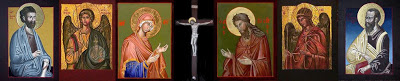
Our patron saint is not completely without representation in the church, however. In the row of icons at the altar (which I reproduced in today’s bulletin) he is there at the far left, and his brother John is at the far right. So, in a way, at Saint James church at least, James and his brother John do have the honor of being to the left and right of Jesus.

But it is important to note that in most churches with icons, those places are taken by Peter and Paul, and in all churches with such an arrangement of icons, the most honorable seats in this portrayal of the heavenly banquet belong to the Blessed Virgin Mary and Saint John the Baptist. In other words, the church has long understood Jesus’s response to James and John as indicating that those seats of honor were reserved for someone else — for the one whom every age would call Blessèd, and the one who was “the Forerunner” and first proclaimer of the Lamb of God.

+ + +

Now, I don’t know about you, but I can well understand the other disciples getting annoyed with James and John when they rushed to the head of the class. We’ve probably all known people who put themselves forward, in the process of putting everyone else down. People might call them the “teacher’s pet” or a “crawler.” There is something offputting about this kind of ambition — an instinctive sense that it is inappropriate to push forward and try to take the front row seats, the best seats, the seats of honor.

Indeed, Jesus elsewhere advises against this sort of behavior: telling people to take the lowest seats at the banquet so that they might be honored in being asked to come up higher, rather than taking a high seat and being embarrassed to be asked to move down lower. Apparently James and John did not think this applied to them — they were, after all, part of the inner circle, along with Peter, who had been invited to go with Jesus to the mountaintop, and later those three would accompany him to the garden of Gethsemane. Maybe the trip to the mountaintop went to their heads!

Whatever the reason, whether pride or self-satisfaction or because of earlier signs of favor, James and John clearly overstep in their request for prime seating, and Jesus gently corrects them, and the other disciples as well, when they get bent out of shape in this unsavory contest of “who does Jesus like best.” Jesus doesn’t settle the issue and say anything about who will be seated where — and as with the seats at the banquet advises taking the position of a servant — of one who serves.

+ + +

As with all Gospel passages, however, there is more to this account. Notice what Jesus does predict concerning James and John. They will drink the cup that he will drink, and undergo the baptism with which he is baptized. And this is where our row of icons comes in again: for although the images of the saints and angels are ranged at the altar where we celebrate the earthly foreshadowing of the heavenly banquet, they are also ranged at the foot of the cross.

This is the cup that Christ would drink, the baptism with which he would be baptized: a cup he would earnestly entreat his father in Gethsemane to pass him by — while James, John and Peter were sleeping. But in union with his father’s will he accepted it, accepted death on the cross for our salvation, in union with us his brothers and sisters.

The prophet Isaiah had spoken centuries before of this suffering servant of God — the one upon whom the iniquity of all of us wandering sheep long since gone astray, would be laid. “He was wounded for our transgressions, crushed for our iniquities; upon him was the punishment that made us whole, and by his bruises we are healed.” Or as an old prayer has it, “By his cross and passion we come to the glory of his resurrection.”

Christ knew that this was what lay before him — the bitter cup and the baptism of death. James and John would indeed share in this with him — James would be the first of the apostles to die for his faith. And his brother John, though he lived to old age, would know the bitterness of exile on the island of Patmos.

And all of us who bear the name of Christian, if Christians we are, share with our Lord in his sufferings as we share in solidarity with all human suffering: doing our best to alleviate it as servants of the one in whose image every human being is made. This is the way that Jesus commends to his apostles, and through them to us: not to lord it over others as their masters, but to serve them as Christ served us and gave himself a ransom for many.

The Christian life is not about climbing the greasy pole to success, of clambering to attain a front row seat, to elbow others out of your way to get the places of honor. Rather it is about the ministry of service that stoops to wash the feet of the poor, that gives itself and spends itself for the benefit of others and their well-being.

But the Christian life is also not about envying those who do succeed or gain seats of honor and privilege, especially when that honor comes unexpected and as a surprise even to the one so honored. I think of some of the recent reactions to President Obama’s Nobel laureate. I very much doubt this is something he expected and he appears to have received it with grace; and I can’t help but hear in the voices of some of those who have said he doesn’t deserve it, the envious echoes of those other disciples.

+ + +

Neither pride nor envy are attractive human traits. Jesus would have us avoid them both. And the surest way to do that is to do as he said: to serve as he did, even if it means a bitter cup and a painful baptism. Few if any of us will be asked to go as far as the apostles and martyrs; but we can do our bit in patience and humility, in service to the least of our brothers and sisters.

And so, away with pride and envy. Our Lord and God has seats prepared for us, and though we know not where exactly they will be, we know that they will be with him, and that should be enough to satisfy us. What need is there for ambition when we have such promises from the living Word of God himself: that living, active word, sharper than a two edge sword that judges the thoughts and intentions of the heart; before whom nothing is hidden and to whom we must render an account; but one who is also able to sympathize with our weakness, as he has borne our griefs. With this Word of God for us, what can stand against us? As Martin Luther wrote,

That word above all earthly Powers,
no thanks to them abideth;
the spirit and the gifts are ours
through him who with us sideth:
let goods and kindred go, this mortal life also;
the body they may kill; God’s truth abideth still,
his kingdom is for ever.+

Goodness Gracious, Put It Down

Proper 23b • SJF • Tobias Stanislas Haller BSG
Jesus said to the rich young man, ‘You lack one thing...’+

Have you ever been shopping, and arrived home with your arms full of packages, only to be faced by the locked door, and the realization that your latch-key is in your purse or your trouser pocket? The only way to get into the house is to put the packages down while you get out the key and open the door. In effect, this is what Jesus said to the man who came running up to him in today’s gospel, asking him what he had to do to inherit eternal life.

This man, as the gospel tells us, had many possessions. You probably didn’t have to be a prophet to tell: no doubt he had a fine suit of clothes, maybe a couple of servants following him at a respectful distance. Here was the proverbial “man who had everything,” and yet Jesus knew he lacked the one thing he needed most of all. He was like a man accidentally locked in a storeroom full of canned food, starving to death because he didn’t have the one thing he needed — a can-opener. What this man needed was the grace to give up what he had so that he could follow Jesus. His arms were so full of his possessions he couldn’t set hold of the key to eternal life. He went away shocked and grieved — he couldn’t let go; he couldn’t put it down, though his life depended on it.

Now, it would be easy to say that this gospel only had to do with the wealth of this world — the physical possessions that weigh us down and keep us from following Jesus. We might remember poor old Jacob Marley in Charles Dickens’ “A Christmas Carol.” He learned too late that the wealth that he should have used for the well-being of his community had instead became a “ponderous chain” he built up link by link in this life, and which kept him shuffling and clanking in his dreary afterlife, doomed forever to witness the suffering that he might once have eased — he “took it with him” and in the grave it kept him.

Yes, it would be easy for us to look at this gospel story as a warning for somebody else — for the rich — since few if any of us here are wealthy by the world’s standards. And it would be easy for me to turn the gospel on its head, and pat myself and all of us on the back just as the apostles did at the end of the reading.

But I would rather invite all of us to look at this message from the gospel a little more closely. Look more closely, and you’ll see that Jesus’ message wasn’t just about the wealth of this world, but about another kind of wealth, a kind of wealth that can get in our way and fill our arms with so many bundles we can’t make it through the door.

The man who came running up to Jesus was carrying more than gold and silver. This man was carrying a mountain of invisible packages, things he didn’t even know he was carrying. And they were good things, too! That’s part of the problem. This man came up to Jesus, knelt before him, and called him, “Good teacher.” And right off, Jesus said to him, “Why do you call me good?” That should get our attention right away. What an odd thing for Jesus to say! But this odd saying of Jesus is the key to today’s gospel, to see that it is about more than money. What we have before us is nothing less than the difference between goodness and grace.

This man came up to Jesus with his arms full of his good deeds. And let’s make sure we’ve got that clear: he was a good man. He had done many good deeds. Jesus looked upon him and loved him. He was a model citizen, a faithful and obedient son of Moses, one who, as the prophet Amos said, “loved good, and established justice in the gate.” And yet his arms were so full of his good deeds, he was so proud that he had kept the law, that he couldn’t see the most important thing of all, the thing he’d neglected in his race to be a perfect “self-made man,” a good citizen.

The one thing he missed was the grace of God — a free gift that you can’t buy with all the money in the world, the free gift you can’t earn with all the good you do or try to do. This man was so conscious of his good works that he forgot his need for grace. As the collect for today reminds us, grace must “always precede and follow us” so that “we may continually be given to good works.” So that... Without that grace, no good can come.

This man thought the good works he did were his — he forgot that without God’s grace he could have done nothing at all worth doing. For not just his good works — but everything he was came from God. He thought himself a self-made-man, but he forgot that even his existence was owed to God, and God alone: God made him, and no one else.

And God would continue to give him all he needed. But when Jesus told him the one thing he lacked, to give up everything he was carrying and to follow him, trusting entirely in God’s grace and providence — not his own wealth, his inheritance, his skill, his wisdom — but in God’s grace, with no visible means of support, he just couldn’t do it.

+ + +

Have you ever sent someone on a shopping errand? Perhaps a youngster, or a brother or sister, or your spouse? You might say, “Oh, Alicia, would you run down to the store and get me a bottle of Pine-Sol?” And off she goes, and an hour later comes back with shopping bags brimful of all the wonderful things she’s found, the incredible bargains, and the once-in-a-lifetime offers — she’s got everything, except, can you guess? — the Pine-Sol! Now, she meant well; she made some wise purchases, perhaps she even saved you some money on a few bargains. But she didn’t bring what you asked for.

Jesus asks for one thing from us, one thing more than anything else — he wants our hearts, our trusting hearts — to follow him. Yes, he wants us to do good works, and he honors and welcomes those good deeds; he loves us for them as he loved the rich man in the gospel, who had done good with all his might from his youth on up. But Jesus, our gracious Lord, our savior who gives us grace without counting the cost, knows that our salvation is a gift that is in his hands to give. And with it all the rest will come, all those other things from God — the houses, brothers and sisters, and fields (with persecutions!) — all of that will come if we first give up what we have. We are not saved on account of our goodness — goodness has nothing to do with it, as Mae West once observed. Only grace — only Christ’s blood shed for us, can purchase our salvation — and this is a purchase Christ makes with what is his: his life, his blood, laid down for us. When we depend on our own goodness, on our own store of virtue, on our own spiritual riches, we are in danger of becoming too rich for Christ’s blood; and of forgetting that all the good we do comes from him in any case.

+ + +

Let me tell you a parable. There was once a man who wanted to become a great fisherman. He was a successful businessman, who had always dreamed of his retirement and the happy hours he’d spend fishing. So when he finally retired, he bought the most expensive fishing tackle, the finest high-tech carbon-fiber rod with the flashiest stainless steel reel, the most elaborate tackle and exquisite lures and lines of finest monofilament. And he went out to fish one day, but he couldn’t for the life of him catch a single fish. And to his amazement, when he looked downstream, there, in a quiet eddy of the very same stream, was a little barefoot twelve-year-old boy with a bamboo stick, a length of string, a can of worms, a bent safety pin — and a pile of fish! And the man yelled out, “How is it that a little kid like you with a stick and a piece of string can catch all those fish and I can’t get a nibble?” And the boy hollered back, “Well, Mister, I guess you have to be where the fish are!”

To be where Jesus is—that is the one thing necessary. And to be where he is, you have to follow him, right? — because he doesn’t stay still, does he? Jesus is on the move, and to follow him we need to be light on our feet, not weighed down with possessions or pride, but free to follow him where he leads. You remember the old hymn, “Where he leads me, I will follow; where he leads me I will follow...” Well, he’s leading; but are we following or just singing? We need that one thing — grace, the grace to follow him. It’s the same “one thing” Jesus told Martha — another person who had her hands full — remember Martha? — Jesus told her that “one thing” was needful: to be with him. That one thing is grace, the grace to be where Jesus is, to follow him and to accept what he offers: without this grace all the good deeds in the world will get you nowhere. But with this grace, we can go anywhere our Lord would have us go! Because he is marking the way before us, and all we have to do is be free enough to follow him.

This is the wonder of grace: It is impossible for us to save ourselves, but God, through grace, will save anybody who wants to be saved. With God’s grace, we need do only one thing: accept Christ’s invitation to follow him to the banquet. Light on our feet, we can follow him down the king’s highway, empty-handed and open-handed, ready to help our brothers and sisters, ready to do good, not because we win heaven thereby, but because the gracious good news of God is too good to keep to ourselves— and the more of it we give away the more of it we seem to have.

We have a choice to make. Would you rather enter into life empty-handed, or spend eternity with the camels parked outside — the camels who can’t fit through the gate? I think I know the answer. I know where I want to be, and I think you do too. “Where he leads me I will follow...”

So as you journey through this world, stay light on your feet and keep your hands free. Don’t stop doing good, but once you’ve done it, forget about it and put it down. You remember what Jesus said that in doing good we ought not let our left hand know what our right hand is doing. Don’t carry your good deeds around; keep both hands free to take Jesus’ hands in yours when he reaches down into the grave to lift you up to the risen life. If you do have too many possessions, if wealth is getting in your way, for the love of God, put it down. If you are conscious of your own good works, if you feel like maybe God owes you something because of your goodness, then for the love of God, and goodness gracious, put it down. If you carry anything, anything at all, then for the love of God let it be nothing other than the cross of Christ, the cross you take up each day as you follow him on the road that leads to the heavenly kingdom of his Father, to whom as is most justly due, we now ascribe all might, majesty, power and dominion, henceforth and for evermore.+


Common Life

A sermon from Saint James Church Fordham

Proper 22b 2009 • Tobias Stanislas Haller BSG
For the man there was not found a helper as his partner.+

The second chapter of the Book of Genesis presents us with a marvelous example of God’s generosity and care, and the extent to which God’s children have the responsibility to make decisions, and how God abides by those decisions once they are made.

You no doubt remember the events that lead up to the events described in our reading from Genesis today. God created Adam from the clay of the riverbank, breathing into him the divine life and spirit. And God planted the beautiful garden of Eden, and placed Adam in it, to tend it and care for it as God’s gardener. And God looked down upon this peaceful creation and instead of smiling at its goodness, frowned slightly and shook his head a little. And for the first time in the whole narrative up to that point God said that something was not good.

And what was that? Was it something God had made? No; it was something yet unfinished, something yet to be made. “It is not good that the man should be alone; I will make him a helper as his partner.” And taking more clay, the same stuff he’d made Adam from, God set to work.

Now, this next part of the story is something many people forget, so I’m glad it was included in this morning’s reading. For what was it that God made out of that additional clay? Not another human being, but rather all of the animals of the field and the birds of the air. And God brought all of these creatures to Adam, for Adam to name, approve and accept. But Adam did not find among them a helper meet or suitable to be his partner.

Only then did God put Adam to sleep and take, not more clay this time, but some of Adam’s very own body, to make for him a helper suitable to be his partner, one like himself. And Adam recognized this kinship immediately, and rejoiced that at last here was one like him, another human being, one who could truly be called his mirror image, bone of his bones and flesh of his flesh.

The wonderful thing about this narrative is that God gave Adam such respect, and abided by Adam’s judgment as to who in all creation was to be his helper and partner, one truly like himself. God did not force Adam to be content to live alone as a solitary hermit in a garden. God did not force Adam to be happy with just the animals to keep him company. God did not take offense when Adam shook his head at all of these other creatures, and found none to be a suitable partner for him. God did not force Adam to accept them, and didn’t get offended and say, “Who do you think you are to turn down what God has provided.”

Rather God allowed Adam the freedom to choose the one who was like himself, his own flesh and blood, as a partner and a helper. God used no force in this: but allowed freedom, revealing, as our Gospel hymn said, that “force is not of God.”

+ + +

Well, you know the rest of the story. Adam and Eve lived in the garden only for a short time. One of those animals Adam had rejected as an unsuitable helper and partner perhaps didn’t take too kindly to the rejection. It was the creature God made with some of the leftover clay, the kind of animal any child knows is the easiest thing to make with a lump of clay — just as the Gary Larson cartoon shows God at his work table rolling out the snake and saying, “Gee, these things are a cinch!” Cinch it might be, but it opened up a whole can of worms! The serpent wriggled in and did his dirty work, sowing the seeds of discontent and pride, taunting with the fear of death, tempting with the promise of divinity, leading Adam and Eve to disobedience. The serpent dangled temptation before them, and they bit.

And so the caretakers got evicted from the garden. And for thousands of years human beings continued to stumble about in their ignorance and pride. Humanity lived under the fear of death, yet unable to escape it, no matter what they did, alternately sinned against and sinning, unable to find righteousness even though God tried time and time again to show them how, by giving them the Law and inspiring the preaching of the Prophets.

God would not, you see, simply force people to be good, any more than God forced Adam to accept Eve. God wanted people to be good from the inside, good from the heart, not just coated over with a whitewash of proper behavior, but deeply loving, deeply just, deeply free — and deeply responsible for the choices they made in that love, justice and freedom.

Just as God had a few false starts in creation, so too there were false starts in this re-creation. God first gave the people a law written in stone, and the people disobeyed it and rejected it. God sent the people prophets, but they ignored them or mistreated them. God gave the people kings and most of the kings turned out to be worse than the people!

But finally, in the fullness of time, God decided to do something similar to what he had done way back in Eden. God would not this time send the Law. God would not send a prophet. God would not send a king, at least not the kind of king people were used to. God would not even send an angel.

God would instead give to humankind one who was human, a human being like Adam himself, but one who was also divine, one who was God incarnate. God would choose incarnation — being made flesh — our flesh.

So as of old when God took the raw material from a human being, from Adam, this time God took from the flesh of a young woman named Mary all that was needed to make the one who was for a little while to be made a lower than the angels, one not ashamed to call men and women his sisters and brothers, for he shared the same human flesh as they — as we. “He sent him down as sending God; in flesh to us he came; as one with us he dwelt with us, and bore a human name.”

+ + +

The human name he bore is Jesus, which means Savior. The divine name he bore is Emmanuel, which means God is with us. He was and is our Saving God who is with us, who shared with us in mortality and pain, shared the weakness of human flesh, so that he might redeem and save that human flesh. He suffered death so that he might destroy death for ever, and destroy the one who, as the Letter to Hebrews says, had the power of death, the same devil who ages before had snaked his way in, to ensnare and enslave humanity by their fear of death.

Jesus, our Savior and our God, is also our brother, for he taught us to call his Father our Father. We who share in the flesh of Adam also share — through Jesus — in the Spirit of God. The old serpent can do nothing to us any longer if we do not let him. He’s done his best to do his worst, and he failed utterly when Jesus broke the power of death and was raised to life again. And we who are united with Jesus in his death, are also given the power to rise with him in his life.

We can still refuse God’s offer. God respects our freedom too much to force us to follow the path he so desires for us. And there are those who would rather listen to a serpent’s lies than to God’s own truth. There are still some so possessed by their fear of death that they have forgotten how to live. We look at a world in which we see that all things are not under human control — disease, crime, famine, and injustice still seem to rule. Some seek long life or wealth, or pleasure or fame, but rarely find lasting happiness. But we also see Jesus, the human one who suffered, the human one who died, who gave up everything and yet who through the power of God triumphed over everything, and now is exalted over all things.

We too can confront all the shallow promises of the world, promises offered in the devil’s accent, to find that none of these things will answer our deepest need. In none of these things can we find our true and final happiness whatever the snake may say to the contrary. It is only in Jesus — God from God, light from light, true God from true God, that we recognize our own truest human self — the perfect image of humanity made after God’s own image and likeness. God offers us the option, and will not force us to choose life rather than death. God invites us to find our truest life in him, and has shown us the way, but he will not force us on that path.

In this is our hope, our freedom, and our challenge. As we make our choices, let us always remember the promise of our Gospel hymn, and choose rightly:“Not to oppress, but summon all their truest life to find, in love God sent his Son to save, not to condemn mankind.”+


God's Children

SJF • Proper 20b 2009 • Tobias Stanislas Haller BSG
Jesus said, Whoever wants to be first must be last of all and servant of all. And he took a little child and put it among them.

If you’ve ever watched a couple of children playing with their toys you have seen human nature at work — at its best and at its worst. I have seen two children playing, each with his own toy. Then one of them tires of his toy and goes to the toy-box for a different one. Suddenly, the other child completely loses interest in his own toy. The toy the other child has taken is the one he wants, and the only one. Nothing else will satisfy him.

The first child rightly claims, “I had it first!” and the second counters, “But I wanted it.” And so the battle begins, the timeless tug-of-war fed by the desire to possess what someone else has, the need to have what someone else wants.

We put aside many childish things when we grow to maturity, but this tendency to covet what someone else has can stay with us all our lives. The grass is always greener in the neighbor’s yard, so the saying goes. And his wife may be prettier, his salary higher, his car flashier. Oh, there are all sorts of things that we find to be attractive primarily because someone else has them!

And it doesn’t stop with individual people. Whole nations are torn apart in struggles born of envy and desire, the envy of what another nation has, and the desire to possess it, the need to be — or envy — the biggest, the best, the brightest, the richest, the strongest. Imperialism, colonialism, conquest, and sometimes bald tyranny are what you get when a big nation acts like a selfish child, never having enough: a bully snatching up what smaller nations hold.

It is easy to point at the great tyrants of the past, to hold up Nazi Germany as an example of a powerful nation that invaded its neighbors. It is easy to shake my head in dismay over the never-ending squabbles of the English and the Irish, the Israelis and the Palestinians. But as an American,I must confess that my own country, has also shown this fatal weakness, this tendency towards acquisitiveness. You can dress it up in fancy words as they did in the nineteenth century, when they called it “Manifest Destiny” — that is, the doctrine that drove the westward expansion of the United States, because somehow it must be intended that this nation should stretch “from sea to shining sea,” and nobody better get in the way! The economic system built on slavery, the destruction of native cultures and peoples through forced migration or occupation, the fruit of conquest from wars and invasions — the United States has its share of wrongs to repent of!

But, as we learned to our horror on Nine-Eleven, envy and anger work both ways, and weapons of mass destruction and terrorism, can unleash horrors undreamt of a century ago. Saint James spoke truly when he said, “Where there is envy and selfish ambition, there will also be disorder and wickedness of every kind.” Envy of the success and power of the United States, envy of the so-called “Christian West” — of all that has been achieved and gained and built — envy and hatred stewed in the hearts and souls of angry malcontents in the two-thirds world, until it boiled over. Small countries we once would have taken no notice of — sometimes not even countries, just a bands of angry, alienated and single-minded extremists — wreak havoc out of all proportion to any rational basis for their anger. This irrational anger isn’t even about gaining anything,

it is only about making those whom they hate suffer: not acquisition, but retaliation; not gain, but vengeance; the irrational hatred that says, I can never have what you have, so I will bring you down. And one child destroys the other’s toy out of envy, saying, If I can’t have it, you won’t either.

This is truly sour, green-eyed envy at its most poisonous. We see it reflected in our reading from Wisdom: the wicked plans of the malicious company, the evil crowd scheming to bring down a good and righteous man just because his goodness exposes their badness; their desire to take advantage of the widow and the weak, because they are unable to protect themselves. + + + What Saint James calls “these cravings that are at war within you” are not always so externally violent, not always so maliciously wicked, but they are always unattractive. Look at the disciples along the road in today’s Gospel: arguing about which of them is the greatest — and doesn’t that sound like something from the schoolyard! Now, at least the disciples are wise enough to be embarrassed about their argument when Jesus asks what they are up to. And Jesus gently corrects them, saying, Whoever wants to be first must be last of all and servant of all.

It doesn’t matter how much territory you possess,

or how many toys are in your toy-box. What matters is having the willingness to serve, the willingness to wait, the willingness to set your own needs aside. What is important is the ability to say, Maybe you do need this more than me — I can wait my turn, I can accept my share when it comes round.

I said at the beginning of this sermon that in children you can see the best and the worst of human nature. I’ve talked about the worst you see in kids: the selfishness, the anger and the envy. But what about the best? After all, that’s what Jesus was talking about, what he intended when he set a child before the disciples, to shame their envy with innocence. Jesus wanted to emphasize the best in children as examples of simplicity and openness, to shame the disciples’ grown-up pride and envy. And I want to do the same to end this sermon, to tell you the true story of a child whose generosity is an example of the kind of transparent generosity that can shine through a child sometimes.

Little Johnny’s sister Mary had fallen ill and needed a blood transfusion. Mary had a very rare blood type, and Johnny was the only possible donor. The doctor approached the ten-year-old boy and explained to him how sick his little sister was, and how she needed blood if she was going to recover. He explained how rare her blood was, and how it was that Johnny had the same kind. The doctor then asked,“Would you be willing to give your blood to Mary?” Johnny’s eyes widened; he paused for a moment, then he swallowed and, knitting his brows said resolutely, “For my sister... sure.” The two children were prepped for the transfusion, Mary looking pale and listless, Johnny healthy and sound. Johnny looked at his sick sister and smiled. Then the nurse inserted the needle in his arm, and his smile faded. He watched his blood flowing through the tube, and looked over at his sister where she lay quietly. Minutes passed as the blood was collected; and as the process was almost complete, Johnny looked up at the doctor, and said, in a brave but shaky voice, “Doctor, when do I die?”

Only then did the doctor understand what Johnny had done, what a momentous decision this child had made. Only then did the doctor understand that this child had been willing to give up his life-blood — all of it — so that his little sister could live. The doctor reached out and touched the brave boy’s head, and said, “That’s all right, Johnny. We’ve taken enough to save your sister. You’ll be all right, too.”(1)

When Jesus calls us to be last of all and servants of all, he is not asking for our deaths, but for our lives. He is asking us to put others first, not to be envious of another’s success, but to rejoice in it. He is asking us not to base our self-worth on the number of toys in our toy-box but on how well we play with our brothers and sisters, how much we share what we have with those who have less. God asks us to turn from selfishness to generosity, from pride to humility. And God asks from us no more than he has given us to give, and he assures us that when we have given what we can with open hands and hearts, that we his children, like little Johnny, will be all right, too.+


Note 1. Based on Robert Coleman’s Written in Blood (Larson Illustrations 25)[^]

Be Opened

SJF • Proper 18b 2009 • Tobias Stanislas Haller BSG
Then looking up to heaven, Jesus sighed and said to the deaf man, Ephphatha, that is, Be opened.
Have you ever found yourself the object of someone else’s sharp accusation: You haven’t heard a word I’ve been saying! Perhaps at the end of a long day you’ve been sitting in front of the TV while your spouse has been telling you about what’s been going in their day — then there’s that sudden pause, not the pause that refreshes, but the one that alerts you to think, “Uh-oh,” followed by the magic words that bring us fully back to the present: “You haven’t heard a word I’ve been saying!”

Or perhaps you remember the experience of your school days, especially in that deadly time after lunch from one to three. I don’t know what Einstein or Stephen Hawking might say, but I think those hours had something to do with a distortion in the space-time continuum! Maybe teachers have a special gravitational force! Certainly you find yourself and your eyelids getting heavier and heavier the longer the teacher talks. You even find that your mind is getting further and further detached from your body. Then suddenly you hear the voice of the teacher say, “Miss Martin, can you answer the question?” And with an awful sinking feeling you know that not only don’t you know the answer, but you don’t know the question!

+ + +

These aren’t examples of being hard of hearing, but being hard of listening. When we find ourselves accused, “You haven’t heard a word I’ve been saying,” it isn’t quite true. We’ve heard, all right, we just haven’t listened. Unlike the man whom Jesus cured, it isn’t our ears that need to be opened, but our hearts and our minds.

Listening is more important than hearing — it is the reason we hear, the goal and end for which hearing exists. God has given us the gift of hearing so that we might listen, understand, and ultimately act to do his will. And yet how often, like a tired spouse at the end of a long day, do we allow our weariness to transform us from human beings into couch potatoes?

Is there such a thing as a pew potato? Haven’t we all known times when our Sunday morning worship, instead of filling us with energy to do God’s work, instead lulls us into a celestial snooze, contented to be in God’s presence, drifting on a spiritual cloud. Then, suddenly, something in the Gospel, some phrase in a hymn, I’d like to think maybe even a word from the preacher, pierces our hearts like a voice that says, “You haven’t heard a word I’ve been saying!” and we are called back to awareness of the importance of our call to serve the Lord our God: to be doers of the word, and not hearers only. Thanks be to God for that wake-up call when it comes, for this is one of God’s greatest gifts to us, the gift of awareness of his purposes for us, that we might become, as Saint James says in the epistle we heard this morning, “a kind of first fruits of his creatures” — that is, a result, an end, a purpose: For just as listening is the goal of hearing, the harvest is the goal of the planting. God does not plant the seed of his word in vain, but in order that it might bring in a plentiful harvest.

+ + +

Saint James describes a kind of spiritual deafness, and gives us helpful advice on how to avoid it. He begins, “Let everyone be quick to listen, slow to speak.” I’m reminded of an old proverb, one of my grandmother’s favorites: You were born with two ears and one mouth — so listen twice as much as you speak! And it isn’t just talking with your lips that can impede your listening: there’s body language and brain babble, too. Have you ever tried to talk to someone who was doing this? [hand on hip, looking into space, sighing] You know what it’s like. That’s mighty eloquent body language, and it tells me “I can’t hear you” just as effectively as the schoolyard version [fingers in ears, la-la-la]. The fact that you see one in the boardroom and the other in the schoolyard simply shows how universal is the tendency to not want to hear, to not want to listen.

Then there’s brain-babble. That’s what happens when you tune out the person talking to you and start listening to your own inner monologue instead — this is where we’re liable to be caught short when we lose track of the exterior conversation because we’ve been talking to ourselves on the inside, rather than listening to our brother or sister right there before us on the outside.

+ + +

Saint James mentions one more cause of spiritual deafness: “Be slow to anger,” he counsels. How hard it is to listen when we’re angry, particularly if the person we’re trying to listen to is the one we’re angry with! And what solution does Saint James offer? “Rid yourselves of all sordidness and rank growth of wickedness, and welcome with meekness the implanted word that has the power to save your souls.”

That’s a gardener talking, you know, one who expects a good crop: Saint James is telling us to weed our hearts; to pull up anger by the roots, cultivating and tilling the soil of our souls to be pure good top-quality topsoil to receive the word of God when it comes to be planted, and able, then, to bear much fruit. Saint James counsels us to treat anger in our hearts as we would weeds in a flower-bed: out of place, and good only for pulling up and throwing out.

Then Saint James makes his final appeal: after you hear the word, don’t stop at being a hearer, but be a doer! Get into action! This is where the harvest comes in. Otherwise you’re like some silly soul who looked in a mirror and saw he’d forgotten to button his shirt or do up his fly, but as soon as he walked away from the mirror forgot what he had seen and walked out into the street half dressed.

We talked last week about being properly dressed for the service of God, dressed in the armor of God that is provided to all who believe in him. And this week we are reminded that those who hear and bear God’s word and prepare for action, but who never act, are, as the saying puts it, all dressed up with no place to go! It’s time to stop looking in the mirror and admiring how fine we look. It is time to get to work!

+ + +

As I told you a few weeks ago, the Secretary-General of the Anglican Communion has invited me to join with a group of four other theologians and leaders in reconciliation and peace-making from around the Communion, under the leadership of the Primus of the Scottish Episcopal Church. Our task is to help the Anglican Communion engage in a process of listening to each other, meeting together as Christians should who care deeply about each other. Our first meeting is next week in London, and I will be traveling next weekend and so will be away from Saint James. I ask your prayers for my travel and our meeting. I will carry all of you in my heart — you who come, many of you, from different provinces of the Anglican Communion yourselves; and I will carry the other Saint James in my heart: that other Saint James, the one from whose Epistle we heard this morning, for he has much to say about listening.

I know that in all of this I have been equipped, as all of us have, with the armor of God and ears to hear. Brothers and sisters, we are all dressed up and do we have a place to go whether to London or Staten Island or Co-op City or just down the block! We have work to do, God’s work. We have a mission to accomplish, God’s mission to bring all people into unity with each other in Christ. We live in a world so full of noise that people have grown deaf to the sweet sound of God’s voice calling to them from afar, or even whispering in their ear. We live in a world so overgrown by the weeds of rank self-absorption that the seeds of God’s grace are finding fewer and fewer places to grow.

But we know that God has put the tools into our hands to go forth and help clear those weeds. He gave us the belt of truth, the breastplate of righteousness, the shoes of the Gospel, the shield of faith, the helmet of salvation and the sword of the Spirit. I’d like to see any weed stand up to that! And we know that God can use us to speak the truth in love, to speak even in a babbling, self-absorbed world, to put what we hear in church to work when we go to the world. To call for justice for the oppressed, for food for those who hunger, for freedom for the prisoners, welcome for the stranger, sustenance for the orphan and widow.

This is the message we carry to an inattentive world. We will speak clearly — but we will not have to shout or raise our voices. For with God’s implanted word in our hearts, we know how powerful it is when we simply pause for a moment, and then say to that world in God’s name, “You haven’t heard a word I’ve been saying.”+


Inside Out

What do an old book, a ramshackle building, and a broken leg have in common?

SJF • Proper 17b 2009 • Tobias Stanislas Haller BSG
The Pharisees and scribes asked Jesus, “Why do your disciples not live according to the tradition of the elders?”+

There is an old story — you have probably hear it — about three women who departed this life on the same day. All three were active in their respective churches. And one was a Southern Baptist, and one a Roman Catholic, and the third an Episcopalian. And as they were waiting in line at the gate of heaven to find out if they would be admitted or not, all three of them looked very nervous and unhappy. Finally the Baptist, who was first in line, turned to the other two and moaned, “I don’t think I’ll be let in to heaven. I was the treasurer of the Shiloh Baptist Ladies Club — and I embezzled the proceeds from the church fair.”

The Roman Catholic woman then sighed and shook her head, and said in a resigned voice, “I’m not looking for any better treatment. When my husband was on a business trip I had an affair with the cable guy.”

Finally, the Episcopalian, who sounded as if she might have perished from a case of what they call “Scarsdale Lockjaw,” looking back and forth and lowering her voice, confided, “I’ve been hiding this secret for years, and I know it will come out now that Saint Peter opens the book and reviews the ledger of my life. Once, at a dinner party, I ate my entree with the salad fork!

+ + +

That may seem a far-fetched joke, doesn’t our gospel today looks just as odd when you read it seriously and carefully. Here are the Pharisees and scribes getting all upset about Jesus’ disciples for not washing their hands before dinner. And it isn’t sanitation that they’re worried about. The Pharisees, following the traditions of the elders, believed that washing your hands, and following all of those complicated rules for washing cups, pots, and metal vessels, were not just matters of cleanliness, but literally of Godliness. For them, failing to wash before eating wasn’t just bad manners, or poor hygiene; it was downright immoral. For the Pharisees, eating with unwashed hands, as for our poor imaginary Episcopal Churchwoman eating her entree with the salad fork, was a deadly serious matter. And for the Pharisees it was serious enough for them to come to Jesus and say, “Look at what you’re disciples are doing!”

And Jesus, well, he had little patience with that sort of attitude. He laid it right on the line, and called their concerns lip-service and hypocrisy, abandonment of God’s commandments in favor of mere human tradition. That is strong language. And if any doubt remained, Jesus called the people to him and spelled it out. What comes from outside people and goes in cannot defile them. There is no sin in eating with dirty hands or dirty dishes. Hands and silverware and porcelain have no moral value, and have nothing to do with sin. It’s what’s inside people already that is the problem.

The problem is those inside “devices and desires of our hearts” that creep out when we are off our guard, the roaches and rats of the fallen human nature that come out of hiding, scurrying about when the lights are turned out. These are the things that defile; things that are the substance of sin: not dirty hands but dirty thoughts.

For it is from within the fallen human heart that evil intentions come, and Jesus gives us a whole laundry list or the soiled linens of sin hung out in the light of day for all the world to see — fornication, theft, murder, adultery, avarice, wickedness, deceit, licentiousness, envy, slander, pride, folly. These are the things that come from within, and these are the things that defile a person.

How easy it would be to purchase salvation just by washing your hands and your cup and your plate and your bowl. Even wiping your mouth is not enough: as Proverbs says, “This is the way of an adultress — she eats and wipes her mouth and says, ‘I have done no wrong.’” No amount of scrubbing the outside will make the inside clean. The stain of sin remains when the evil that is inside spills forth, and it cannot just be washed away.

Do you remember Lady Macbeth? After she murdered the old king she went quite mad — no matter how much she washed her hands — rubbed raw — they always looked bloody to her still, spotted and stained with the blood of a guest, and not just any guest, not just a any good and righteous man, but her king, murdered in his sleep. Lady Macbeth went mad, haunted and pursued by the evil she unleashed from her own prideful and ambitious heart, haunted and pursued until she took her unhappy life with those same hands, hands scrubbed raw in the futile effort to remove the stain of her guilt.

+ + +

So is there any hope? If washing our hands or our outside is of no use, and our inside is chock full of terrible and nasty things, what are we to do? Have you ever had an old favorite book that you’ve read so many times that it is starting to fall apart? When it reaches that state, the only thing that can be done to care for it, to save it, is a new binding: not just cleaning the outside, but putting on a whole new outside: a spine and covers, rebinding it carefully. Or what do you do when a building is in such bad state that it is in danger of falling down? You put up scaffolding and set to work on the walls and the roof! You know we went through that here five years ago: replacing our 143-year-old slate roof with a brand new one. It was tempting to just want to patch up the inside, to plaster over the holes where the rain came through, and then give them a lick of paint. But a lick of paint would not have solved the problem. We had to start on the outside first, and even there not just putting down a new layer of tar, but stripping off all that old decaying slate and wood and starting afresh. And we also had to build a scaffold so the workers could get to the roof and do their work.

So too when we look to our own moral and personal renovation, we need to do more than just try to think happy thoughts to drive out those darker thoughts in our hearts. There is nothing we can do on our own to change our inner human nature: it is part of our heritage, whether you want to look at it from the religious angle as the legacy of Adam and Eve, or take the secular view that the drive to self-preservation, the source of success and survival, is also the source of selfishness and competition, and all the evils that dwell within.

But we can get a whole new scaffolding outside to help this feeble and sin-weakened body stand up against the wiles of the devil; not just a cleaning, but a renovation, becoming a new creature.

Saint Paul calls this new outside “the armor of God.” It goes on the outside but it helps the inside to stand up. It’s like the cast that goes on the outside of a broken limb to help it heal from within. And it is healing we need. We will never overcome our inner evils just by washing our hands: we need the armor of God to mend our broken hearts. We need the scaffold of God’s support to rebuild our ramshackle selves, to make them whole and fill them with the love of God so that there is no more room for all that nasty stuff that hid there.

If we are willing, God will fasten the belt of truth around us, the truth that acknowledges our weakness and casts its whole dependence upon the one who alone is the living Truth.

If we will let him, he will put his righteousness on our chests like a breastplate, the sign of a righteousness not our own, but loaned to us to protect us and give us confidence to stand tall and proud with our chests out and shoulders square.

If we let him, he will give us shoes of readiness to proclaim the Gospel for our feet, shoes to protect our soft soles — that’s s-o-l-e-s — from the ruts and rocks and broken glass on life’s road.

If we let him, he will put a shield of faith on our arm, not our faith in him, but his faith in us, strengthening us by this act of confidence, as the presence of any proud parent in the bleachers will spur on the child to greater efforts in the game.

And he will crown us with a helmet of salvation — and remember that helmets in Saint Paul’s day didn’t just cover the top of the head, but came down over the nose and the cheeks, with eye-holes to look out of: so the helmet of salvation doesn’t just protect us, but it directs our view straight ahead towards the prize for which we are competing.

Lastly he will put the sword of the Spirit in our hands, which is the living Word of God, living and active, cutting both ways and searching out the inner realities and secrets of our human heart.

Clothed from above like this, given a whole new outside to support us by the Lord of Glory himself, we need fear no evil from without. Strengthened to stand in the armor of God, we need fear no evil from within. Like a fragile old manuscript newly bound, we can be put back into circulation. Like a damaged building given a new roof and walls, we can then open our doors in hospitable welcome. Like a person with a broken limb that has been healed and strengthened, we will be able to stand and bear witness, clothed with the armor of God against all evils, with confidence that nothing from within our now-
cleansed and rehabilitated insides will ever be able to do usor others any harm.

To God who has thus remade us and armed us in his spiritual power against all evils from within or without, to him be the glory, henceforth and for evermore.+


Union Troubles

SJF • Proper 16b 2009 • Tobias Stanislas Haller BSG
Jesus asked the Twelve, Do you also wish to go away? Peter answered him, Lord, to whom can we go?+

Has anybody here ever played the board game Scrabble? One thing that often happens in a Scrabble game is that somebody will put down their letter tiles to spell a word that no one else recognizes. And one of the players will challenge the spelling — especially if it’s a triple word score with lots of Z’s and X’s. Someone will pipe up, “That’s not how it’s spelled!” or “That’s a proper name!” or “There’s no such word as that!” And when this happens, the person who advanced the word will either say, “Yes it is” or “No it isn’t” according to the challenge. In short, there is a division of opinion.

And according to the rules of Scrabble, there is only one way to solve the problem: the dictionary! Pages will be flipped, and if the word isn’t in the dictionary, or if it is spelled differently, or if it turns out to be a proper name — well, then the player must pick up his or her tiles off the board, and lose the points. Or if they are vindicated and the word is correct, they get to smile a little grin of self-satisfaction to tote up that score. But however it turns out, once the dictionary is appealed to, a decision is reached. The dictionary is the court of last appeal and final arbiter.

+ + +

Today is one of those unusual days in which all three of our Scripture readings point to the same theme: fittingly, the theme of unity versus division. In the reading from Joshua we witness an ancient covenant liturgy, as Joshua, the successor to Moses, challenges the tribes of Israel to make a choice between following the Lord as a unified people or going after other gods as a scattered collection of tribes each following its own god.

Then Paul’s letter to the Ephesians describes the unity of husband and wife in terms that reflect Christ’s love for the church. And the Gospel shows the disciples wavering in their faithfulness to Jesus, as he concludes his teaching on the bread of heaven — a teaching so difficult for some of them to understand that many of them turned back and forsook him, and one would go on to betray him.

In each of these passages the tension between unity and division is placed before us. And in each of these passages we are presented with a clear message that true unity cannot come from within the group of individuals. There must be some external and overarching power and grace to bring true and lasting unity to a divided group — or a couple — of people.

In short, people cannot achieve unity on their own, any more than Scrabble players can settle their disagreements over how to spell a word on their own, just by arguing back and forth. Scrabble players need a dictionary. And the people of God need God — whether the tribes of Israel, or a married couple, or the church of Christ itself. Without God at the center, any human institution will fall apart.

And we’ve seen it happen, haven’t we? If you know your scripture, you know that the tribes of Israel did fall apart, each going after its own gods, within just a few generations of Joshua’s effort to call them to a unified covenant with the Lord. And Joshua knew it, too, that the people could not serve the Lord, the holy one; he knew that the people would soon be tempted to follow the local gods of the local people among whom they lived: tame gods made of cast metal or stone, gods who would do nothing for them but who would ask nothing of them. And so the history of ancient Israel went, from division through fragmentation, and finally into dissolution and captivity.

We’ve seen what happens in marriages that try to survive just on the strength of the couple themselves, marriages that lack the holy quality that Saint Paul describes, the self-giving holiness that mirrors the very love of God, the mysterious love of Christ for the church. For although Saint Paul starts with the old pagan answer to all marriage problems: wives, obey your husbands, note that he doesn’t stop there. Simple one-sided obedience was the way to keep peace in the old days, before Christ came: wives were viewed primarily as first-class servants in the husband’s household, without personal freedom of self-determination, and peace was maintained through submission, because the wife had no other choice.

But Paul affirms that things have changed since Christ has come: now the husband is a subject too, a subject of Christ, and called upon to obey the law of love and sacrifice which alone makes him worthy of being a Christian husband: loving his wife as himself; loving his wife, the most intimate neighbor, as himself, according to Christ’s teaching. In this dance of loving and mutual obedience, with God in Christ as the true master of the dance, a marriage can survive and flourish. Without that love, without Christ’s presence, no marriage will ever be more than a marriage of convenience — or inconvenience, as the case may be.

Finally, we have also seen how the church itself can fall apart when it loses its focus on God and turns in upon itself, placing new idols on the throne of God. Like all institutions, the church can fall into the habit of exalting the particular and peculiar personality of its human leaders over against the universal and eternal personhood of our Lord and God. It is no irony that the Western church began to crumble, in a slow slide leading to the Reformation and the collapse of the Roman Church, just at the time the pope began to assert his supremacy as Christ’s personal representative on earth. And it is no wonder that many parishes and congregations have split and divided, or wandered off into schism, when they have focused all their attention on their priest or pastor instead of turning together towards God, the giver of every perfect gift.

And I don’t mean that just in terms of personal dynamics; I mean it physically. Upon my arrival in this church almost exactly ten years ago, I restored the ancient tradition of joining with you and together facing east towards the rising sun at the heart of the Eucharistic feast — as your leader — but also first and foremost as one of you. We are not turned in upon ourselves, We all of us turn together to face the altar, all of us are on the same side of the table — just like at the Last Supper! And if you don’t believe me, there it is [in the stained glass window on the north wall.]


We are not turned in upon ourselves, but all of us together turned towards the One who is, as the Psalmist says, “our Lord, our good above all other… our portion and our cup who upholds our lot.”

It is no accident that the Christian churches have suffered the greatest division and loss in membership since they foolishly decided in the 1960s that priests should face their congregations across the altar. This change transformed the worshiping church from a grand procession moving forward together in unity into a closed circle focused on itself. Or even worse, it focused the congregation’s attention on the priest behind the altar, who was cast in the role of a performer to be reacted to, rather than as the leader of a grand parade in which all are invited to join. But I’m glad to say the tide is turning, and many parishes such as ours are rediscovering that the church had it right for 1900 years after all, and that all of us together turning in our focus on the transcendent Lord of glory, joined in turning our gaze upward and beyond our own preoccupations, is the best way to find our true unity under one Lord and one God.

+ + +

Scrabble players know they need a dictionary. Joshua knew that he and his household would only find their identity in serving the One Lord, the God of Israel. Paul knew that a marriage that did not have Christ and his love at its heart would not survive. Peter and the apostles knew that only Jesus had the words of eternal life, that he was the holy one of God. And so it is that we too know that our true unity is to be found, not in pastors, priests, bishops or popes, nor even in ourselves as a gathering, but here at this altar where we gather, in Jesus Christ our portion and our cup, our good above all other, our Blessed Lord, who lives and reigns with his Almighty Father, in the unity of the Holy Spirit, one God, now and for ever.+


Surprise Package

SJF • Proper 14b 2009 • Tobias Stanislas Haller BSG
They began to complain about him, because he said, I am the bread that came down from heaven. They were saying, Is not this Jesus, the son of Joseph, whose father and mother we know?+

Have you ever gotten a surprise package? They come, you know, in several forms. One kind is the grab-bag: sometimes a store or a mail-order company will dispose of excess stock by offering you a selection that you pay for sight unseen — and which, who knows, might contain a wonderful bargain. And then there’s the birthday or Christmas gift that you weren’t expecting, the carefully and lovingly wrapped package that contains a wonderful surprise. Have you ever gotten a package that surprised you — opened a gift you expected to contain one thing, and then been delighted to discover it was something else? something you never expected? There is a lot of fun in a good surprise package!

The common thing about all of these surprise packages is that you don’t know what’s inside; that’s what makes them a surprise. Either you can’t guess the nature of the contents, or you think it’s one thing and it turns out to be something else. In both cases, you’re in for a surprise.

In today’s Gospel, the leaders of the people have received a surprise package in the person of Jesus. He’s just told them something extraordinary: that he is the bread that came down from heaven. The problem is he doesn’t look like bread from heaven. He looks like Joseph’s son, like a man whose father and mother they know. How can he be bread from heaven? He’s just a carpenter!

+ + +

Many years ago, long before steamships and radios, there was a sailing ship in sore distress out on the Atlantic. The ship was in trouble because their supply of fresh water had run out. It was like that memorable line from “The Rime of the Ancient Mariner”: “Water, water everywhere, nor any drop to drink.” The crew were perishing from thirst, because the saltwater all around them, however tempting as it might look, would if you drank it lead only to delirium and death. With hope almost gone, they sighted a ship approaching in the distance and hoisted their distress signal pennants: spelling out, “No water.” And as the captain looked earnestly through his telescope, the distant ship hoisted its pennants and signaled in return. But what the answering flags spelled out was not “We’re on our way,” but “Dip it up.”

“Dip it up?” the parched and weakened crew moaned. What heartless mockery, they said among themselves. To suggest that they dip up buckets of lethal salt water! They signaled again, “No fresh water,” but the very same answer a second time, “Dip it up!” Finally, in despair, they lowered a bucket and hoisted up some of the sea water To their amazement and joy it turned out that the water in which they were sailing, even out in the Atlantic Ocean, was fresh, sweet water. They hadn’t know it, but they were sailing through a current of water that flowed from the mouth of the mighty Amazon river, flowing out into the Atlantic Ocean fresh water flowing invisibly far out at sea. All the thirsty while, they thought for sure that the water surrounding them was useless, yet the means to save their lives was all around them.

+ + +

Yes, Jesus was a carpenter. It’s said he made good yokes; easy, light ones, as he said himself. And yes, he was reckoned to be the son of Joseph and Mary, well known to the folks in town. But he was also the bread which came down from heaven, to give life to the world. He looked like a man, and so he was — but he was also the Son of God, the Word made flesh, the bread of life, whom to eat is to live for ever. He was and is the surprise package for the world’s birthday, the unexpected miracle that looks so ordinary, and turns out to be beyond our dearest expectations.

We are here in this church because we have accepted the surprise package. We’ve bought the grab bag. We’ve been presented with the greatest gift ever given. And when we open it up, what do we see? What do we see when we come to this altar to receive communion. Bread! And skeptical folks today like the skeptical folks from Jesus’ home town might say of us, as they said of him, How can they believe that is bread from heaven?! Don’t we know it comes from Vermont Church Supply, shipped by UPS in cardboard boxes. Don’t we know how much it costs and how it’s baked? How can we imagine it to be bread from heaven? How can we imagine that it is the Body of Christ, given for the life of the world, that whoever eats of it will live forever?

+ + +

There was once an elderly woman who made her living by making and selling artificial fruit. One day a potential customer came into her shop and after looking around with a frown, complained that the artificial fruit she made was not realistic enough — it was too perfect. She pointed to an apple sitting there on the counter. “Look at that,” she said. “It is far too red, it’s too round and it’s too big to be a real apple.” The old woman nodded thoughtfully, picked up the apple (which happened to be her lunch) and proceeded to take a nice big bite out of it!

+ + +

You see, there will always be people who will never understand that things are sometimes exactly what they appear to be; that sometimes you find a perfect apple it looks too good to be true — but it is — and is it ever good! And on the other hand, there will always be people who will never understand that some things are not what they appear to be, that our wrong understanding of a thing can make us believe it is something other than what it is. People can go off the road of understanding on both sides.

Anger, for instance, can so preoccupy us that we miss the new opportunities offered to us. People can get so angry at things not going their way that they fail to see how much better things are going than if they had gone their way. Fear can make an old hollow tree on a dark road look like a monster. Simple ignorance — just simply not knowing — can make us think that clear fresh water is deadly poison. Pride can convince us that we know more about apples than an apple grower, or more about art than an artist. Familiarity can make us miss the marvelous hidden in the people and places we think we know through and through but who contain wonderful surprises for us. Contempt for the ordinary can cause us to miss wonders — or worse. For remember that when the king wanted to come among us to see what we really thought of him, he took the distressing disguise of a poor man from the Galilean hill country, son of a working family and a working-man himself!

God has enriched this world with surprise packages so numerous that life can be a perpetual birthday party if we’ll only allow ourselves to look for the mystery and the surprise instead of being happy with the obvious, or missing the depths of reality as our limited senses skim only the surface appearance. The stranger you pass by on the street, the person you neglect to greet, may have some wonder to show or tell you, or a smile that could light up your days for a month of Sundays.

There will always be people who will tell you that bread from Vermont can’t possibly be bread from heaven. There will always be unbelievers who will say that Jesus was just a poor misguided human being, the son of quite ordinary small-town folks, who got himself into trouble with the law and suffered the consequences. There will always be sober and serious people whose lives contain no surprises, who pass up the grab-bags because they don’t want to risk losing out — and consequently never have the pleasure of a surprising bargain. There will always be angry people so bitter that things don’t go their way that they miss the sweetness offered to them; unhappy, angry people who frown ungraciously at the gifts they receive simply because they aren’t what they expected. There will always be people who will die of thirst because they will not dip their buckets into the living water that surrounds them. There will always be people who die from hunger and pass into oblivion because they won’t take and eat the bread that comes down from heaven and gives life to the world.

But sisters and brothers, thank God that we are not among them. Thanks be to God that we have seen the signal pennants aright, we have heard the words, life-giving words from the mouth of God and his son Jesus Christ: Dip it up! Take and eat! And isn’t that a wonderful surprise! +

The story of the fresh water current is adapted from Donald Deffner, “Seasonal Illustrations,” Resource 1992

True Bread

SJF • Proper 13b 2009 • Tobias Stanislas Haller BSG
Jesus said to them, “I am the bread of life. Whoever comes to me will never be hungry, and whoever believes in me will never be thirsty.”+

When I was a child one of our local bakeries in Baltimore installed what must have been one of the first automated systems in any kind of factory. Their slogan was, “The bread untouched by human hands.” They had a grainy black and white TV ad that showed robot hands at work kneading the dough and shaping it into loaves before it was baked. One of the local Baltimore TV personalities who was kept busy doing many different things at the TV station — he hosted “Dialing for Dollars” in the morning, he was the weatherman in the evening, and, in the after-school hours in between, he played Bozo the Clown on the kiddie cartoon show. It was there, I think, that he made fun of the bread company and its slogan, “Untouched by human hands,” by cutting to a grainy black-and-white film of a chimpanzee dressed in a baker’s costume furiously pounding on the dough! I hope he didn’t get fired for offending a sponsor.

In any case, clearly, there is bread, and then there’s bread. And where and who it comes from makes all the difference.

+ + +

In our Scripture readings today, we hear about three different kinds of bread. First of all, there is earthly bread — and let’s not ask about who it was that baked it! This is the earthly bread that the Israelites in the desert have run out of, and the bread that Jesus multiplied to feed other Israelites in a different desert. One might observe that the touch of his human hands worked wonders!

Then there’s that miraculous bread from heaven — the bread that God showered on those Israelites coming out of Egypt in a form that at first they did not recognize as bread — who, after all, would recognize that a light dusting of frost on the ground is something you might gather and eat. And so they called it manna — which means, basically, what’s it? So it was that God fed them withwhazzit scattered through the camp every morning, through those forty years.

Finally there is a third kind of bread, and it appears in John’s Gospel. It is neither bread from an earthly oven, nor some previously unknown dusting of a mysterious substance on the ground, appearing with the morning dew. This third kind of bread, Jesus says, is the true bread. This true bread, the Bread of God, comes down from heaven and gives life to the world.

The people who followed Jesus still didn’t understand what he meant and they ask to be given this bread. And then Jesus tells them that he is that bread. In many ways they were like the Samaritan woman who appears a few chapters earlier in John’s Gospel, and she’s right there in our stained glass window. You will recall that Jesus tells her that he has a source of living water; and thinking this is literal water she asks him to tell her how to get it so she won’t have to go to the well with a bucket. And then Jesus reveals to her that he is the source of living water, the Messiah, “the one who is speaking to you.” That moment is preserved in our stained glass window there, as Jesus reveals himself to her and she looks up, in that instant of being startled and amazed, before she turns to go back to tell the rest of the people in her town the miracle that has happened.

Both she and the people who came to Capernaum looking for Jesus are like a third character in John’s Gospel — this is a consistent theme in John: Martha. Remember how after she affirms her belief in the resurrection, telling Jesus she believes her brother will rise again at the last day. Remember what Jesus says, “I am the resurrection and the life.”

In all three of these instances Jesus proclaims himself to be what the people are looking for; he proclaims that we who also seek him, we who bear the name of Christian, through faith, believe him to be: he is the son of God, he is the source of light and life, he is the satisfaction to all our earthly hunger and thirst. He is resurrection and life. Just as I said last week that we cannot have unity and peace in this boat we call the church without Jesus being on board with us, so too we cannot have eternal life and release from hunger and thirst without him: the One who is the true source of life and nourishment.

+ + +

So it is that we have been told what the true bread is. It is not the bread we bake ourselves, nor even the earthly bread that Jesus multiplies when the people turned it over to him. Nor is it even the miraculous bread that nourished the Israelites for the years of their wanderings, but which ceased upon their arrival in the land of promise. No: it is Jesus himself: the true bread who comes down from heaven and gives life to the world, such that whoever comes to him will never be hungry and whoever believes in him will never be thirsty.

As I’ve tried to show, this is a particular angle of John’s Gospel — whether living water, or the life of the resurrection, or the bread of life — it is all about Jesus. He, John says, is the answer to all our questions.

But I would like for a moment to relate this to what I said about our Gospel from Mark from last week: Mark’s account of that rocky boat ride, stabilized only upon Jesus’s arrival. For it seems to me that the message for the church is the same in this case, in Mark and John: it is only in Jesus that we will find our peace, our life, our nourishment.

+ + +

And yet, how many appear to spend their time whining about the lack of bread, like the Israelites in their hunger in the desert? Or how many scan the ground seeking some other miracle than the one God offers? Or how many think that they can make do with merely earthly bread — bread that grows stale and fails to satisfy even as it eaten?

Paul writes of this latter sort, who try to turn back or away from the Lord, or cling to their former way of life: the life that did not give them life. They are like the Israelites who longed for the fleshpots of Egypt, and who were ready to turn back to slavery rather than to accept the freedom God offered them through Moses. It was bad enough to live that way when they had not heard of Jesus — but once they had, how much worse to turn away and go back to that former way of life, that old self, corrupt and deluded. When offered the opportunity to be clothed in a new self created according to God’s own likeness in righteousness and holiness — who would turn back to the disorder and disaster of merely human life, a life untouched by divine hands?

Unity and peace in the church will not come about through our doing — neither our bread nor the bread we gather from the hillside (even when it comes from God) will unite us. Unity and peace in the church is rather only through God himself in Jesus Christ, true bread come down from heaven and given for the life of the world. Our unity is in Jesus Christ — and he has given us the means to share in that unity by his own everlasting promise: when he took bread and broke it and gave it to his disciples and said, “Take, eat; this is my body which is given for you.” That bread: his Body.

Unity and peace in the church will come through our participation in the holy meal at this holy table, and all the other holy tables set up throughout the world and consecrated to the unity for which Christ gave himself, and gives himself: Unity through communion. This is a miracle greater than the manna that fed the children of Israel; this is a miracle greater than the broken bread that fed the multitudes that followed Jesus in the wilderness; this is the greatest miracle — that Jesus Christ should come to be with us in, with, and under the form of visible and edible bread, bread we take into our hands, place on our tongues, and eat, in fulfillment of his commandment: take, eat. He is the bread of life, the Bread of God from God’s own hands, and it is here at God’s table that we unite with him, and become one with him, in communion with each other through communion with him.

Let us pray. Heavenly Father, give us this bread always, the bread of your Son Jesus — bread which earth has given, and human hands have made, but which through your gracious gift has become for us the bread of life; for it is in sharing this bread that we are both nourished and built into his Body; so that at the last we shall hunger no more, and thirst no more, but sit at your table in your heavenly kingdom for ever; through Jesus Christ our Lord.+


Christ Our Captain

SJF • Proper 12b 2009 • Tobias Stanislas Haller BSG
We must no longer be children, tossed to and fro and blown about by every wind of doctrine, by people’s trickery, by their craftiness in deceitful scheming. But speaking the truth in love, we must grow up in every way into him who is the head, into Christ.+

It is good to be back from the meeting of the General Convention. I have to say that at times it felt a great deal like being in that windblown boat with the disciples on Lake Galilee. There was, as usual, controversy to spare, and the usual moments of high drama.

But as anyone who knows the history of the church or who can read the epistles of Peter and Paul knows, there is nothing new to controversy in the church. As with most aspects of life, there are ups and downs, ins and outs, and tos and fros. Paul describes the situation as like that of children being tossed to and fro and being blown about by powerful winds. I can imagine he may have been referring to the amount of hot air that emanated from some of the people with whom he had to contend, especially the ones he called “super apostles.” Of course, Paul himself was no lightweight when it came to rhetoric and he could blast his opponents with a force to equal whatever it was they blew in his direction.

What’s strange, though, is that we think of the church as a source of stability — and there have been times in history when the church did provide a shelter from the stormy blast; for example, when the northern barbarians were besieging the Mediterranean world, the church was largely responsible for holding that civilization together.

But the times when the church has served as ballast for the rocky boat of the world seem to be few and far between. More often than not the church was not the brake to slow things down in a runaway world, but the engine that drove the conflict. Like a mad Captain Ahab, instead of cutting sail in the midst of the storm, the church’s leaders sometimes put up even more canvas, and drove the boat onto the rocks. To use another analogy, far from quenching the flames of a world gone mad, the church has often played chief arsonist, and added fuel to the fire.

Sometimes, of course, those flames were literal. During the English Reformation — that long struggle through much of the reign of Henry VIII, all of the reigns of his son Edward and his daughter “Bloody” Mary, and well into the reign of Elizabeth I, who finally settled things down to a simmer — all through those 30 years from about 1530 to 1560 people on both sides of the raging ecclesiastical storm were imprisoned, executed, and sometimes even burned at the stake because of the controversies in which the church was embroiled.

+ + +

The long and short of it is that looking to the church as a source of stability in and of itself is looking in the wrong direction. It seems the more trust people put in the institution the more suspicious we should become. If the sinking of the Titanic taught us anything it is to be cautious when people try to assure you that a vessel is unsinkable or infallible.

So, if the institutional church is not going to be a source of stability, a trustworthy vehicle, where can we look for security and a sure promise. I think we need to look no further than to Jesus Christ himself. Notice how the winds rocking of the disciples’ boat only stop when they let Jesus get into the boat with them. I sometimes wonder if Jesus was at all welcome on either side in the churches of the Reformation — if those who were so eager to silence each other, imprison each other, or burn each other up, would have recognized Jesus or been recognized by him. I can imagine them looking at the Prince of Peace as he passes them by on the stormy sea, as they are hard at work at the oars, as he urges them to calm and charity, and saying, “Who are you? We are doing the work of God!” — burning each other up! Being unable to see the presence of God and hear God’s message can afflict anyone, especially when the demands God places upon us conflict with the contrary devices and desires of our own all too human hearts.

+ + +

I’m reminded of the story about Abraham Lincoln’s sister-in-law Elizabeth Edwards. She had never really approved of her sister Mary Todd marrying that lanky country bumpkin. Even after his assassination and towards the end of Mary’s unhappy life when Elizabeth rescued her from the insane asylum she had been committed to, and took her into her home, Elizabeth still nursed resentment — a resentment not aided by the fact that Lincoln had removed her husband Ninian from a government post in which he had performed poorly.

But then one night Elizabeth had a dream. In the dream, there was a knock at the door; she went to open it, and there, standing outside, was Jesus. But he had bare feet, and those feet had not been washed recently; his seamless robe was dusty, and his hair and beard were wild. And so she wouldn’t let him in!

Fortunately, when she woke from this dream she realized what her resentment about Lincoln had done to her own life — she had missed the chance to come to know one of the wisest and best men of that century; and had been harsh to her sister as well.

+ + +

How often have the members of the church refused to let Jesus in because he didn’t meet our expectations — didn’t let him in to our home, or our boat, or our hearts, or our church? It seems sometimes we would rather be tossed about in the storm, or blown to and fro by the winds of eccentric doctrines, even to give ourselves to the mercies of pirates or mutineers, rather than to find the calm and settled state that can come only if we let Jesus in.

It is hard, of course, to live up to what Jesus expects of us; as Paul says, “to live a life that is worthy of the calling to which you have been called, with all humility and gentleness, with patience, bearing with one another in love, making every effort to maintain the unity of the Spirit in the bond of peace.”

It is hard to do this, and we cannot do it on our own. Our General Convention has tried to do this: being truthful about where we stand and what we stand for, in our willingness and our desire to remain in communion with our brothers and sisters around the world, while still standing — as we believe we do — with Christ in his Gospel based on love and forgiveness, and respect for the dignity of every human being. It is only when we do this, standing with Jesus because we have let him into our hearts, our homes, our church, that we can be stabilized by his presence and inspired by his Spirit to do all we are called to do. It is only through his presence that we receive the gifts with which he means to equip the church to do the work of the ministry we are called to do. It is only through him that we are empowered to pass through the changes and chances of this life, the temporal ups and downs of the rocky ride the world will take us through, so that we do not lose hold of that which is eternal.

It is only by holding fast to him, the way a drowning person holds fast to a life preserver; it is only by allowing him to come aboard and captain our boat, that we will safely come to port. The church, after all, is his, not ours: we are only passengers and crew; and we had best not spend our time fighting among ourselves but put our elbows and backs into the work of keeping the church shipshape.

We need not fear the winds of tempestuous doctrines, or the trickery of those who spend their hours scheming in craftiness, the pirates and the mutineers. With our hearts open to Christ, the only wind that need concern us is the blessed wind of the Holy Spirit. We have the Scripture for our chart, the cross as our compass, and our captain at the helm — and, God bless us, it is Jesus Christ our Lord.+


Little Girl, Get Up

SJF • Proper 8b 2009 • Tobias Stanislas Haller BSG
He took her by the hand and said to her, “Talitha cum,” which means Little girl, get up.+

Death is unavoidable. Each of us knows, even as we try to avoid thinking about it, that a day will come that will be our last. In a hospital bed after a long illness, in the sudden shock of an automobile accident, surrounded and supported by a loving family, or alone in a cold room — each of us will die one day. But before that day comes, each of us will very likely be touched by death in another way. Almost everyone first knows someone else’s death before our own day comes. Who hasn’t lost a loving grandparent, perhaps a distant relation you perhaps saw only rarely, or a father or mother, a beloved friend, a husband or wife — most of us will be acquainted with death before we experience it personally. And acquaintanceship with death, though it makes it no less painful, can blunt the edge of sorrow with familiarity.

Some deaths, however, will still find us unprepared. And of all such un-looked-for passings, the most keenly felt is the loss of a child. For while to an old man or woman rich in years death may come as a gentle and familiar friend, bringing easy transition to the next world, to a child death is a stranger, and to the parents a traitor and thief who has snuck in before his time.

This was true even in days long gone by, when the death of children was far more common than it is now. The blessings of technology and medicine have greatly reduced infant and child mortality. The Psalms, written some three thousand year ago, assure us that, “The span of our life is seventy years, perhaps in strength even eighty” — about the same as today. But in those ancient times the death of children was so common, that they weren’t even counted in the average — to get to that seventy or eighty figure, which only applied to those who made it to adulthood.

And most of us need not look back that far to the past, to the times of the Psalms. Take a look through the front pages of an old family Bible. You will probably find as recently as two or three generations back the names of great-aunts and uncles whom you never knew, who died at seven or eight, or ten, all in childhood.

Still, however common such childhood tragedies might be, in biblical times or in the days of our grandparents, to the parents of a sick or dying child it would have all been as if nothing else had happened; it was something new, a hard sharp pain striking them then and there as keenly as anyone would feel it today. The knowledge that pain is common or widespread doesn’t really make it any easier to bear; and though misery loves company, it is no less miserable.

+ + +

So we can be sure that the ruler of the synagogue, Jairus by name, was fearful and in pain for the life of his little daughter. Though he may have had a dozen other children, that would not lessen the grief of this particular loss. For this was his little daughter, twelve years old, and at the point of death. When the others came with the news, “Your daughter is dead. Why trouble the Teacher any further?” it was easy for them to keep a “stiff upper lip.” “He has other children, a good wife and many years ahead of him,” they might have thought. “Why trouble the Teacher any further?” But for Jairus, this was his little girl, just twelve years old, his little gazelle, his own dear little child. Would those sweet brown eyes never smile at him again, never twinkle with mischief, never glow with delight at the little gift of a beaded necklace from Sidon? “Why trouble the Teacher any further?”

Did Jairus shrug, nod, and turn away? Did he look at Jesus with hope, or with despair? We do not know. Because whatever Jairus did, Jesus did something as well. “Ignoring what they said, Jesus said... ‘Do not fear, only believe.’” A moment before the bottom had fallen out of Jairus’ hopes. He had heard of the wonders performed by this Teacher from Nazareth, the healings performed in Capernaum. His hopes had been high as he fell at Jesus’ feet, imploring his help, so that he might lay his hands on his little daughter and restore her to health. Then the word had come, the word he had dreaded hearing all along. “Your daughter is dead. Why trouble the Teacher any further?” But then, into the midst of that empty, cold loss came a voice that said, “Do not fear, only believe.” And his hopes revived.

When they came to the house, they saw the crowd weeping and wailing, the cries of the professional mourners, still common in many cultures to this day. This was not the deep, sorrowful silence of heartbroken parents. The professionals and the neighbors were doing their part, weeping and wailing loudly, tumultuously grieving in the ritual style that is as ageless as human civilization, as the community expresses the grief that the family itself is too numb, and too drained to express. But such ritual mourning is rarely from the heart. And it does little to fill the empty void left by the loss of the loved one.

We see how conventional this formal mourning was by how quickly it turned into sarcastic laughter. When Jesus gave the great good news that the little girl was not dead, but only sleeping, the crowd laughed in his face.

But the father and mother, standing by in the silence of grief, too numb to put on the show of conventional mourning — did they suddenly look up, look into the eyes of this man from Nazareth, this wonder-worker? Was the silence of their grief broken by a sudden gasp of hope? “Not dead, but sleeping!” So Jesus took this father and mother, and his disciples, into the house where the child lay, dismissing everyone else.

Imagine how quiet it must have gotten. The laughter has died down; perhaps a few whispers are going through the crowd outside; perhaps one of the flute players is keeping up a somber tune. But in the house, there is an intense silence. The parents have their eyes fixed on Jesus; the disciples wonder what is going to happen next — they have seen so much these last few weeks.

Into that silence a voice speaks. It is a voice filled with power, a voice filled with command. It is the voice that called all of creation into being, the Word through whom all things were made, “God’s all-animating voice” who calls from above, as our hymn put it. But that voice, a voice from beyond all time and space, here is a voice speaking gently to a little girl. “’Talitha cum... Little girl, get up.’ And immediately the little girl got up and began to walk... and he told them to give her something to eat.”

+ + +

That voice still speaks to us today. We have all fallen asleep in the death of sin, and that same voice calls out to us to awaken, to get up. We are not dead... we are only sleeping, lulled by the siren song of the world, the flesh and the devil. And Jesus says to each of us, Wake up, Get up!

This startling command stills the weeping and wailing of merely conventional repentance, the excessive display of grief and breast-beating.

This startling command silences the cruel laughter of those who would rather keep us dead, just so they could be proved right, those of the sour looks, and the judgment of others.

This startling command shakes people out of that deep despair at the sense of their own sin, lost in the false belief they are beyond forgiveness.

This startling command brings us back from the edge of death, from the shadow of death and the valley of tears: Jesus assures us we are not dead but asleep.

And he tells us to get up. Just as he called that little girl from the sleep of death, he calls us from the death of sin. “Get up, little girl; young man, arise; woman, I say to you rise up; come, Mother, take my hand; stand up, Grandfather.”

He quiets the mourners with a blessed assurance. He touches us with forgiveness, and fills the depth of our empty grief out of the abundance of his love. He lifts us from the sleep of death, stands us on our feet that we may walk and follow him, and feeds us with the spiritual food of his own body and blood.

Touched by that love, awakened by that voice, healed by this forgiveness, fed with this food, we can face anything — even bodily death itself — in the sure and certain knowledge that nothing in the universe can separate us from the love of God in Christ Jesus our Lord.+


The Fatherhood of God

SJF • Proper 7b 2009 • Tobias Stanislas Haller BSG
Jesus woke up and rebuked the wind, and said to the sea, “Peace! Be still!” And he said to them, “why are you afraid?”+

Happy Father’s Day! This being Father’s Day, I thought it would be good for us to reflect for a moment on what we mean when we call God our Father — as we do every time we say the prayer that Jesus himself taught us, literally almost every time we gather for prayer, either formally or informally.

First of all, it is most important to admit to our own experience of earthly fathers, as this will have some impact on us when we try to think of God our heavenly father. It doesn’t take too much earthly experience to recognize that not all earthly fathers are good fathers. I hope and pray that most of us here were fortunate enough to have good and loving fathers; but even if we have not experienced a bad father ourselves, we have no doubt heard about them or read about them, or perhaps had friends whose fathers were not as good as they ought to have been.

It is perfectly understandable for someone who had the misfortune to be brought up by either a neglectful or a cruel father to say, “I don’t want to think of God as a father, because my father was so terrible.” And it may take such people a long time to come to understand that the problem is not with God but with the bad experience they had of their own fathers.

The point is that God is not simply like any and all fathers, good or bad; but rather that God our Father in heaven is a good and loving father. All earthly fathers are called to be like him, even though many of them fail to be so — some simply because of the natural imperfections that all human beings share, others to a greater extent because they are truly bad fathers.

But that, thank God, is not God’s fault. God is the perfect father: and all of earthly fathers, even as we seek to emulate God’s fatherhood, will fall short in one way or another.

+ + +

Our Scripture readings today give us a glimpse into the nature of God’s fatherhood — into what kind of a father God is. We have before us, as it were, three pictures of God our Father in heaven, three photographs from the church’s family album, and they can give us some insight into who God our Father is, and what kind of a father God is.

On Trinity Sunday I cautioned about the error of contrasting the God of the Old Testament as harsh and judgmental, with the God of the New Testament as sweet and loving. There is only one God, who, as I said a couple of weeks ago is sometimes stern with us because of our failings but is always loving to us because we are his children.

I mention this because the reading from towards the end of the book of Job presents God in one of those sterner moments. You will recall that the book of Job consists almost entirely of a conversation between Job and his friends about the nature of God. They’ve been arguing back and forth about whether Job deserved the suffering that he has received, and whether God was fair in dishing it out.

And finally God speaks up, out of the whirlwind. And we have to admit it’s pretty stern stuff! However, even with the whirlwind and storm and tempest and the stern language, I invite you for a moment to hear this speech in a different light. Imagine a group of children, sisters and brothers, maybe one or two of them adopted into the family, perhaps at a slumber party, not having turned the lights out, and still talking among themselves as the shadows fall. And they’ve been arguing about is which of them loves their father best, and which of them the father loves best. And imagine them saying the kinds of things that children will say about their parents when they are off on their own. “I know Dad is tough but I can always get to him through Mom.” “If Dad really loved you best you would get a bigger allowance.” “Dad likes the best because I gave him the best Father’s Day present last year.” And on it goes into the night. And then imagine that the father is standing outside the door hearing every word.

Don’t you think that when the father opens the door he might say something very much like what God said to Job and his friends? Here is a picture of God who is angry, not because he hates his children, but because they have reduced him to a mere force to be reckoned with, and manipulated if possible. And so God lays it out: “Do you think you can work me this way? Tell me, if you know.”

And even here the language that God uses to Job reflects God’s care and nurture — notice how much the language about the creation of the sea makes God sound like a caring parent: when the sea is born, bursting forth from the womb, God makes a blanket out of the clouds, and puts a safety gate on the doorway at the top of the stairs, with a stern warning, to go thus far, and no farther.

So that’s our first snapshot of God: stern, yes; but only because he loves and cares so much.

+ + +

The second picture shows us God as the source of reconciliation and forgiveness. What could be more loving than that? Here is a father like the one in that other beautiful snapshot — the father of the prodigal son — who not only doesn’t store up wrongs and trespasses to hold against us, but gives us a fresh start: a new creation in which everything old has passed away and everything has become new. As Paul says, this is all from God who reconciled us to himself through Christ. And not only does God forgive us, and welcome us back, and let us start afresh — but even gives us a promotion, to serve with Paul as ambassadors for Christ, to spread the good news of reconciliation to all of our brothers and sisters, about what a wonderful father we have, a wonderful father who loves us, forgives us, and reconciles us. This portrait shows us God as generous and forgiving, the source of refreshment and grace and creativity — and a whole new start.

+ + +

The final snapshot really does look familiar. How many of us, especially as young children, haven’t had moments when a thunderstorm or windstorm or some other frightening event hasn’t sent us running to our parents looking for reassurance that everything is going to be all right?

I remember from my childhood — I was about six years old — a terrible hailstorm that swept through Baltimore. The hailstones were literally the size of golf-balls, and heavy enough to cause the roof of the house across the street to collapse under the weight. My younger brother and I were terrified, but I admit a little excited to see such a display — the hailstones were breaking car windshields up and down the street.

I remember my dad, though, standing at the screen door, and then suddenly bursting it open and rushing out onto the front walk, to gather up a few handfuls of the huge hailstones — with my mother screaming and shouting out to stop him. Those hailstones went into a mug of Coca-Cola after Dad came back into the house, and we all enjoyed a sip and enjoyed the clattering as it continued, no longer afraid now, as those hailstones continued to fall, and my father laughed, and Mom just shook her head at my dad’s impetuousness.

In our gospel passage today, don’t you hear the familiar voices of children crying out in the disciples’ complaint, “Do you not care that we are perishing?” Do you not also hear the familiar voice of a father having been awakened from his nap on the sofa to deal with a spider in the bathtub, “Why are you afraid.” God will manage those acts of bravado, calming the storm, and our fears, and even killing that spider in the bathtub, with one hand tied behind his back. God is our refuge and our strength, a very present help in trouble.

+ + +

These three family snapshots give us some sense of who God is — and taken together with all of the rest of the pictures in that family album we call the Bible, we can be assured of certain truths about God. We can be assured that God our Father can and will be stern with us — but only because he cares so much about us and loves us so much that he seeks to protect us from danger — both from a dangerous world and the dangers we get ourselves into when we turn away from him and treat him as something other than who he is.

We can be sure that however badly we stray God can and will forgive us and reconcile us to him, and give us a fresh start and a new life — and even a promotion!

And we can be sure that God will protect us when we are afraid, and shelter us from the storm and the night — calming the winds of fear, and assuring us that even when our faith is small, his power to save is great.

So let us give thanks to God our Father, the Father Almighty, our creator, our reconciler, our shelter from the stormy blast, and our eternal home.+